Plot No. C40, Road No. 21Y, MIDC, Wagle Industrial Estate,
Thane(W)-400604, MH, India.
Plot No. C40, Road No. 21Y, MIDC, Wagle Industrial Estate,
Thane(W)-400604, MH, India.

 Your enquiry has been submitted
Something problem with the server. Try again.

Recommended for cultivation and enumeration of microorganisms encountered in dairy industry.
| Ingredients | Gms/Litre |
|---|---|
| SM powder # | 28.000 |
| Tryptone | 5.000 |
| Yeast extract | 2.500 |
| Dextrose (Glucose) | 1.000 |
| Agar | 15.000 |
| Final pH (at 25°C) | 7.0±0.2 |
**Formula adjusted, standardized to suit performance parameters
# Equivalent to Skim Milk powder
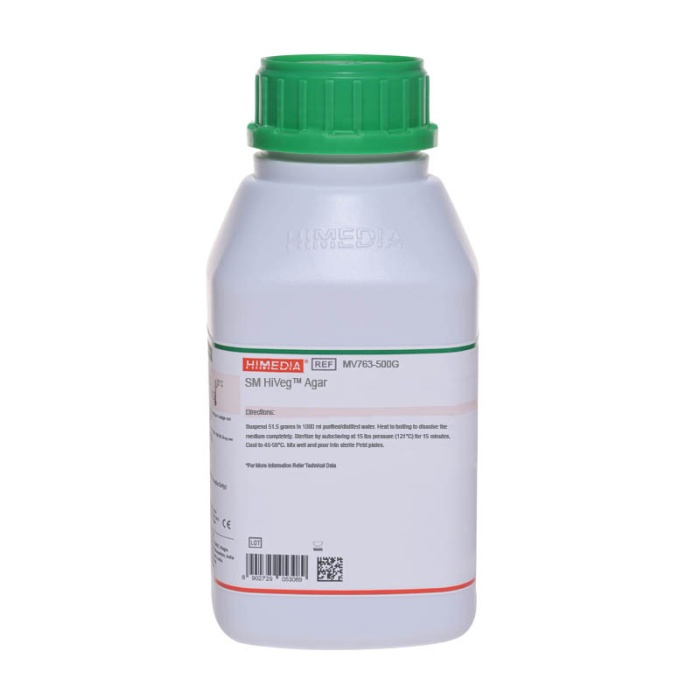
Suspend 51.5 grams of in 1000 ml purified / distilled water. Heat to boiling to dissolve the medium completely. Sterilize by autoclaving at 15 lbs pressure (121°C) for 15 minutes. Cool to 45-50°C. Mix well and pour into sterile Petri plates.
SM Agar is used for the demonstration of coagulation and proteolysis of casein (1). The medium is recommended by APHA (4) for cultivation and enumeration of microorganisms encountered in dairy industry (6). Addition of SM powder to any nutrient-rich medium creates favorable conditions for growth of organisms, which are encountered in milk. The number of bacteria isolated thus is more than the number of organisms isolated on a regular medium (5). Proteolytic bacteria hydrolyze casein to form soluble nitrogenous compounds indicated as clear zone surrounding the colonies. More clear zones are seen on milk agar if, the bacteria produce acid from fermentable carbohydrates in the medium.
Tryptone provides amino acids and other complex nitrogenous substances. Yeast extract supplies vitamin B complex. Addition of SM powder in the medium makes the conditions optimal for microorganisms encountered in milk. Glucose acts as the carbon source.
Dairy samples
For Dairy samples, follow appropriate techniques for sample collection and processing as per guidelines (6). After use, contaminated materials must be sterilized by autoclaving before discarding.
Read the label before opening the container. Wear protective gloves/protective clothing/eye protection/ face protection. Follow good microbiological lab practices while handling specimens and culture. Standard precautions as per established guidelines should be followed while handling specimens. Safety guidelines may be referred to in individual safety data sheets.
Performance of the medium is expected when used as per the direction on the label within the expiry period when stored at recommended temperature.
Appearance
Cream to yellow homogeneous free flowing powder
Gelling
Firm, comparable with 1.5% Agar gel
Colour and Clarity of prepared medium
Off white coloured opaque gel forms in Petri plates
Reaction
Reaction of 5.15% w/v aqueous solution at 25°C. pH: 7.0±0.2
pH
6.80-7.20
Cultural characteristics observed after an incubation at 35-37°C for 18-24 hours.
| Organism | Inoculum (CFU) | Growth | Recovery | Proteolytic activity |
|---|---|---|---|---|
| Bacillus subtilis subsp. spizizenni ATCC 6633 (00003*) | 50-100 | good-luxuriant | >=70% | positive reaction, clear zone surrounding colonies |
| Enterococcus faecalis ATCC 29212 (00087*) | 50-100 | luxuriant | >=70% | negative reaction, no clear zone surrounding colonies |
| Escherichia coli ATCC 25922 (00013*) | 50-100 | good-luxuriant | >=70% | negative reaction,no clear zone surrounding colonies |
| Proteus mirabilis ATCC 25933 | 50-100 | luxuriant | >=70% | positive reaction, clear zone surrounding colonies |
| Pseudomonas aeruginosa ATCC 27853 (00025*) | 50-100 | luxuriant | >=70% | positive reaction, clear zone surrounding colonies |
| Serratia marcescens ATCC 8100 | 50-100 | luxuriant | >=70% | positive reaction, clear zone surrounding colonies |
Key: (*) Corresponding WDCM numbers.
Store between 10-30°C in a tightly closed container and the prepared medium at 2-8°C. Use before expiry date on the label. On opening, product should be properly stored dry, after tightly capping the bottle in order to prevent lump formation due to the hygroscopic nature of the product. Improper storage of the product may lead to lump formation. Store in dry ventilated area protected from extremes of temperature and sources of ignition Seal the container tightly after use. Use before expiry date on the label. Product performance is best if used within stated expiry period.
User must ensure safe disposal by autoclaving and/or incineration of used or unusable preparations of this product. Follow established laboratory procedures in disposing of infectious materials and material that comes into contact with clinical sample must be decontaminated and disposed of in accordance with current laboratory techniques (2,3).
| Product Name | SM Agar |
|---|---|
| SKU | M763 |
| Product Type | Regular |
| Physical Form | Powder |
| Origin | Animal |
| Packaging type | HDPE |
| References | 1. Frazier W. C. and Ripp P., 1928, J. Bacteriol., 16: 57. 2.Salfinger Y., and Tortorello M.L. Fifth (Ed.), 2015, Compendium of Methods for the Microbiological Examination ofFoods, 5th Ed., American Public Health Association, Washington, D.C. 3.Wehr H. M. and Frank J. H., 2004, Standard Methods for the Microbiological Examination of Dairy Products, 17th Ed.,APHA Inc., Washington, D.C. 4.Terplan G. Rundfeldt,H.u. Zaadhof, K.J. Zur Eignung verschiedener Nährböden für die Bestimmung der Gesamtkeimzahlder Milch. - Arch. Lebensmittelhyg., 18; 9-11 (1967). 5.Isenberg, H.D. Clinical Microbiology Procedures Handb0ook. 2nd Edition. 6.Jorgensen,J.H., Pfaller , M.A., Carroll, K.C., Funke, G., Landry, M.L., Richter, S.S and Warnock., D.W. (2015)Manual of Clinical Microbiology, 11th Edition. Vol. 1. |
| Customized Product Available | No |