Plot No. C40, Road No. 21Y, MIDC, Wagle Industrial Estate,
Thane(W)-400604, MH, India.
Plot No. C40, Road No. 21Y, MIDC, Wagle Industrial Estate,
Thane(W)-400604, MH, India.

 Your enquiry has been submitted
Something problem with the server. Try again.
 Your enquiry has been submitted
| Ingredients | Gms/Litre |
|---|---|
| Tryptose | 20.000 |
| Yeast extract | 5.000 |
| Dextrose | 2.000 |
| Disodium phosphate | 4.000 |
| Sodium azide | 0.400 |
| Agar | 15.000 |
| Final pH (at 25°C) | 7.2±0.2 |
**Formula adjusted, standardized to suit performance parameters
Suspend 46.4 grams in 1000 ml distilled water. Heat to boiling to dissolve the medium completely. DO NOT AUTOCLAVE OR OVERHEAT. Excessive heating is detrimental. Cool to 45-50°C. If desired add sterile 1% TTC solution (FD057) to the medium. Mix well and pour into sterile Petri plates.
Warning: Sodium azide has a tendency to form explosive metal-azides with plumbing materials. It is advisable to use enough water to flush off the disposables.
Slanetz and Bartley Medium was originally devised by Slanetz and Bartley (1) for the detection and enumeration of Enterococci by membrane filtration technique. It can be also used as a direct plating medium (2, 3). If desired, triphenyl tetrazolium chloride can be added separately as FD057 in case of GM612A/M612A as compared to GM612/GM612 where it is an ingredient of the medium itself.
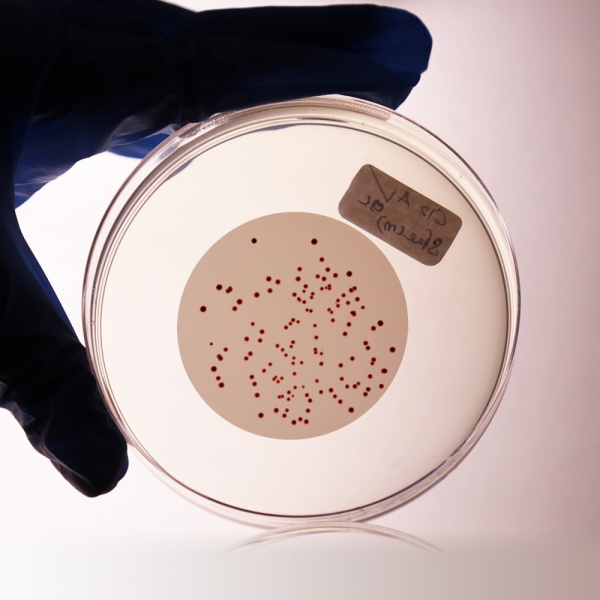
Tryptose and yeast extract serves as the source of essential nutrients to the organisms. The medium is highly selective for Enterococci. Sodium azide has inhibitory effect on gram-negative organisms. If Triphenyl Tetrazolium Chloride(TTC) is added to the medium, it is reduced to the insoluble formazan inside the bacterial cell forming dark red-coloured colonies. When the medium is incubated at higher temperature (44-45°C), all red or maroon colonies can be considered as presumptive Enterococci (4, 5).
The Department of Health (6) has recommended similar medium with TTC to be used for enumeration of Enterococci in water supplies. Water is filtered through a membrane filter, which is then placed on the surface of the Slanetz and Bartley Medium plates and incubated at 35°C for 4 hours and then at 44-45°C for 44-48 hours. Red or maroon colonies are counted as Enterococci. The preliminary incubation at 35°C helps for the recovery of stressed organisms. Not all the species reduce TTC; hence pale colonies also should be considered.
For analyzing food samples, it is homogenized and diluted with normal saline to give countable 15-150 colonies on each Petri plate when spread on agar surface and incubated at 35°C for 48 hours. Pink or dark red colonies with a narrow whitish border are counted (3).
Appearance: Cream to yellow coloured granular medium
Gelling: Firm, comparable with 1.5% Agar gel
Colour and Clarity of prepared medium: Light yellow coloured clear to slightly opalescent gel forms in Petri plates
Reaction: Reaction of 4.64% w/v aqueous solution at 25°C. pH : 7.2±0.2
pH: 7.00-7.40
Cultural characteristics observed after an incubation at 35-37°C for 18-48 hours with addded TTC solution (FD057).
| Organism | Inoculum (CFU) | Growth | Recovery | Colour of colony |
|---|---|---|---|---|
| Escherichia coli ATCC 25922 | >=10³ | inhibited | 0% | |
| Enterococcus faecalis ATCC 29212 | 50-100 | good-luxuriant | >=50% | red or maroon |
Store below 30°C in tightly closed container and the prepared medium at 2 - 8°C. Use before expiry date on the label.
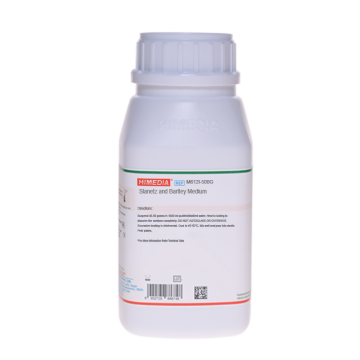
| Product Name | Slanetz and Bartley Medium w/o TTC, Granulated |
|---|---|
| SKU | GM612A |
| Product Type | Granulated |
| Physical Form | Granular |
| Origin | Animal |
| Packaging type | HDPE |
| References | 1. Slanetz L. W. and Bartley C.H., 1957, J. Bact., 74:591. 2.Burkwall M.K. and Hartman P.A., 1964, Appl. Microbiol., 12:18. 3.Nordic Committee on Food Analysis, 1968, Leaflet 68. 4.Taylor E.W. and Burman N.P., 1964, J. Appl. Bact., 27:294. 5.Mead G.C., 1966, Proc. Soc. Wat. Treat. Exam., 15:207. 6.Department of Health and Social Security, 1982, Report 71, HMSO, London. 7.Salfinger Y., and Tortorello M.L. Fifth (Ed.), 2015, Compendium of Methods for the Microbiological Examination of Foods, 5th Ed., American Public Health Association, Washington, D.C. 8.Baird R.B., Eaton A.D., and Rice E.W., (Eds.), 2015, Standard Methods for the Examination of Water andWastewater, 23rd ed., APHA, Washington, D.C.9.Isenberg, H.D. Clinical Microbiology Procedures Handb0ook. 2nd Edition.10.Jorgensen,J.H., Pfaller , M.A., Carroll, K.C., Funke, G., Landry, M.L., Richter, S.S and Warnock., D.W. (2015)Manual of Clinical Microbiology, 11th Edition. Vol. 1. |
| Customized Product Available | No |