Plot No. C40, Road No. 21Y, MIDC, Wagle Industrial Estate,
Thane(W)-400604, MH, India.
Plot No. C40, Road No. 21Y, MIDC, Wagle Industrial Estate,
Thane(W)-400604, MH, India.

 Your enquiry has been submitted
Something problem with the server. Try again.
 Your enquiry has been submitted
| Ingredients | Gms / Litre |
|---|---|
| Dextrose | 1.000 |
| Peptone | 1.000 |
| Sodium chloride | 5.000 |
| Potassium dihydrogen phosphate | 2.000 |
| Urea | 20.000 |
| Phenol red | 0.012 |
| Final pH (at 25°C) | 6.8±0.2 |
**Formula adjusted, standardized to suit performance parameters
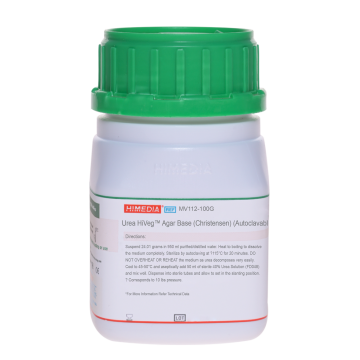
Suspend 29.01 grams in 100 ml distilled water. Mix thoroughly to dissolve completely. Sterilize by filteration. DO NOT BOIL OR AUTOCLAVE. Suspend 15 grams of agar in 900 ml distilled water and dissolve completely by boiling. Sterilize by autoclaving at 15 lbs pressure (121°C) for 15 minutes.
Cool to 45-50°C and mix with 100 ml filter sterilized Basal medium. Mix well and aseptically dispense in sterile tubes to prepare a 3 cm slant and 2 cm deep butt. Do not heat or overheat the medium as urea gets decomposed very easily.
Urea Agar Base is formulated in accordance with Christensen formulation (1,2). Rustigian and Stuart (3) had originally formulated a medium to detect urease activity. However these media differentiate between rapid urease positive Proteus species and other urease positive organisms like Citrobacter, Enterobacter and Klebsiella and bacteria other than Enterobacteriaceae. Christensen observed that addition of peptone, dextrose and reduced content of buffer helps to support an early luxuriant growth.
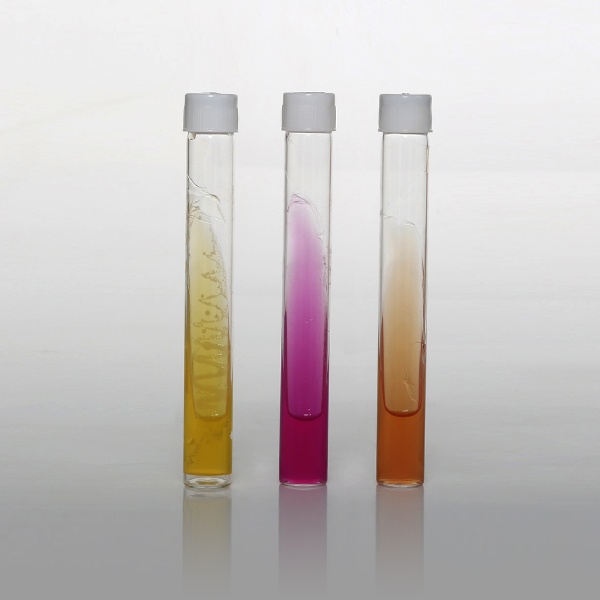
Heavy inoculum of growth is inoculated on the surface of the slants. When urea is utilized, ammonia is formed during incubation which makes the medium alkaline, showing a pink-red colour by the change in the phenol red indicator. Prolonged incubation may cause alkaline reaction in the medium. Check using medium without urea as the negative control.
Appearance
Light orange coloured granular medium.
Colour and Clarity of prepared medium
Orange coloured clear to slightly opalescent gel as slants.
Reaction
Reaction of the Basal Medium (2.9% w/v aqueous solution) at 25°C. pH : 6.8±0.2
pH
6.60-7.00
Cultural characteristics observed after an incubation at 35-37°C for 18-24 hours.
| Organism | Inoculum (CFU) | Growth | Urease |
|---|---|---|---|
| Escherichia coli ATCC 25922 (00013*) | 50-100 | good-luxuriant | Negative reaction, no change |
| Enterobacter aerogenes ATCC 13048 (00175*) | 50-100 | good-luxuriant | Negative reaction, no change |
| Klebsiella pneumoniae ATCC 13883 (00097*) | 50-100 | good-luxuriant | Weakly positive |
| Proteus vulgaris ATCC 13315 | 50-100 | good-luxuriant | Positive reaction, cerise colour |
| Salmonella Typhimurium ATCC 14028 | 50-100 | good-luxuriant | Negative reaction, no change |
Key:- * Corresponding WDCM numbers
On receipt store dehydrated medium and the prepared medium at 2-8°C. Use before expiry date on the label.
| Product Name | Urea Agar Base, Granulated (Filter Sterilizable) (w/o Agar) |
|---|---|
| SKU | GM112A |
| Product Type | Granulated |
| Physical Form | Granular |
| Origin | Animal |
| Packaging type | HDPE |
| References | 1. Christensen W. B., 1946, J. Bacteriol., 52:461. 2.MacFaddin J. F., 2000, Biochemical Tests for Identification of Medical Bacteria, 3rd Ed., Williams and Wilkins, Baltimore.Md. 3.Farmer J. J. III, McWhorter A. C., Huntley G. A., Catignani J., J. Clin. Microbiol. 1975: 1 (1): 106-107. 4.MacFaddin J. F, 1985, Media for Isolation-Cultivation-Identification-Maintenance of Medical Bacteria, Vol. 1, Williamsand Wilkins, Baltimore, Md. 5.American Public Health Association, Standard Methods for the Examination of Dairy Products, 1978, 14th Ed., WashingtonD.C. 6.Salfinger Y., and Tortorello M.L. Fifth (Ed.), 2015, Compendium of Methods for the Microbiological Examination ofFoods, 5th Ed., American Public Health Association, Washington, D.C. 7.Baird R.B., Eaton A.D., and Rice E.W., (Eds.), 2015, Standard Methods for the Examination of Water andWastewater, 23rd ed., APHA, Washington, D.C. 8.Isenberg, H.D. Clinical Microbiology Procedures Handbook. 2nd Edition. 9.Jorgensen,J.H., Pfaller , M.A., Carroll, K.C., Funke, G., Landry, M.L., Richter, S.S and Warnock., D.W. (2015)Manual of Clinical Microbiology, 11th Edition. Vol. 1. 10.Wehr H. M. and Frank J. H., 2004, Standard Methods for the Microbiological Examination of Dairy Products, 17th Ed.,APHA Inc., Washington, D.C. |