Plot No. C40, Road No. 21Y, MIDC, Wagle Industrial Estate,
Thane(W)-400604, MH, India.
Plot No. C40, Road No. 21Y, MIDC, Wagle Industrial Estate,
Thane(W)-400604, MH, India.

 Your enquiry has been submitted
Something problem with the server. Try again.

Recommended for selective cultivation and identification of Streptococci.
| Ingredients | Gms / Litre |
|---|---|
| Peptone | 20.000 |
| Yeast extract | 5.000 |
| Bile salts | 10.000 |
| Sodium citrate | 1.000 |
| Esculin | 1.000 |
| Ferric ammonium citrate | 0.500 |
| Sodium azide | 0.250 |
| Final pH (at 25°C) | 7.2±0.2 |
**Formula adjusted, standardized to suit performance parameters
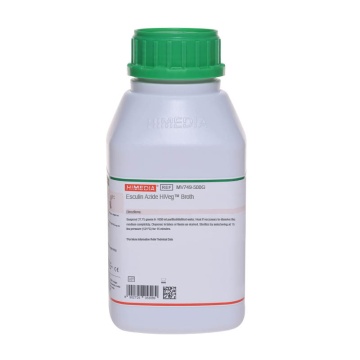
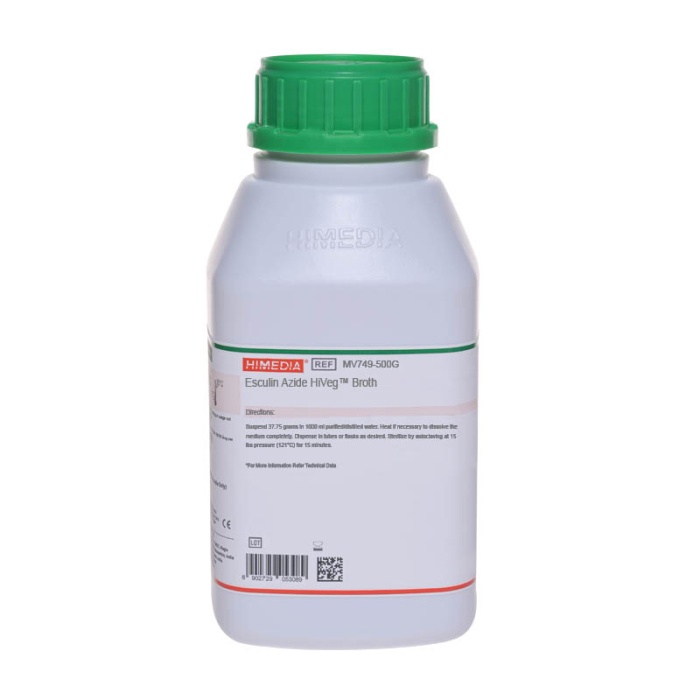
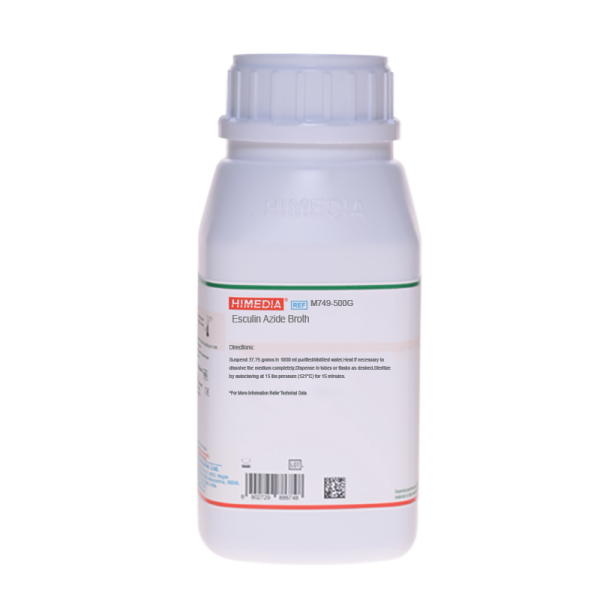
Suspend 37.75 grams in 1000 ml purified/distilled water. Heat if necessary to dissolve the medium completely. Dispense in tubes or flasks as desired. Sterilize by autoclaving at 15 lbs pressure (121°C) for 15 minutes.
Esculin Azide Broth is prepared as per the modification of original formula of Isenberg (3). Enterococci are able to hydrolyze esculin whereas other streptococci are not able to do so. Swan (7) used an esculin medium containing 40% bile salts and reported that a positive reaction on bile esculin medium could be correlated with a serological group D precipitin reaction. Further studies by Facklam and Moody presumptively identified group D Streptococci and found that the bile esculin test provided a reliable means of identifying group D Streptococci and differentiating them from non-group D Streptococci (2). The present formulation is a modification of Bile Esculin Agar formulated by Isenberg et al in which bile concentration was 40 g/l. In Esculin Azide Broth, the concentration of bile was reduced to 10 g/l and also additional sodium azide was added (3).
The broth is selective due to presence of bile salts and sodium azide and provides rapid growth of Streptococci. Peptone and yeast extract provide nitrogenous nutrients to the organisms. Bile salts inhibit other gram-positive bacteria while sodium azide inhibits gram-negative bacteria. Streptococci hydrolyze esculin to esculetin and dextrose. Esculetin and ferric ammonium citrate forms dark brown to black complex, imparting dark brown colour to the broth.
Food and dairy samples
For food and dairy samples, follow appropriate techniques for sample collection and processing as per guidelines (1,6,8). After use, contaminated materials must be sterilized by autoclaving before discarding.
Read the label before opening the container. Wear protective gloves/protective clothing/eye protection/ face protection. Follow good microbiological lab practices while handling specimens and culture. Standard precautions as per established guidelines should be followed while handling specimens. Safety guidelines may be referred to individual safety data sheets.
Performance of the medium is expected when used as per the direction on the label within the expiry period when stored at recommended temperature.
Appearance
Cream to yellow homogeneous free flowing powder
Colour and Clarity of prepared medium
Amber coloured, clear solution having slight purplish tinge
Reaction
Reaction of 3.78% w/v aqueous solution at 25°C. pH : 7.2±0.2
pH
7.00-7.40
Cultural Response
Cultural characteristics observed after an incubation at 35-37°C for 18-24 hours
| Organism | Inoculum (CFU) | Growth | Esculin Hydrolysis |
|---|---|---|---|
| Enterococcus faecalis ATCC 29212 (00087*) | 50-100 | good to luxuriant | positive reaction, blackening of medium |
| Escherichia coli ATCC 25922 (00013*) | >=104 | inhibited | |
| Streptococcus bovis ATCC 27960 | 50-100 | good to luxuriant | positive reaction, blackening of medium |
| Streptococcus pyogenes ATCC 19615 | 50-100 | poor | negative reaction, no change |
| Proteus mirabilis ATCC 25933 | 50-100 | poor to fair | negative reaction, no change |
Key : (*) Corresponding WDCM numbers.
Store between 10-30°C in a tightly closed container and the prepared medium at 15-25°C. Use before expiry date on the label. On opening, product should be properly stored dry, after tightly capping the bottle in order to prevent lump formation due to the hygroscopic nature of the product. Improper storage of the product may lead to lump formation. Store in dry ventilated area protected from extremes of temperature and sources of ignition Seal the container tightly after use. Product performance is best if used within stated expiry period.
User must ensure safe disposal by autoclaving and/or incineration of used or unusable preparations of this product. Follow established laboratory procedures in disposing of infectious materials and material that comes into contact with sample must be decontaminated and disposed of in accordance with current laboratory techniques (4,5).
| Product Name | Esculin Azide Broth |
|---|---|
| SKU | M749 |
| Product Type | Regular |
| Physical Form | Powder |
| Origin | Animal |
| Packaging type | HDPE |
| References | 1. Isenberg, 1970, Clin. Lab. Forum. 2.Swan A., 1954, J. Clin. Pathol., 7:160 3.Facklam R. R. and Moody M. D., 1970, Appl.Microbiol., 20:2451. Isenberg, 1970, Clin. Lab. Forum. 2.Swan A., 1954, J. Clin. Pathol., 7:160 3.Facklam R. R. and Moody M. D., 1970, Appl. Microbiol., 20:245 |