Plot No. C40, Road No. 21Y, MIDC, Wagle Industrial Estate,
Thane(W)-400604, MH, India.
Plot No. C40, Road No. 21Y, MIDC, Wagle Industrial Estate,
Thane(W)-400604, MH, India.

 Your enquiry has been submitted
Something problem with the server. Try again.

Recommended for selective enumeration of total Staphylococci from foodstuffs.
| Ingredients | Gms / Litre |
|---|---|
| Peptone | 5.000 |
| Sodium chloride | 5.000 |
| Yeast extract | 1.500 |
| HM peptone B# | 1.500 |
| Potassium thiocyanate | 25.500 |
| Sodium pyruvate | 8.200 |
| Mannitol | 5.100 |
| Lithium chloride | 5.100 |
| Sodium azide | 0.050 |
| Cycloheximide | 0.041 |
| Agar | 15.000 |
| Final pH (at 25°C) | 6.8±0.2 |
**Formula adjusted, standardized to suit performance parameters
# Equivalent to Beef extract
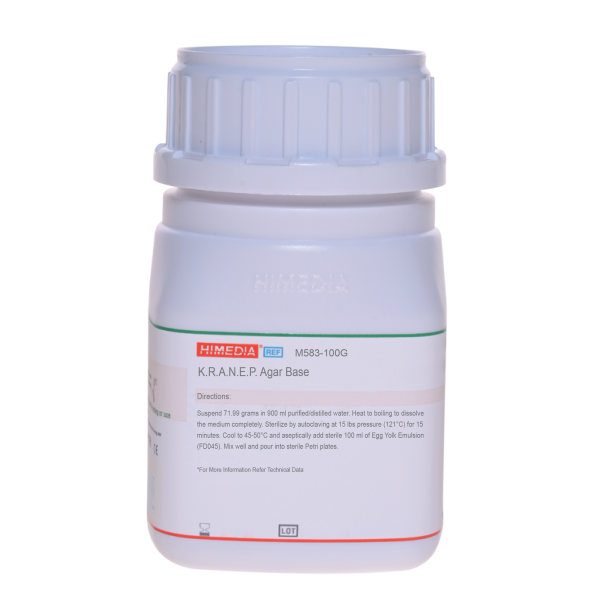
Suspend 71.99 grams in 900 ml purified/distilled water. Heat to boiling to dissolve the medium completely. Sterilize by autoclaving at 15 lbs pressure (121°C) for 15 minutes. Cool to 45-50°C and aseptically add sterile 100 ml of Egg Yolk Emulsion (FD045). Mix well and pour into sterile Petri plates.
K.R.A.N.E.P. Agar is a selective medium used for the enumeration of Staphylococcus aureus in foods, which was first described, by Sinell and Baumgart (11). The name K.R.A.N.E.P. Agar comes from the initial letters of its main diagnostic, selective and stimulatory agents like Kalium-Rhodanid-Actidione-Natriumazid-Eigelb-Pyruvate. The medium is selective for the detection of Staphylococci due to the presence of potassium thiocyanate and mannitol (15). The selectivity is further enhanced by the addition of sodium azide and cycloheximide (12). Sodium pyruvate and egg yolk emulsion added to the medium serve as growth enhancer and diagnostic agent respectively (2,6). K.R.A.N.E.P. Agar is recommended for the selective isolation of coagulase negative Staphylococci from meat products (13,14) and therefore this medium is used to enumerate the total staphylococcal count i.e. coagulase positive a and coagulase negative Staphylococci, from food products.
Peptone, yeast extract and HM peptone B in the medium supplies essential growth nutrients including B complex nutrients. Cycloheximide inhibits most of the yeasts and moulds. Inclusion of sodium azide helps to inhibit the accompanying aerobic organisms like Bacillus species, which interfere with the cultivation of Staphylococci (1). Due to the presence of inhibitory agents, various gram-negative bacteria as well as gram-positive bacteria fail to grow on this medium (2,3). Inoculation can be done by spread plate technique using 0.1 ml inocula on Petri plates or 0.05 ml each from different decimal dilution steps in drop plate technique. After incubation of 48 hours, well-grown golden yellow colonies with a precipitation zone of egg yolk in the medium, which remains opaque, are considered as S.aureus. Confirmatory tests for coagulase production are required. Colonies typical for S.aureus but without an egg yolk reaction should also be tested for coagulase and if positive their identity should be confirmed by further tests (4,5,9).
Food samples
For food samples, follow appropriate techniques for sample collection and processing as per guidelines (10).
After use, contaminated materials must be sterilized by autoclaving before discarding.
Performance of the medium is expected when used as per the direction on the label within the expiry period when stored at recommended temperature.
Appearance
Cream to yellow homogeneous free flowing powder
Gelling
Firm, comparable with 1.5% Agar gel
Colour and Clarity of prepared medium
Basal medium : Light yellow coloured clear to slightly opalescent gel. After addition of Egg Yolk Emulsion : Yellow coloured opaque gel forms in Petri plates.
Reaction
Reaction of 7.2% w/v aqueous solution at 25°C. pH : 6.8±0.2
pH
6.60-7.00
Cultural Response
Cultural characteristics observed with added sterile Egg Yolk Emulsion(FD045) after an incubation at 35-37°C for 24-48 hours.
| Organism | Inoculum (CFU) | Growth | Recovery | Colony characteristics | Lecithinase activity |
|---|---|---|---|---|---|
| Staphylococcus aureus subsp. aureus ATCC 25923 (00034*) | 50-100 | luxuriant | >=50% | golden shiny | positive, opaque zone around the colony |
| Staphylococcus epidermidis ATCC 12228 (00036*) | 50-100 | luxuriant | >=50% | white shiny | negative |
| Escherichia coli ATCC 25922 (00013*) | >=104 | inhibited | 0% | ||
| Candida albicans ATCC 10231 (00054*) | >=104 | inhibited | 0% | ||
| Bacillus subtilis subsp.spizizenii ATCC 6633 (00003*) | >=104 | inhibited | 0% |
Key : (*) - Corresponding WDCM numbers
Store between 10-30°C in a tightly closed container and the prepared medium at 2-8°C. Use before expiry date on the label. On opening, product should be properly stored dry, after tightly capping the bottle in order to prevent lump formation due to the hygroscopic nature of the product. Improper storage of the product may lead to lump formation. Store in dry ventilated area protected from extremes of temperature and sources of ignition. Seal the container tightly after use. Product performance is best if used within stated expiry period.
User must ensure safe disposal by autoclaving and/or incineration of used or unusable preparations of this product. Follow established laboratory procedures in disposing of infectious materials and material that comes into contact with sample must be decontaminated and disposed of in accordance with current laboratory techniques (7,8).
| Product Name | K.R.A.N.E.P. Agar Base |
|---|---|
| SKU | M583 |
| Product Type | Regular |
| Physical Form | Powder |
| Origin | Animal |
| Packaging type | HDPE |
| References | 1.Sinell H. J. and Baumgart J., 1967, Zbl. Bakt. I. Abt. Orig., 204:248. 2.Skorkovsky B., 1963, Zent. Bl. Bakt. I. Abt., Orig., 558. 3.Sinell H. J. and Baumgart J., 1965, Zent. Bl. Bakt. I. Abt. Orig., 197:447. 4.Baird - Parker A. C., 1962, J. Appl. Bacteriol., 25:12. 5.Gillespie W. A. and Alder V. G., 1952, J. Pathol. Bacteriol., 64:187. 6.Sinell H. J. and Kusch D., 1969, Arch. Hyg. (Berlin), 153:56-66. 7.Sinell H. J., Kusch D., and Untermann F., 1970, Zent. Bl. Veterinarmed Reihe., 17: 429-435. 8.Appleman M. D., 1963, J. Appl. Bacteriol., 26, ii, Society for Applied Bacteriology : Meetings.9.Crisley F. D., Peeler J. T. and Angelotti R., 1965, J. Appl. Microbiol., 13:140.10.Corry J. E. L., Curtis G. D. W., and Baird R. M., (Eds.), Culture Media for Food Microbiology, Vol. 34, Elsevier, Amsterdam. 11.Kusch D. and Reuter G., 1971, Zbl. Bakt. I Abt. Orig. 217, 23-24. 12.Devriese L. A., and Hajek V., 1980, J. Appl. Bacteriol., 49, 1- |