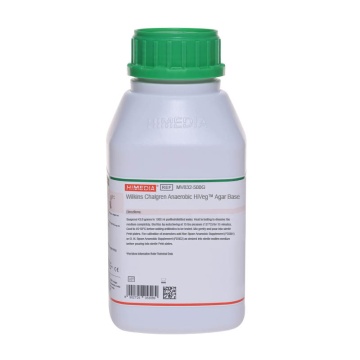
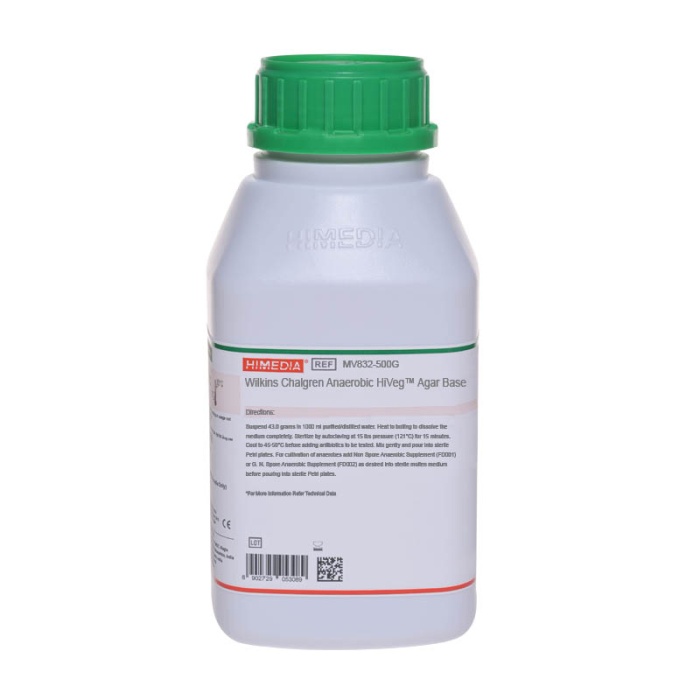
Plot No. C40, Road No. 21Y, MIDC, Wagle Industrial Estate,
Thane(W)-400604, MH, India.
Plot No. C40, Road No. 21Y, MIDC, Wagle Industrial Estate,
Thane(W)-400604, MH, India.

 Your enquiry has been submitted
Something problem with the server. Try again.
 Your enquiry has been submitted
Used for the selective isolation and cultivation of anaerobic bacteria and also for susceptibility testing of anaerobes by the agar dilution method.
| Ingredients | g/L |
|---|---|
| Tryptone | 10.000 |
| Peptone | 10.000 |
| Yeast extract | 5.000 |
| Dextrose (Glucose) | 1.000 |
| Sodium chloride | 5.000 |
| L-Arginine | 1.000 |
| Sodium pyruvate | 1.000 |
| Hemin | 0.005 |
| Menadione | 0.0005 |
| Agar | 10.000 |
| Final pH (at 25°C) | 7.1±0.2 |
**Formula adjusted, standardized to suit performance parameters
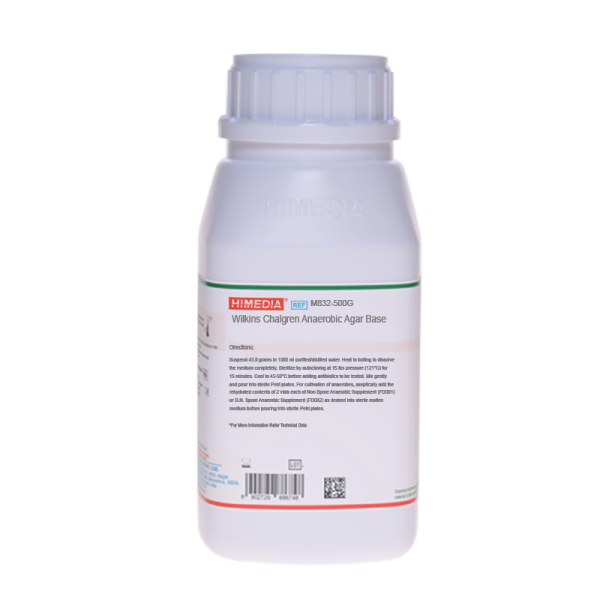
Suspend 43.0 grams in 1000 ml purified/distilled water. Heat to boiling to dissolve the medium completely. Sterilize by autoclaving at 15 lbs pressure (121°C) for 15 minutes. Cool to 45-50°C before adding antibiotics to be tested. Mix gently and pour into sterile Petri plates. For cultivation of anaerobes, aseptically add the rehydrated contents of 2 vials each of Anaero Supplement (FD001) or G.N. Anaero Supplement (FD002) as desired into sterile molten medium before pouring into sterile Petri plates.
Anaerobic bacteria are widespread in soil, marshes, lake and river sediments, oceans, sewage, food and animals. In humans, anaerobic bacteria normally are prevalent in the oral cavity around the teeth, in the gastrointestinal tract, in the orifices of the genitourinary tract and on the skin. Anaerobic infections in humans and various animals can involve virtually any organ under immunocompromised conditions (1). Also, anaerobic infections are often associated with tissue necrosis and abscess formation, leading to impaired delivery of antimicrobial agents in blood to the actual site of infection. This explains why anaerobic infections are often aggressively managed with debridement, aspiration and/or surgical removal of infected tissue. Because of the technical and interpretive difficulties associated with anaerobic susceptibility testing, presentation of definitive recommendations is difficult (2).
Wilkins Chalgren Anaerobic Agar Base, formulated by Wilkins and Chalgren (3), along with Brucella Agar Base is the preferred medium for agar dilution tests with anaerobes. This medium is also recommended for testing anaerobic bacteria (4,5,6). Wilkins Chalgren Agar need to be appropriately supplemented to support the growth of certain anaerobic bacteria. Hemin and Menadione (Vitamin K3) enhances the growth of Bacteroides species and Prevotella melaninogenica, respectively and many other species of gram-negative anaerobic rods (5,7). The medium can also be supplemented with defibrinated or lysed blood for the growth of fastidious anaerobic bacteria (8). Tryptone and peptone serve as sources of essential nutrients including carbon and nitrogen. Yeast extract provides vitamins and other growth factors like purines and pyrimidines that are essential for the growth of P. melaninogenica. Arginine serves as an amino acid source while pyruvate serves as an energy source. The medium can be made selective for non-sporing anaerobic bacteria and gram-negative anaerobic bacteria by addition of Anaero Supplement (FD001) and G.N. Anaero Supplement (FD002) respectively.
Clinical- stool, abscess
For clinical samples follow appropriate techniques for handling specimens as per established guidelines (9,10). After use, contaminated materials must be sterilized by autoclaving before discarding.
In Vitro diagnostic use only. For professional use only. Read the label before opening the container. Wear protective gloves/protective clothing/eye protection/face protection. Follow good microbiological lab practices while handling specimens and culture. Standard precautions as per established guidelines should be followed while handling clinical specimens. Safety guidelines may be referred in individual safety data sheets.
Performance of the medium is expected when used as per the direction on the label within the expiry period when stored at recommended temperature.
Appearance
Cream to yellow homogeneous free flowing powder
Gelling
Firm, comparable with 1.0% Agar gel.
Colour and Clarity of prepared medium
Medium amber coloured clear to slightly opalescent gel forms in Petri plates.
Reaction
Reaction of 4.3% w/v aqueous solution at 25°C. pH: 7.1±0.2
pH
6.90-7.30
Cultural Response
Cultural characteristics observed with added Anaero Supplement (FD001) or G.N. Anaero Supplement (FD002) under anaerobic condition, after an incubation at 35-37°C of 48 hours.
| Organism | Inoculum (CFU) | Growth | Recovery |
|---|---|---|---|
| Bacteroides fragilis ATCC 25285 | 50-100 | luxuriant | >=50% |
| Clostridium perfringens ATCC 12924 | 50-100 | luxuriant | >=50% |
| Escherichia coli ATCC 25922 (00013*) | >=104 | inhibited | 0% |
| Prevotella melaninogenicus ATCC 15930 | 50-100 | luxuriant | >=50% |
Key: (*) Corresponding WDCM numbers.
Store between 10-30°C in a tightly closed container and the prepared medium at 2-8°C. Use before expiry date on the label. On opening, product should be properly stored dry, after tightly capping the bottle in order to prevent lump formation due to the hygroscopic nature of the product. Improper storage of the product may lead to lump formation. Store in dry ventilated area protected from extremes of temperature and sources of ignition. Seal the container tightly after use. Product performance is best if used within stated expiry period.
User must ensure safe disposal by autoclaving and/or incineration of used or unusable preparations of this product. Follow established laboratory procedures in disposing of infectious materials and material that comes into contact with clinical sample must be decontaminated and disposed of in accordance with current laboratory techniques (9,10).
| Product Name | Wilkins Chalgren Anaerobic Agar Base |
|---|---|
| SKU | M832 |
| Product Type | Regular |
| Physical Form | Powder |
| Origin | Animal |
| Packaging type | HDPE |
| References | 1.Koneman E. W., Allen S. D., Janda W. M., Schreckenberger P. C., Winn W. C. Jr., 1992, Colour Atlas and Textbook ofDiagnostic Microbiology, 4th Ed., J. B. Lippinccott Company.2.Murray P. R., Baron E. J., Jorgensen J. H., Pfaller M. A., Yolken R. H., (Eds.), 8th Ed., 2003, Manual of Clinical Microbiology,ASM, Washington, D.C.3.Wilkins T. D. and Chalgren S., 1976, Antimicrob. Agents Chemother., 10 : 926.4.King A., Phillips I., 1988, J. Antimicrob. Chemother., 21:425-438.5.Clinical and Laboratory Standards Institute, 2006, Methods for Antimicrobial Susceptibility Testing of Anaerobic Bacteria,Approved standard M11-A3, CLSI, Villanova, Pa.6.Collee J. G., Fraser A. G., Marmion B. P., Simmons A., (Eds.), Mackie and McCartney Practical Medical Microbiology,1996, 14th Edition, Churchill Livingstone.7.Gibbons R. J. and MacDonald J. B., 1960, J. Bacteriol., 80:164.8.Isenberg (Ed.),2004, Clinical Microbiology Procedures Handbook, Vol.3, American Society for Microbiology, Washington.D.C. |