Plot No. C40, Road No. 21Y, MIDC, Wagle Industrial Estate,
Thane(W)-400604, MH, India.
Plot No. C40, Road No. 21Y, MIDC, Wagle Industrial Estate,
Thane(W)-400604, MH, India.

 Your enquiry has been submitted
Something problem with the server. Try again.

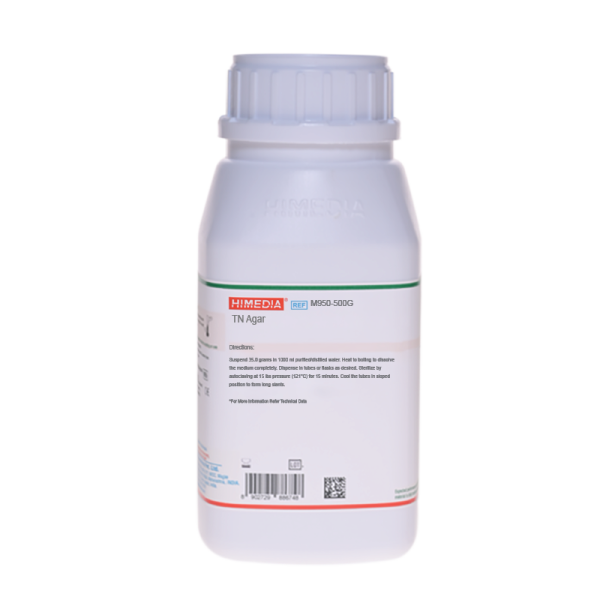
TN Agar is used for isolation and cultivation of Vibrios from food samples.
| Ingredients | Gms/Litre |
|---|---|
| Casein enzymic hydrolysate | 10.000 |
| Sodium chloride | 10.000 |
| Agar | 15.000 |
| Final pH (at 25°C) | 7.2±0.2 |
**Formula adjusted, standardized to suit performance parameters
Suspend 35 grams in 1000 ml distilled water. Heat to boiling to dissolve the medium completely. Dispense in tubes. Sterilize by autoclaving at 15 lbs pressure (121°C) for 15 minutes. Allow the tubed medium to solidify in an inclined position (long slants).
Members of the genus Vibrio are defined as gram-negative, asporogenous rods that are straight or have a single rigid curve. Three species of Vibrio, namely Vibrio cholerae, Vibrio parahaemolyticus and Vibrio mimicus are well-documented human pathogens.
V. cholerae, the type species of the genus Vibrio is the causative agent of cholera outbreaks and epidemics.
V. cholerae can be differentiated from other Vibrio species except V. mimicus, because of its obligate requirement for sodium ions (Na+).TN Agar is formulated as per APHA (1) for cultivation of Vibrio species from foods.
Casein enzymic hydrolysate provides nitrogenous, carbonaceous compounds, sulphur, vitamin B complex and other essential growth nutrients. Sodium chloride improves the selectivity of the medium.
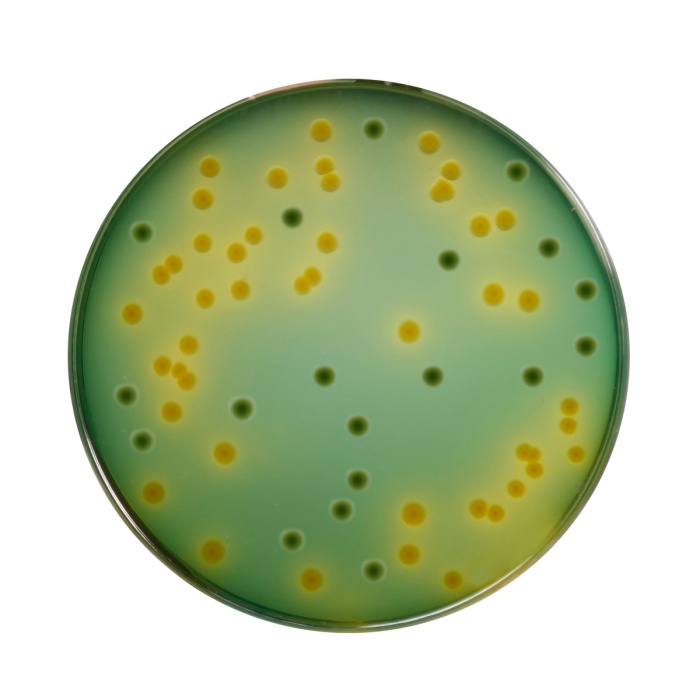
Weigh 25 grams of food sample such as seafood or vegetable and blend or cut into small pieces into two jars. To one jar add 225 ml Alkaline Peptone Water (M618) and to another jar add 225 ml Gelatin Phosphate Salt Broth. Incubate at 35 ± 2°C for 6 to 8 hours. Transfer a loopful from surface growth of each broth culture to two plated media, i.e. TCBS Agar (M189) and Gelatin Phosphate Salt Agar (M921), and incubate at 35 ± 2°C for 18-24 hours. Subculture 3-4 colonies from each plating medium to TN Agar. Growth from TN Agar is further confirmed by inoculating Kligler Iron Agar slants (M078) and stabbing the butt. After incubation, V. cholerae cultures will have an alkaline (red) slant and an acid (yellow) butt, no gas, and no blackening (H2S production) in the butt. Presumptive test for suspected strains of V. cholerae from TN Agar is carried out by using string test (2).
Appearance
Cream to yellow homogeneous free flowing powder
Gelling
Firm, comparable with 1.5% Agar gel.
Colour and Clarity of prepared medium
Light yellow coloured clear to slightly opalescent gel forms in tubes as long slants.
Reaction
Reaction of 3.5% w/v aqueous solution at 25°C. pH: 7.2±0.2
pH
7.00-7.40
Cultural Response
M950: Cultural characteristics observed after an incubation at 35-37°C for 18-24 hours.
| Organism | Inoculum (CFU) | Growth |
|---|---|---|
| Vibrio cholerae ATCC 15748 | 50-100 | good-luxuriant |
| Vibrio parahaemolyticus ATCC 17802 | 50-100 | good-luxuriant |
Store below 30°C in tightly closed container and the prepared medium at 2 - 8°C. Use before expiry date on the label.
| Product Name | TN Agar |
|---|---|
| SKU | M950 |
| Product Type | Regular |
| Physical Form | Powder |
| Origin | Animal |
| Packaging type | HDPE |
| References | 1. Downes F. P. and Ito K., (Eds.), 2001, Compendium of Methods for the Microbiological Examination of Foods, 4th Ed.,APHA, Washington, D.C. |