Plot No. C40, Road No. 21Y, MIDC, Wagle Industrial Estate,
Thane(W)-400604, MH, India.
Plot No. C40, Road No. 21Y, MIDC, Wagle Industrial Estate,
Thane(W)-400604, MH, India.

 Your enquiry has been submitted
Something problem with the server. Try again.
 Your enquiry has been submitted
Recommended for selective isolation and differentiation of Campylobacter species from food and animal feeding stuffs. The composition and performance criteria of this medium are as per the specifications laid down in ISO 10272-1&2:2017.
| Ingredients | g/L |
|---|---|
| HM Peptone B # | 10.000 |
| Peptone | 10.000 |
| Tryptone | 3.000 |
| Sodium chloride | 5.000 |
| Sodium deoxycholate | 1.000 |
| Ferrous sulphate | 0.250 |
| Sodium pyruvate | 0.250 |
| Charcoal, bacteriological | 4.000 |
| Agar | 12.000 |
| Final pH (at 25°C) | 7.4±0.2 |
**Formula adjusted, standardized to suit performance parameters
# Equivalent to Beef extract
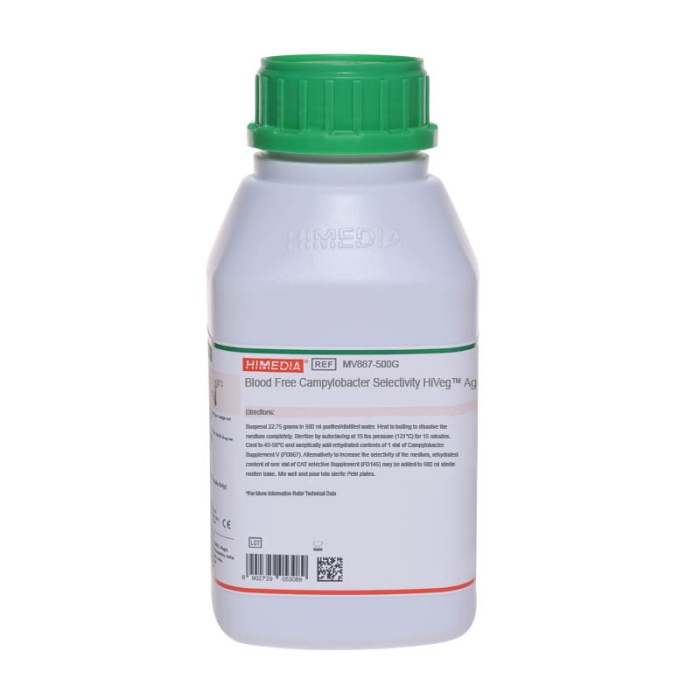
Suspend 22.75 grams in 500 ml purified/distilled water. Heat to boiling to dissolve the medium completely. Sterilize by autoclaving at 15 lbs pressure (121°C) for 15 minutes. Cool to 45-50°C and aseptically add rehydrated contents of 1 vial of CF Selective Supplement I (FD067). Alternatively to increase the selectivity of the medium, rehydrated content of one vial of CAT Selective Supplement (FD145) may be added to 500 ml sterile molten base. Mix well and pour into sterile Petri plates.
Campylobacters are carried in the intestinal tract of animal and therefore contaminate foods of animal origin (1). Campylobacter causes intestinal upset or abortion in animals. It is also one of the most important causes of human gastroenteritis, particularly in children. Initially blood was used in the isolation of Campylobacter. But, later it was reported by Bolton et al (2) that charcoal can be effectively used in place of blood. This rules out the variability obtained due to the use of blood.
Blood Free Campylobacter Selectivity Agar Base (3) formulated as per APHA (1) and recommended by the ISO Committee (4) is used for selective isolation of Campylobacter species. Cephalothin in the original formulation was replaced by Cefoperazone as the selective agent since the latter gave better selectivity (5). Campylobacter species are highly resistant to cefoperazone, an antibiotic which effectively suppresses growth of Pseudomonas and Enterobacteriaceae (6,7, 8). Addition of cefoperazone increases the selectivity of the medium. Due to this addition, the medium is also known as Campylobacter Charcoal Differential Agar (CCDA). Charcoal, sodium pyruvate and ferrous sulphate reduces the aero-tolerance of medium by quenching photo-chemically generated toxic oxygen derivatives (8). Peptone, tryptone and HM peptone B serve as sources of carbon, nitrogen, amino acids, vitamins and other essential nutrients. Casein is added to help grow certain strains of nalidixic acid resistant thermophilic Campylobacter that are environmental organisms (9). Additional Amphotericin B in Blood Free Campylobacter Broth Base suppresses the growth of yeast and mold contaminants. Colonies tend to swarm when initially isolated from clinical specimens.
Food and animal feeding samples.
For food samples, follow appropriate techniques for sample collection and processing as per guidelines (1). After use, contaminated materials must be sterilized by autoclaving before discarding.
Read the label before opening the container. Wear protective gloves/protective clothing/eye protection/ face protection. Follow good microbiological lab practices while handling specimens and culture. Standard precautions as per established guidelines should be followed while handling clinical specimens. Safety guidelines may be referred in individual safety data sheets.
Performance of the medium is expected when used as per the direction on the label within the expiry period when stored at recommended temperature.
Appearance
Grey to black granulated free flowing powder.
Gelling
Firm, comparable with 1.2% Agar gel
Colour and Clarity of prepared medium
Black coloured, opaque gel forms in Petri plates
Reaction
Reaction of 4.55% w/v aqueous solution at 25°C. pH: 7.4±0.2
pH
7.20-7.60
Cultural characteristics observed with added CF Selective Supplement I(FD067),after an incubation at 42°C for 24-48 hours.
| Organism | Growth | Inoculum (CFU) | Recovery | Colour of colony |
|---|---|---|---|---|
| Campylobacter coli ATCC 33559 | good-luxuriant | 50-100 | >=50% | creamy-grey |
| Campylobacter jejuni ATCC 29428 (00156*) | good-luxuriant | 50-100 | >=50% | grey |
| Escherichia coli ATCC 25922 (00013*) | inhibited | >=104 | 0% | |
| Campylobacter laridis ATCC 35222 | good-luxuriant | 50-100 | >=50% | varying type |
Key: (*) Corresponding WDCM numbers.
Store between 10-30°C in a tightly closed container and the prepared medium 2-8°C. Use before expiry date on the label. On opening, product should be properly stored dry, after tightly capping the bottle in order to prevent lump formation due to the hygroscopic nature of the product. Improper storage of the product may lead to lump formation. Store in dry ventilated area protected from extremes of temperature and sources of ignition Seal the container tightly after use. Product performance is best if used within stated expiry period.
User must ensure safe disposal by autoclaving and/or incineration of used or unusable preparations of this product. Follow established laboratory procedures in disposing of infectious materials and material that comes into contact with sample must be decontaminated and disposed of in accordance with current laboratory techniques (10,11).
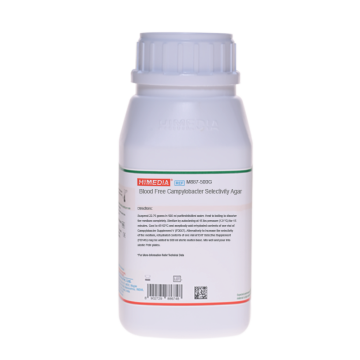
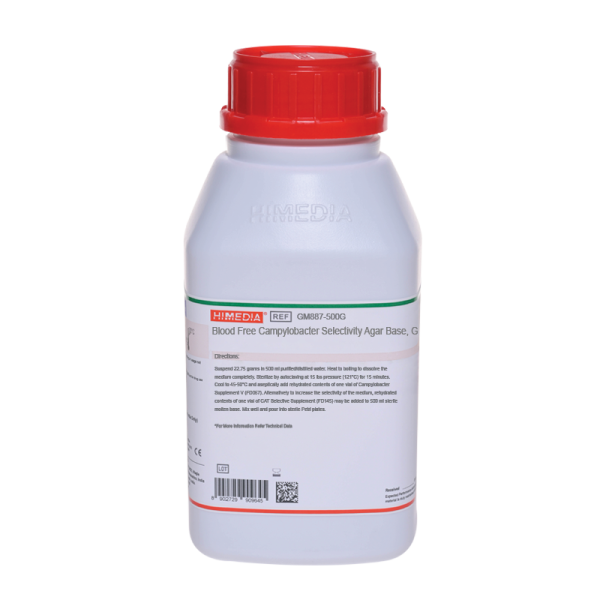
| Product Name | Blood Free Campylobacter Selectivity Agar Base, Granulated |
|---|---|
| SKU | GM887 |
| Product Type | Granulated |
| Physical Form | Granular |
| Origin | Animal |
| Packaging type | HDPE |
| References | 1. Downes F. P. and Ito K., (Eds.), 2001, Compendium of Methods for the Microbiological Examination of Foods, 4th Ed.,APHA, Washington, D.C. |