Plot No. C40, Road No. 21Y, MIDC, Wagle Industrial Estate,
Thane(W)-400604, MH, India.
Plot No. C40, Road No. 21Y, MIDC, Wagle Industrial Estate,
Thane(W)-400604, MH, India.

 Your enquiry has been submitted
Something problem with the server. Try again.
 Your enquiry has been submitted
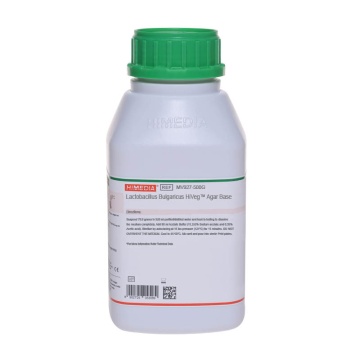
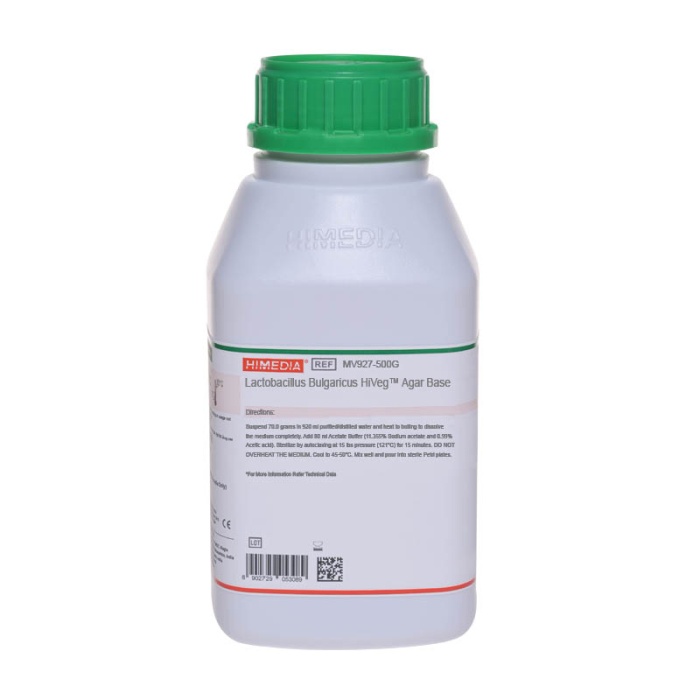
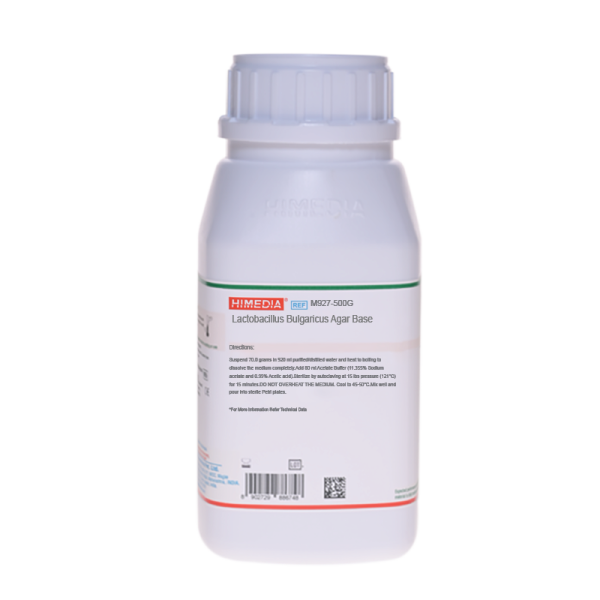
With acetate buffer is used for isolation and identification of Lactobacillus bulgaricus from clinical and non-clinical samples.
| Ingredients | g/L |
|---|---|
| Tryptone | 10.000 |
| Yeast extract | 5.000 |
| HM peptone B # | 10.000 |
| Dextrose (Glucose) | 20.000 |
| Dipotassium hydrogen phosphate | 2.000 |
| Tomato juice | 2.000 |
| Polysorbate 80 (Tween 80) | 1.000 |
| Agar | 20.000 |
| Final pH (at 25°C) | 6.8±0.2 |
**Formula adjusted, standardized to suit performance parameters
# Equivalent to Beef extract
Suspend 70 grams in 920 ml purified/distilled water and heat to boiling to dissolve the medium completely. Add 80 ml Acetate Buffer (11.355% Sodium acetate and 0.99% Acetic acid). Sterilize by autoclaving at 15 lbs pressure (121°C) for 15 minutes. DO NOT OVERHEAT THE MEDIUM. Cool to 45-50°C. Mix well and pour into sterile Petri plates.
Lactobacillus bulgaricus (Lactobacillus delbrueckii subsp. bulgaricus) is one of several bacteria used for the production of Kisselo mlyako (Bulgarian) - "Sour milk" yoghurt (yogurt). The bacterium was first identified in 1905 by the Bulgarian doctor Stamen Grigorov. It is named after Bulgaria, the country where it was first used (it thrives freely on the Balkan Peninsula). The bacterium feeds on milk and produces lactic acid which also helps to preserve the milk. Lactobacillus Bulgaricus Agar was originally formulated by Kulp and White (1) for the recovery of Lactobacilli. Further modification is recommended by APHA (2) for isolation and identification of L. bulgaricus from foods. Streptococcus thermophilus and L. bulgaricus are the essential microbial species and are active in symbiotic relationship in yoghurt. Because of the emphasis on maintaining a balance between cocci and rods, techniques are needed to determine the relative proportions of S. thermophilus and L. bulgaricus when grown together in milk cultures.
Tryptone, yeast extract and HM peptone B in the medium provide nitrogenous compounds, minerals, vitamins and trace ingredients. Polysorbate 80 supplies fatty acids required for the metabolism of Lactobacilli. Dextrose is the fermentable carbohydrate. Tomato juice along with acetate maintains the low pH of the medium and thus inhibits microorganisms other than Lactobacilli. Acetate also restricts the swarming of L. bulgaricus and along with dipotassium phosphate forms the buffering system.
Clinical sample; Dairy sample- Yoghurt sample
For clinical samples follow appropriate techniques for handling specimens as per established guidelines (3,4). For dairy samples, follow appropriate techniques for sample collection and processing as per guidelines (5,6). After use, contaminated materials must be sterilized by autoclaving before discarding.
In Vitro diagnostic use. For professional use only. Read the label before opening the container. Wear protective gloves/protective clothing/eye protection/face protection. Follow good microbiological lab practices while handling specimens and culture. Standard precautions as per established guidelines should be followed while handling clinical specimens. Safety guidelines may be referred in individual safety data sheets.
Performance of the medium is expected when used as per the direction on the label within the expiry period when stored at recommended temperature.
Appearance
Cream to yellow homogeneous free flowing powder
Gelling
Firm, comparable with 2.0% agar gel.
Colour and Clarity of prepared medium
Medium amber coloured, clear to slightly opalescent gel forms in Petri plates
Reaction
Reaction of the medium (7% w/v aqueous solution of base containing 8%v/v acetate buffer) at 25°C. pH: 6.8±0.2
pH
6.60-7.00
Cultural Response
Cultural characteristics observed with added acetate buffer, after an incubation at 35-37°C for 18-48 hours.
| Organism | Inoculum (CFU) | Growth | Recovery |
|---|---|---|---|
| Lactobacillus delbrueckii subsp. bulgaricus ATCC 11842 (00102*) | 50-100 | good-luxuriant | >=50% |
Key: (*) Corresponding WDCM numbers.
Store between 10-30°C in a tightly closed container and the prepared medium at 20-30°C. Use before expiry date on the label. On opening, product should be properly stored dry, after tightly capping the bottle in order to prevent lump formation due to the hygroscopic nature of the product. Improper storage of the product may lead to lump formation. Store in dry ventilated area protected from extremes of temperature and sources of ignition. Seal the container tightly after use. Product performance is best if used within stated expiry period.
User must ensure safe disposal by autoclaving and/or incineration of used or unusable preparations of this product. Follow established laboratory procedures in disposing of infectious materials and material that comes into contact with clinical sample must be decontaminated and disposed of in accordance with current laboratory techniques (3,4).
| Product Name | Lactobacillus Bulgaricus Agar Base |
|---|---|
| SKU | M927 |
| Product Type | Regular |
| Physical Form | Powder |
| Origin | Animal |
| Packaging type | HDPE |
| References | 1. Kulp W. L. and White V., 1932, Science, 76:17. |