Plot No. C40, Road No. 21Y, MIDC, Wagle Industrial Estate,
Thane(W)-400604, MH, India.
Plot No. C40, Road No. 21Y, MIDC, Wagle Industrial Estate,
Thane(W)-400604, MH, India.

 Your enquiry has been submitted
Something problem with the server. Try again.

Recommended for cultivation of lactic Streptococci and plaque assay of lactic bacteriophages.
| Ingredients | g/L |
|---|---|
| Peptone | 5.000 |
| Soya peptone | 5.000 |
| Yeast extract | 2.500 |
| HM peptone B # | 5.000 |
| Ascorbic acid | 0.500 |
| Magnesium sulphate | 0.250 |
| Lactose | 5.000 |
| Agar | 10.000 |
| Final pH (at 25°C) | 7.1±0.2 |
**Formula adjusted, standardized to suit performance parameters
#-Equivalent to Beef extract
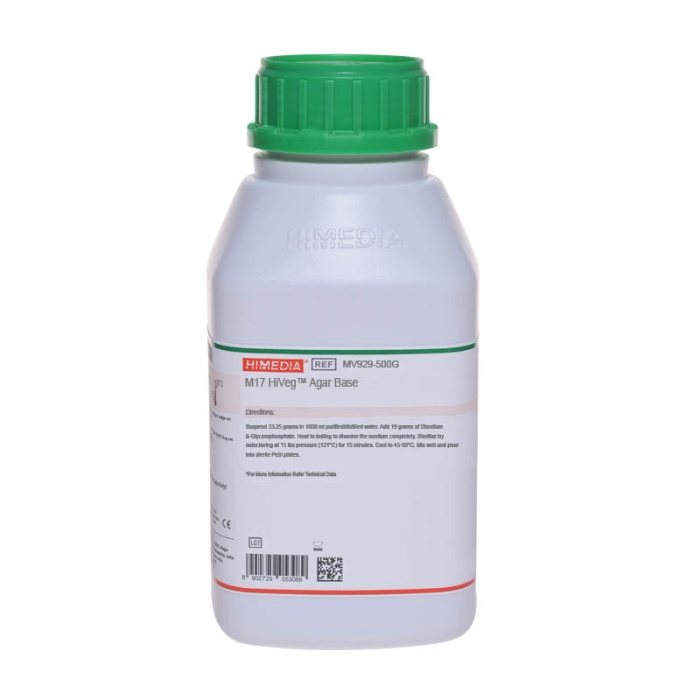
Suspend 33.25 grams in 1000 ml purified/ distilled water. Add 19 grams of Disodium B-Glycerophosphate. Heat to boiling to dissolve the medium completely. Sterilize by autoclaving at 15 lbs pressure (121°C) for 15 minutes. Cool to 45-50°C. Mix well and dispense as desired.
M17 media are based on the formulation described by Terzaghi and Sandine (1) for the cultivation and enumeration of lactic Streptococci and their bacteriophages. It is possible to study plaque morphology and lysogeny. M17 Agar is recommended by the International Dairy Federation (2) for selective enumeration of Streptococcus thermophilus from yoghurt. M17 Agar is recommended by APHA for the cultivation of lactic Streptococci (3,4). Lactic Streptococci are nutritionally fastidious and require complex media for optimal growth (5,6). Disodium glycerophosphate maintains the pH above 5.7. The maintenance of pH is very important as lower pH results in injury and reduced recovery of lactic Streptococci. Glycerophosphate does not form precipitate with calcium which is needed for the plaque assay of lactic bacteriophages
Peptone, soya peptone, yeast extract and HM peptone B provide carbonaceous, nitrogenous compounds, long chain amino acids, vitamin B complex and other essential growth factors. Lactose is the fermentable carbohydrate and ascorbic acid is stimulatory for the growth of lactic Streptococci. Magnesium sulphate provides essential ions to the organisms. Disodium-#-glycerophosphate maintains the pH above 5.7. The maintenance of pH is very important as lower pH results in injury and reduced recovery of lactic Streptococci. Disodium glycerophosphate suppresses Lactobacillus bulgaricus. Shankar and Davies (7) reported isolation and enumeration of Streptococcus thermophilus from yoghurt. M17 Agar is also recommended by the International Dairy Federation (2) for selective enumeration of Streptococcus thermophilus from yoghurt. It is also suitable for cultivation and maintenance of starter cultures for cheese and yoghurt manufacturing. This medium helps in detecting streptococcal mutants that are lactose non-fermenters. Suggested technique to enumerate streptococci is to seed in mass or by stabbing with agar, melted and cooled to 50-55° C, and incubating them at 42°C for 24 hours period. With these conditions, all the colonies might be streptococci. Longer incubation periods or lower temperatures may cause morphological changes in the colonies, which hinders in the recognition of the colonies. Lactose-positive colonies of streptococci are visible after 15 hours and after 5 days they may reach a diameter of about 3-4 mm, whereas those of lactose-negative are 1 mm in diameter. Bacteriophages presence is observed by appearance of characteristic plaques over the bacterial growth.
Food and Dairy samples
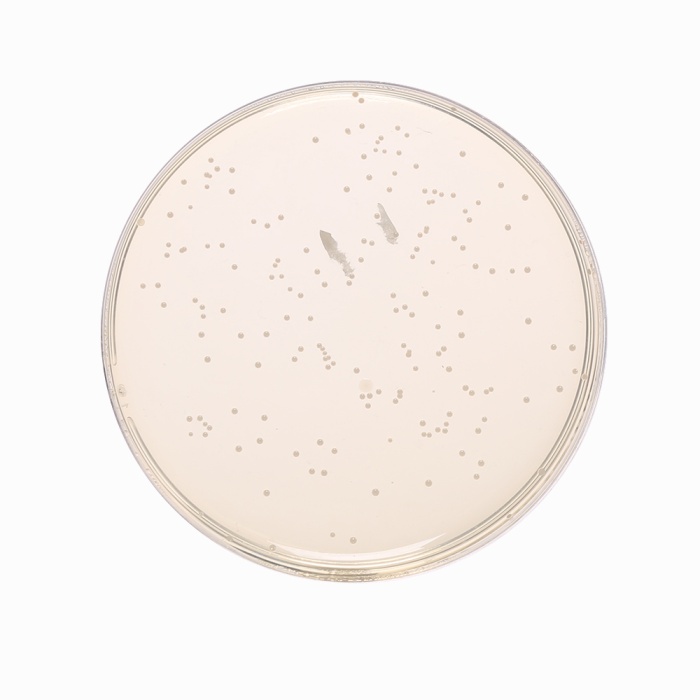
Suggested technique to enumerate streptococci is to seed in mass or by stabbing with agar, melted and cooled to 50-55°C, and incubating them at 42°C for 24 hours period. With these conditions, all the colonies might be streptococci. Longer incubation periods or lower temperatures may cause morphological changes in the colonies, which hinders in the recognition of the colonies. Lactose-positive colonies of streptococci are visible after 15 hours and after 5 days they may reach a diameter of about 3-4 mm, whereas those of lactose-negative are 1 mm in diameter. Bacteriophages presence is observed by appearance of characteristic plaques over the bacterial growth.
Read the label before opening the container. Wear protective gloves/protective clothing/eye protection/ face protection. Follow good microbiological lab practices while handling specimens and culture. Standard precautions as per established guidelines should be followed while handling specimens. Safety guidelines may be referred in individual safety data sheets.
Performance of the medium is expected when used as per the direction on the label within the expiry period when stored at recommended temperature.
Appearance
Cream to yellow homogeneous free flowing powder
Gelling
Firm, comparable with 1.0% Agar gel.
Colour and Clarity of prepared medium
Light yellow coloured clear to slightly opalescent gel forms in Petri plates.
Reaction
Reaction of 3.33% w/v aqueous solution at 25°C. pH: 7.1±0.2
pH
6.90-7.30
Cultural characteristics observed after an incubation at 35-37°C for 24-48 hours with added Disodium ß-Glycerophosphate.
| Organism | Inoculum (CFU) | Growth | Recovery |
|---|---|---|---|
| Enterococcus faecalis ATCC 29212 (00087*) | 50-100 | good-luxuriant | >=50% |
| Lactobacillus bulgaricus subsp. bulgaricus ATCC 11842 (00102*) | 50-100 | none-poor | <=10% |
| Lactobacillus leichmannii ATCC 4797 | 50-100 | good-luxuriant | >=50% |
| #Lactiplantibacillus plantarum ATCC 8014 | 50-100 | good-luxuriant | >=50% |
| Streptococcus thermophilus ATCC 14485 | 50-100 | good-luxuriant | >=50% |
Key: *Corresponding WDCM numbers.
#Formerly known as Lactobacillus plantarum
Store between 10-30°C in a tightly closed container and the prepared medium at 20-30°C. Use before expiry date on the label. On opening, product should be properly stored dry, after tightly capping the bottle in order to prevent lump formation due to the hygroscopic nature of the product. Improper storage of the product may lead to lump formation. Store in dry ventilated area protected from extremes of temperature and sources of ignition. Seal the container tightly after use. Product performance is best if used within stated expiry period.
User must ensure safe disposal by autoclaving and/or incineration of used or unusable preparations of this product. Follow established laboratory procedures in disposing of infectious materials and material that comes into contact with sample must be decontaminated and disposed of in accordance with current laboratory techniques (8,9).
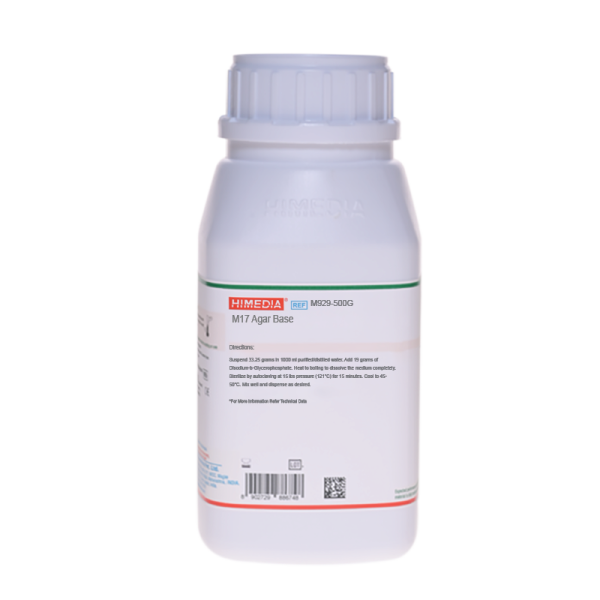
| Product Name | M17 Agar Base |
|---|---|
| SKU | M929 |
| Product Type | Regular |
| Physical Form | Powder |
| Origin | Animal |
| Packaging type | HDPE |
| References | 1. Terzaghi B.E. and Sandine W.E., 1975, Appl. Microbiol., 29:807. |
| Customized Product Available | No |