Plot No. C40, Road No. 21Y, MIDC, Wagle Industrial Estate,
Thane(W)-400604, MH, India.
Plot No. C40, Road No. 21Y, MIDC, Wagle Industrial Estate,
Thane(W)-400604, MH, India.

 Your enquiry has been submitted
Something problem with the server. Try again.
 Your enquiry has been submitted
For isolation and identification of pathogenic Staphylococci and Bacillus species.
| Ingredients | g/L |
|---|---|
| Peptone | 10.000 |
| HM extract # | 1.000 |
| D-Mannitol | 10.000 |
| Sodium chloride | 10.000 |
| Phenol red | 0.025 |
| Agar | 15.000 |
| Final pH (at 25°C) | 7.1±0.2 |
**Formula adjusted, standardized to suit performance parameters
# Equivalent to Meat extract
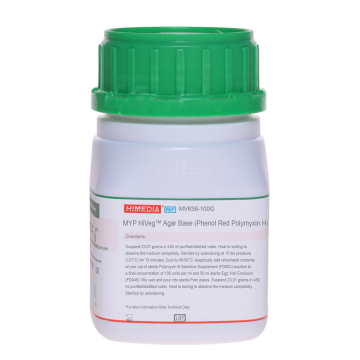
Suspend 23.01 grams in 450 ml purified/distilled water. Heat to boiling to dissolve the medium completely. Sterilize by autoclaving at 15 lbs pressure (121°C) for 15 minutes. Cool to 45-50°C. Aseptically add rehydrated contents of one vial of sterile PolyB Selective Supplement (FD003) solution to a final concentration of 100 units per ml and 50 ml sterile Egg Yolk Emulsion (FD045). Mix well and pour into sterile Petri plates.
Bacillus cereus is ubiquitously present in soil, vegetation water and dust. It has been isolated from a large variety of foods, including vegetables, meat, cereals, pasteurized fresh milk and powdered milk (1-3) and processed foods. Under favourable conditions, the organism multiplies and causes gastrointestinal illness (4). It is implicated in two different forms of food poisoning; an emetic illness and a diarrhoeal illness. The emetic illness is mediated by a highly stable toxin that survives high temperature, exposure to trypsin, pepsin and pH extremes. The diarrhoeal illness is mediated by a heat and acid labile enterotoxin. Lecithinase activity is the key reaction in the differential identification of B.cereus, the most commonly encountered and important species in clinical laboratories, from the majority of the other Bacillus species. If unknown isolate produces lecithinase, Bacillus cereus can be presumptively identified by also observing colonial morphology, hemolytic reactivity and motility tests. Mossel et al (5) formulated Mannitol-Egg Yolk-Polymyxin (MYP) Agar, which is recommended by APHA to isolate and enumerate B.cereus from foods (3,4,6,7). When present in large numbers in certain foodstuffs, B.cereus can produce metabolites responsible for the clinical symptoms of food poisoning (5). This medium differentiates B.cereus from other bacteria based on the basis of lecithinase activity, mannitol fermentation and resistance to polymyxin (FD003) (3,8). MYP Agar contains peptone and HM extract, which provide nitrogen source. Mannitol fermentation can be detected by phenol red, which yields yellow colour to the mannitol fermenting colonies due to acid production. Added egg yolk emulsion helps in differentiation of lecithinase producing colonies, which are surrounded by a zone of white precipitate. Addition of PolyB Selective Supplement (FD003) helps to restrict growth of gram-negative bacteria such as Escherichia coli and Pseudomonas aeruginosa. These differentiating media allow differentiation of B.cereus from other Bacillus species by its inability to ferment mannitol and poor sporulation. B. cereus dissimilates egg yolk and gives rise to typical bacilli form colonies.
Clinical samples - Faeces; Food samples; Water samples
For clinical samples follow appropriate techniques for handling specimens as per established guidelines (9,10).
For food samples, follow appropriate techniques for sample collection and processing as per guidelines (11).
For water samples, follow appropriate techniques for sample collection, processing as per guidelines and local standards.(12)
After use, contaminated materials must be sterilized by autoclaving before discarding.
In Vitro diagnostic Use. For professional use only. Read the label before opening the container. Wear protective gloves/protective clothing/eye protection/ face protection. Follow good microbiological lab practices while handling specimens and culture. Standard precautions as per established guidelines should be followed while handling clinical specimens. Safety guidelines may be referred in individual safety data sheets.
Performance of the medium is expected when used as per the direction on the label within the expiry period when stored at recommended temperature.
Appearance
Light yellow to light pink coloured granular media
Gelling
Firm, comparable with 1.5% Agar gel
Colour and Clarity of prepared medium
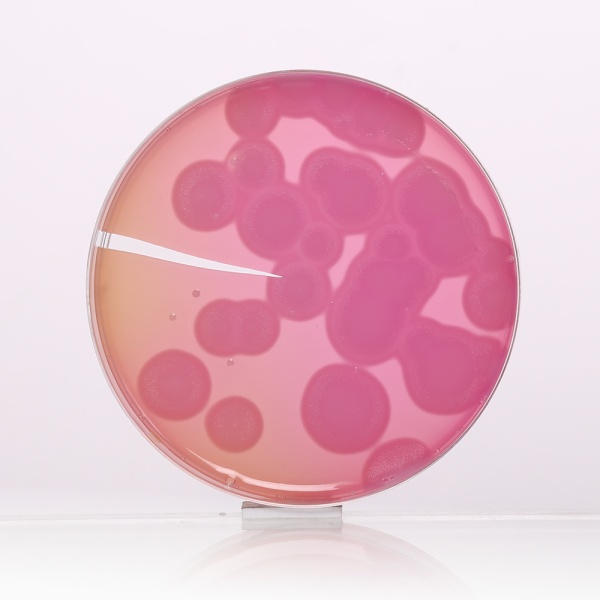
Basal medium :Red coloured clear to slightly opalescent gel. After Addition of Egg Yolk Emulsion (FD045) : Light orange coloured opaque gel forms in Petri plates
Reaction
Reaction of 4.6% w/v aqueous solution at 25°C. pH: 7.1±0.2
pH
6.90-7.30
Cultural Response
Cultural characteristics observed with added Egg Yolk Emulsion (FD045)and Polymyxin B Sulphate (FD003) after an incubation at 32°C for 18-40 hours.
| Organism | Inoculum (CFU) | Growth | Recovery | Colour of colony | Lecithinase activity |
|---|---|---|---|---|---|
| Bacillus cereus ATCC 10876 | 50-100 | luxuriant | >=50% | red | positive, opaque zone around the colony |
| ** Bacillus spizizenii ATCC 6633 (00003*) | 50-100 | luxuriant | >=50% | yellow | negative |
| Escherichia coli ATCC 25922 (00013*) | 50-100 | none-poor | <=10% | ||
| Proteus mirabilis ATCC 25933 | 50-100 | luxuriant | >=50% | red | negative |
| Pseudomonas aeruginosa ATCC 27853 (00025*) | 50-100 | none-poor | <=10% | ||
| Staphylococcus aureus subsp. aureus ATCC 25923 (00034*) | 50-100 | luxuriant | >=50% | yellow | positive, opaque zone around the colony |
Key: *Corresponding WDCM numbers.
**Formerly known as Bacillus subtilis subsp. spizizenii
Store between 10-30°C in a tightly closed container and the prepared medium at 2-8°C. Use before expiry date on the label. On opening, product should be properly stored dry, after tightly capping the bottle in order to prevent lump formation due to the hygroscopic nature of the product. Improper storage of the product may lead to lump formation. Store in dry ventilated area protected from extremes of temperature and sources of ignition. Seal the container tightly after use. Product performance is best if used within stated expiry period.
User must ensure safe disposal by autoclaving and/or incineration of used or unusable preparations of this product. Follow established laboratory procedures in disposing of infectious materials and material that comes into contact with clinical sample must be decontaminated and disposed of in accordance with current laboratory techniques (9,10).
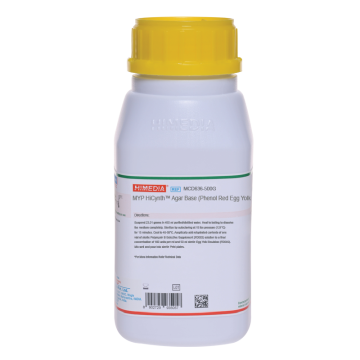
| Product Name | MYP Agar Base, Granulated (Phenol Red Egg Yolk Polymyxin Agar Base, Granulated) |
|---|---|
| SKU | GM636 |
| Product Type | Granulated |
| Physical Form | Granular |
| Origin | Animal |
| Packaging type | HDPE |
| References | 1.Bergdoll M. S., 1981, Clin. Microbiol. Newsletter 3: 85-87. 2.Centers for Disease Control: Bacillus cereus- Maine, MMWR, 35: 408-410, 1986. 3.Mossel D. A. A., Koopman M. J. and Jongerium E., 1967, Appl. Microbiol, 15:650. 4.Downes F. P. and Ito K., (Eds.), 2001, Compendium of Methods for the Microbiological Examination of Foods, 4th Ed.,APHA, Washington, D.C. 5.Nygren B., 1962, Acta Path. Microbiol. Scand., 56: Suppl. 1. 6.Donovan K. O., 1958, J. Appl. Bacteriol., 21:100. 7.Colimer A. R., 1948, J. Bacteriol., 55:777. 8.Rhodehamel J. and Harmon S. M., 1995, FDA Bacteriological Analytical Manual, 8th Ed., AOAC International,Gaithersburg, Md. |
| Customized Product Available | No |