Plot No. C40, Road No. 21Y, MIDC, Wagle Industrial Estate,
Thane(W)-400604, MH, India.
Plot No. C40, Road No. 21Y, MIDC, Wagle Industrial Estate,
Thane(W)-400604, MH, India.

 Your enquiry has been submitted
Something problem with the server. Try again.
 Your enquiry has been submitted
Recommended for the cultivation and enrichment of anaerobic bacteria from food specimen.
| Ingredients | Gms / Litre |
|---|---|
| HL Peptone B solids # | 500.000 |
| Peptone | 10.000 |
| Dipotassium hydrogen phosphate | 1.000 |
| Starch, soluble | 1.000 |
| Final pH (at 25°C) | 7.0±0.2 |
**Formula adjusted, standardized to suit performance parameters
# Equivalent to Fresh lean,beef liver
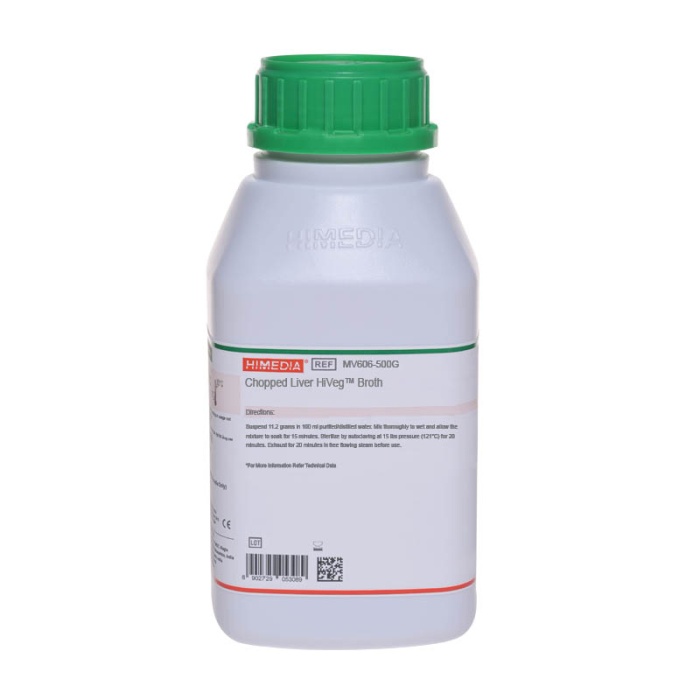
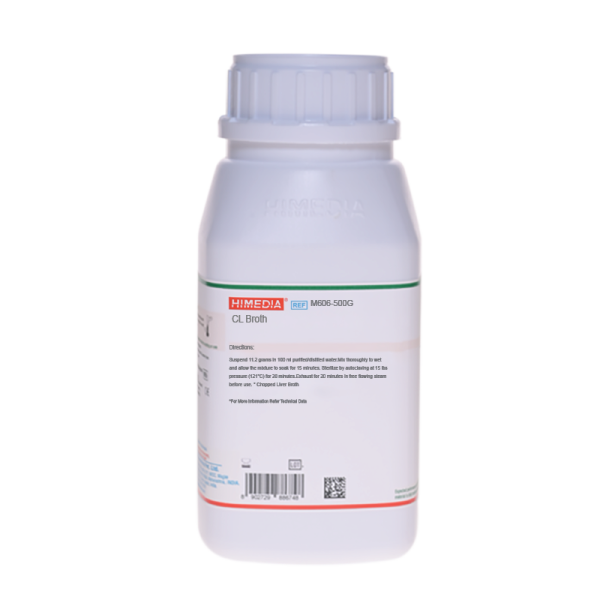
Suspend 11.2 grams in 100 ml purified / distilled water. Mix thoroughly to wet and allow the mixture to soak for 15 minutes. Dispense in tubes or flasks as desired. Sterilize by autoclaving at 15 lbs pressure (121°C) for 20 minutes. Exhaust for 20 minutes in free flowing steam before use.
Clostridium species are one of the major causes of food poisoning and gastrointestinal illnesses. They are gram-positive, spore-forming rods that occur naturally in soil. Among the family are: Clostridium botulinum, which produces one of the most potent toxins in existence; Clostridium tetani, causative agent of tetanus; and Clostridium perfringens, commonly found in wound infections and diarrhoea cases. The use of toxins to damage host cells is a method deployed by many bacterial pathogens. The major virulence factor of C. perfringens is the CPE enterotoxin, which is secreted upon invasion of the host gut, and contributes to food poisoning and other gastrointestinal illnesses. Chopped Liver Broth is formulated in accordance with APHA (5) and is recommended by FDA (2) for cultivation and enrichment of Clostridium species from foods.
HL Peptone B solids and peptone provide nitrogen and other nutrients necessary to support bacterial growth. Dipotassium phosphate provides buffering to the medium. Starch acts as a source of carbon.
Liquid foods are directly inoculated whereas solid foods are grinded first and then inoculated into this enrichment medium. 1 to 2 grams of solid or 1 to 2 ml of liquid food is added per 15 ml of enrichment broth and incubation is carried out at 26 to 28°C for upto 7 days. If no growth is observed after 7 days the culture medium is further incubated for 10 days to allow delayed germination of spores.
Water samples; Food samples
For water samples, follow appropriate techniques for sample collection, processing as per guidelines and local standards (1).
For food samples, follow appropriate techniques for sample collection and processing as per guidelines (5).
After use, contaminated materials must be sterilized by autoclaving before discarding.
Read the label before opening the container. Wear protective gloves/protective clothing/eye protection/ face protection. Follow good microbiological lab practices while handling specimens and culture. Standard precautions as per established guidelines should be followed while handling clinical specimens. Safety guidelines may be referred in individual safety data sheets.
Performance of the medium is expected when used as per the direction on the label within the expiry period when stored at recommended temperature.
Appearance: Light yellow to light brown homogeneous free flowing powder
Colour and Clarity of prepared medium: Dark amber coloured, opalescent solution with slight precipitate
Reaction: Reaction of 11.2% w/v aqueous solution at 25°C. pH: 7.0±0.2
pH: 6.80-7.20
Cultural characteristics observed under anaerobic condition, after an incubation at 35-37°C for 18-48 hours.
| Organism | Inoculum (CFU) | Recovery |
|---|---|---|
| Clostridium botulinum ATCC 25763 | 50-100 | good |
| Clostridium perfringens ATCC 12924 | 50-100 | good |
Store dehydrated medium between 10-30°C and prepared medium between 2-8°C in a tightly closed. Use before expiry date on the label. On opening, product should be properly stored dry, after tightly capping the bottle in order to prevent lump formation due to the hygroscopic nature of the product. Improper storage of the product may lead to lump formation. Store in dry ventilated area protected from extremes of temperature and sources of ignition Seal the container tightly after use. Use before expiry date on the label.Product performance is best if used within stated expiry period.
User must ensure safe disposal by autoclaving and/or incineration of used or unusable preparations of this product. Follow established laboratory procedures in disposing of infectious materials and material that comes into contact with clinical sample must be decontaminated and disposed of in accordance with current laboratory techniques (3,4).
| Product Name | CL Broth (Chopped Liver Broth) |
|---|---|
| SKU | M606 |
| Product Type | Regular |
| Physical Form | Powder |
| Origin | Animal |
| Packaging type | HDPE |
| References | 1. Downes F. P. and Ito K., (Eds.), 2001, Compendium of Methods for the Microbiological Examination of Foods, 4th Ed.,APHA, Washington, D.C. 2.FDA Bacteriological Analytical Manual, 2005, 18th Ed., AOAC, Washington, D.C. |
| Customized Product Available | No |