Plot No. C40, Road No. 21Y, MIDC, Wagle Industrial Estate,
Thane(W)-400604, MH, India.
Plot No. C40, Road No. 21Y, MIDC, Wagle Industrial Estate,
Thane(W)-400604, MH, India.

 Your enquiry has been submitted
Something problem with the server. Try again.
 Your enquiry has been submitted
Used for selective isolation and differentiation of Legionella species.
| Ingredients | g/L |
|---|---|
| Yeast extract | 10.000 |
| Charcoal activated | 1.500 |
| L-Cysteine hydrochloride | 0.400 |
| Ferric pyrophosphate, soluble | 0.250 |
| ACES buffer | 10.000 |
| Alpha - Ketoglutarate | 0.200 |
| Bromocresol purple | 0.010 |
| Bromothymol blue | 0.010 |
| Agar | 15.000 |
| Final pH (at 25°C) | 6.9±0.2 |
**Formula adjusted, standardized to suit performance parameters
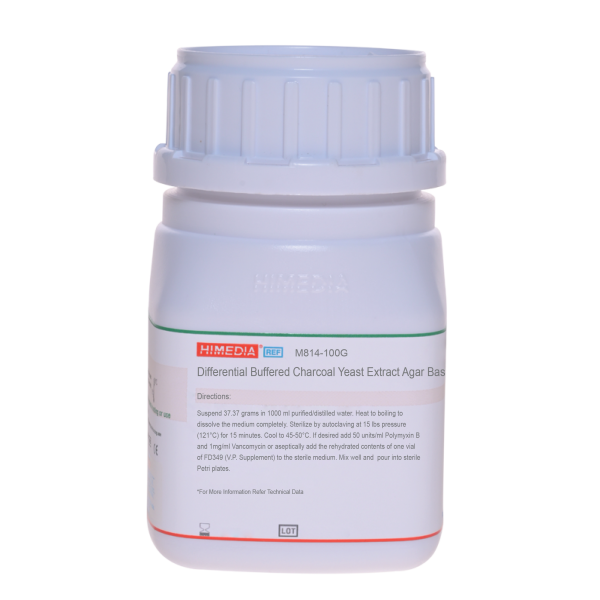
Suspend 37.37 grams in 1000 ml purified / distilled water. Heat to boiling to dissolve the medium completely. Sterilize by autoclaving at 15 lbs (121°C) pressure for 15 minutes. Cool to 45-50°C. If desired aseptically add 50 units/ml of Polymyxin B and 1 mg/ml Vancomycin or aseptically add the rehydrated contents of one vial of FD349 (V.P. Supplement). Mix well and pour into sterile Petri plates.
Legionella pneumophila is a gram-negative rod responsible for Legionnaires disease. It infects the respiratory passage when airborne droplets of water are inhaled. In nature, the bacterium lives within the cytoplasm of the waterborne protozoan Hartmanella (1).
Common sources of Legionella include cooling towers used in industrial cooling water systems as well as in large central air conditioning systems, domestic hot water systems, fountains, and similar disseminators that draw upon a public water supply. Natural sources include freshwater ponds and creeks (2). Initially F-G Agar developed by Feelay et al (3) was used for the isolation of L. pneumophila. F-G Agar was further modified by replacing beef extract and casein hydrolysate by yeast extract. Also starch was replaced by activated charcoal (4). The modified F-G Agar was improved by the addition of ACES Buffer (N-2-acetamido-2-aminoethane sulfonic acid) (5). Sensitivity of the resulting Buffered Charcoal Yeast Extract Agar was increased by the addition of alpha-ketoglutarate (6). Differential Buffered Charcoal Yeast Extract Agar Base used for the selective isolation and differentiation of Legionella species is based on the formulation of Vickers (7) containing the two dyes, bromocresol purple and bromothymol blue.
The medium contains yeast extract, which provide necessary nutrients for bacterial growth. Ferric pyrophosphate, L-cysteine hydrochloride and alpha- Ketoglutarate stimulates the growth of Legionella species (6). Toxic metabolic products produced in the medium get neutralized by activated charcoal which modifies the surface tension of the medium. Bromocresol purple and bromothymol blue help in the identification of Legionella species based on colour and colony morphology (8). Polymyxin B inhibits most of the gram-negative bacilli while vancomycin suppresses the growth of most of the gram-positive bacteria. ACES buffer helps to buffer the medium.
Clinical samples - respiratory swabs; Water samples
For clinical samples follow appropriate techniques for handling specimens as per established guidelines (9,10).
For water samples, follow appropriate techniques for sample collection, processing as per guidelines and local standards (11). After use, contaminated materials must be sterilized by autoclaving before discarding.
In Vitro diagnostic use. For professional use only. Read the label before opening the container. Wear protective gloves/ protective clothing/ eye protection/ face protection. Follow good microbiological lab practices while handling specimens and culture.Standard precautions as per established guidelines should be followed while handling clinical specimens. Safety guidelines may be referred in individual safety data sheets.
Performance of the medium is expected when used as per the direction on the label within the expiry period when stored at recommended temperature.
Appearance
Light grey to black homogeneous free flowing powder
Gelling
Firm,comparable with 1.5% Agar gel
Colour and Clarity of prepared medium
Grey-black coloured, opaque gel forms in Petri plates
Reaction
Reaction of 3.74% w/v aqueous solution at 25°C. pH: 6.9±0.2
pH
6.70-7.10
Cultural characteristics observed with added 50 units/ml Polymyxin B and 1mg/ml Vancomycin, after an incubation at 35-37°C for 72-96 hours.
| Organism | Growth | Colour of colony |
|---|---|---|
| Legionella dumoffii ATCC 33343 |
luxuriant | blue-grey |
| Legionella pneumophila ATCC 33153 |
luxuriant | white-grey to blue-grey |
Store between 10-30°C in a tightly closed container and the prepared medium at 2-8°C. Use before expiry date on the label. On opening, product should be properly stored dry, after tightly capping the bottle in order to prevent lump formation due to the hygroscopic nature of the product. Improper storage of the product may lead to lump formation. Store in dry ventilated area protected from extremes of temperature and sources of ignition Seal the container tightly after use. Product performance is best if used within stated expiry period.
User must ensure safe disposal by autoclaving and/or incineration of used or unusable preparations of this product. Follow established laboratory procedures in disposing of infectious materials and material that comes into contact with clinical sample must be decontaminated and disposed of in accordance with current laboratory techniques (9,10).
| Product Name | Differential Buffered Charcoal Yeast Extract Agar Base |
|---|---|
| SKU | M814 |
| Product Type | Regular |
| Physical Form | Powder |
| Origin | Animal Free (Microbial) |
| Packaging type | HDPE |
| References | 1. Alcamo E. I., 2001, Fundamentals of Microbiology, 6th Ed., Jones and Bartlett Publishers. |