Plot No. C40, Road No. 21Y, MIDC, Wagle Industrial Estate,
Thane(W)-400604, MH, India.
Plot No. C40, Road No. 21Y, MIDC, Wagle Industrial Estate,
Thane(W)-400604, MH, India.

 Your enquiry has been submitted
Something problem with the server. Try again.
 Your enquiry has been submitted
| Ingredients | Gms / Litre |
|---|---|
| Yeast extract | 1.000 |
| Sodium malonate | 3.000 |
| DL-Phenylalanine | 2.000 |
| Ammonium sulphate | 2.000 |
| Dipotassium phosphate | 0.600 |
| Monopotassium phosphate | 0.400 |
| Sodium chloride | 2.000 |
| Bromo thymol blue | 0.025 |
| Final pH (at 25°C) | 6.3±0.2 |
**Formula adjusted, standardized to suit performance parameters
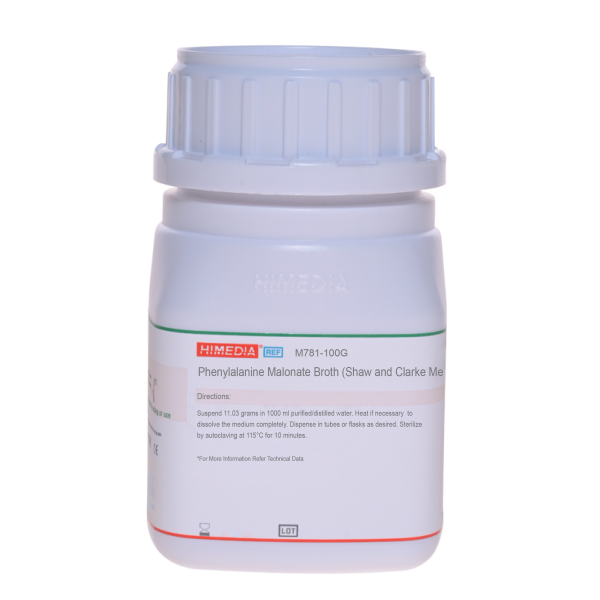
Suspend 11.03 grams in 1000 ml distilled water. Heat to boiling to dissolve the medium completely. Dispense in tubes and sterilize by autoclaving at 115°C for 10 minutes.
The term enteric bacteria (or "enterics") is generally used in reference to organisms of the Family Enterobacteriaceae , many members of which occur in the enteric tract of humans and animals. Members of Enterobacteriaceae are the most frequently encountered bacterial isolates recovered from clinical specimens. Definitive identification of the members of the Enterobacteriaceae may require a battery of biochemical tests (1). This medium is prepared according to the formulation developed by Shaw and Clarke (2) for differentiating gram-negative enteric bacteria on the basis of their ability to utilize malonate and produce pyruvic acid from phenylalanine (4).
Yeast extract in the medium supplies nutrients to the organisms while phosphates buffer the medium. Bromothymol blue is the pH indicator. Sodium chloride maintains osmotic balance. Organisms like Klebsiella and Salmonella arizonae, which are capable of, utilizing malonate, produce an alkaline reaction and thus change the colour of the medium from light green to dark blue due to the pH indicator bromothymol blue. The colour of the medium remains light green if the organisms are malonate negative. Members of the group Proteus and Providencia are capable of deaminating phenylalanine to pyruvic acid. This reaction can be determined by the addition of few drops of 10% ferric chloride dissolved in acidified distilled water to a freshly grown culture. Deep green colour is formed due to production of pyruvic acid from phenylalanine. Malonate utilization results should be read before adding ferric chloride solution to the test tube, to detect phenylalanine deamination (3).
Appearance
Light yellow to light green homogeneous free flowing powder
Colour and Clarity of prepared medium
Yellowish green coloured clear solution without any preciipitate
Reaction
Reaction of 1.1% w/v aqueous solution at 25°C. pH: 6.3±0.2
pH
6.10-6.50
M781: Cultural characteristics observed after an incubation at 35-37°C for 18-24 hours.
| Organism | Inoculum (CFU) | Growth | Malonate | Phenylalanine |
|---|---|---|---|---|
| Escherichia coli ATCC 25922 | 50-100 | luxuriant | negative reaction | negative reaction |
| Klebsiella pneumoniae ATCC 13883 | 50-100 | luxuriant | positive reaction, dark blue colour | negative reaction |
| Proteus mirabilis ATCC 25933 | 50-100 | luxuriant | negative reaction | positive reaction, green colouration after addition of 10% ferric chloride |
| Providencia alcalifaciens ATCC 9886 | 50-100 | luxuriant | negative reaction | positive reaction, green colouration after addition of 10% ferric chloride |
| Salmonella Arizonae ATCC 13314 | 50-100 | luxuriant | positive reaction, dark blue colour | negative reaction |
| Salmonella Typhimurium ATCC 14028 | 50-100 | luxuriant | negative reaction | negative reaction |
Store below 30°C in tightly closed container and the prepared medium at 2-8°C. Use before expiry date on the label.
| Product Name | Phenylalanine Malonate Broth , Shaw and Clarke Medium |
|---|---|
| SKU | M781 |
| Product Type | Regular |
| Physical Form | Powder |
| Origin | Animal Free (Microbial) |
| Packaging type | HDPE |
| References | 1. Koneman E. W., Allen S. D., Janda W.M., Schreckenberger P. C., Winn W. C. Jr., 1992, Colour Atlas and Textbook ofDiagnostic Microbiology, 4 th Ed., J. B. Lippinccott Company 2.Shaw C. and Clarke, 1955, J. Gen. Microbiol., 13:155. 3.MacFaddin J. F., 1985, Media for Isolation-Cultivation-Identification-Maintenance of Medical Bacteria, Vol. 1, Williamsand Wilkins, Baltimore 4.Collee J.G., Fraser A. G., Marmion B. P., Simmons A., (Eds.), Mackie and McCartney, Practical Medical Microbiology,1996, 14th Edition, Churchill Livingstone |