Plot No. C40, Road No. 21Y, MIDC, Wagle Industrial Estate,
Thane(W)-400604, MH, India.
Plot No. C40, Road No. 21Y, MIDC, Wagle Industrial Estate,
Thane(W)-400604, MH, India.

 Your enquiry has been submitted
Something problem with the server. Try again.

M7 Hr FC Agar is recommended for examination of water and waste water.
| Ingredients | Gms / Litre |
|---|---|
| Biopeptone | 5.000 |
| Yeast extract | 3.000 |
| Lactose | 10.000 |
| D-Mannitol | 5.000 |
| Sodium chloride | 7.500 |
| Sodium lauryl sulphate | 0.200 |
| Sodium deoxycholate | 0.100 |
| Bromo cresol purple | 0.350 |
| Phenol red | 0.300 |
| Agar | 15.000 |
| Final pH (at 25°C) | 7.3±0.2 |
Formula adjusted, standardized to suit performance parameters
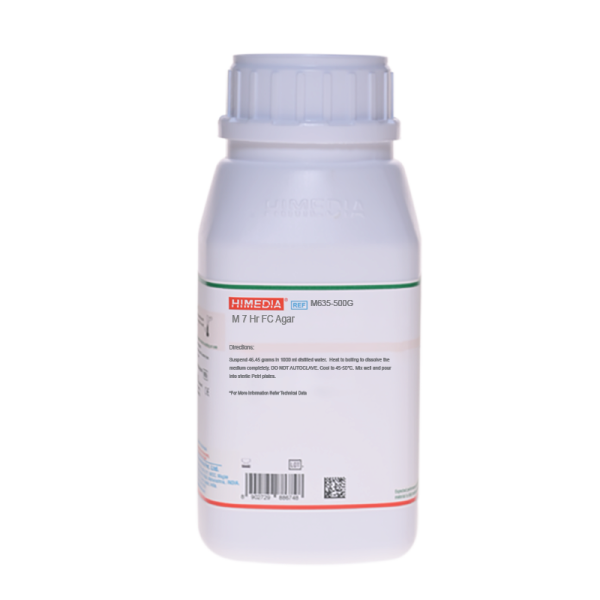
Suspend 46.45 grams in 1000 ml distilled water. Heat to boiling to dissolve the medium completely. DO NOT AUTOCLAVE. Mix well and pour into sterile Petri plates.
M7 Hr FC Agar is a modified method of Van Donsel et al (1) and Reasoner et al (2), which is recommended by APHA (3) for the examination of water and wastewater for the presence of faecal coliforms by the membrane filter technique. This medium has an advantage over other media to yield results in 7 hours that are generally comparable to those obtained by the standard coliform method. Thus this medium is accepted for assessment of the sanitary quality of water during emergencies involving water treatment plant failure or line breaks in a distribution network. It is reliable and has sensitivity levels equal to those of the standard tests routinely used.
Biopeptone and yeast extract provide nutritional requirement to a wide variety of organisms. Lactose and mannitol are energy sources and sodium chloride maintains osmotic equilibrium of the medium. Sodium lauryl sulphate and sodium deoxycholate help to restrict the gram-positive and gram-negative bacterial flora present in water. Bromocresol purple and phenol red help as indicators in the detection of organisms. This is a solid culture medium for the rapid detection of faecal coliforms by membrane filtration method.
After filtering a suitable or desired volume of water, the membrane is placed on the surface of plate and then incubated at 41.5°C for 7 hours. Faecal coliform form yellow colonies, indicating lactose fermentation.
MF technique has certain limitations, particularly when testing waters with high turbidity or non-coliform (background) bacteria. For such waters or when the membrane filter technique has not been used previously, it is desirable to carry out parallel tests with the multiple tube fermentation technique to determine applicability and comparability.
Appearance: Beige to purple homogeneous free flowing powder
Gelling: Firm, comparable with 1.5% Agar gel
Colour and Clarity of prepared medium: Dark pinkish purple coloured clear to slightly opalescent gel forms in Petri plates
Reaction of 4.64% w/v aqueous solution at 25°C. pH : 7.3±0.2
7.10-7.50
M635: Cultural characteristics observed after an incubation at 41.5°C for 7-18 hours.
| Organism | Inoculum (CFU) | Growth | Recovery | Colour of Colony |
|---|---|---|---|---|
| Escherichia coli ATCC 25922 | 50-100 | luxuriant | ≥50% | yellow |
| Staphylococcus aureus ATCC 25923 | ≥103 | inhibited | 0% | |
| Enterococcus faecalis ATCC 29212 | ≥103 | inhibited | 0% |
Store below 30°C in tightly closed container and the prepared medium at 2 - 8°C. Use before expiry date on the label.
| Product Name | M 7 Hr FC Agar |
|---|---|
| SKU | M635 |
| Product Type | Regular |
| Physical Form | Powder |
| Origin | Animal |
| Packaging type | HDPE |
| References | 1. Van Donsel D. J., Twedt R. M. and Geldrich E. E., 1969, Bacteriol.Proc. Abs. No. G46; p. 25. 2.Reasoner, D.J., Blannon J. C. and Geldrich E. B., 1979, Appl. Environ. Microbiol., 38:229. 3.Eaton A. D., Clesceri L. S., Rice E. W. and Greenberg A. W., (Eds.), 2005, Standard Methods for the Examination of Waterand Wastewater, 21st Ed., APHA, Washington, D.C. |