Plot No. C40, Road No. 21Y, MIDC, Wagle Industrial Estate,
Thane(W)-400604, MH, India.
Plot No. C40, Road No. 21Y, MIDC, Wagle Industrial Estate,
Thane(W)-400604, MH, India.

 Your enquiry has been submitted
Something problem with the server. Try again.
 Your enquiry has been submitted
Recommended for selective isolation and identification of pathogenic Staphylococcus aureus by detecting lipase production and mannitol fermentation from clinical and non-clinical specimens.
| Ingredients | g/L |
|---|---|
| HM Peptone B# | 1.000 |
| Peptone, special | 10.000 |
| Sodium chloride | 75.000 |
| D-Mannitol | 10.000 |
| Phenol red | 0.025 |
| Agar | 15.000 |
| Final pH (at 25°C) | 7.4±0.2 |
**Formula adjusted, standardized to suit performance parameters
# - Equivalent to Beef extract
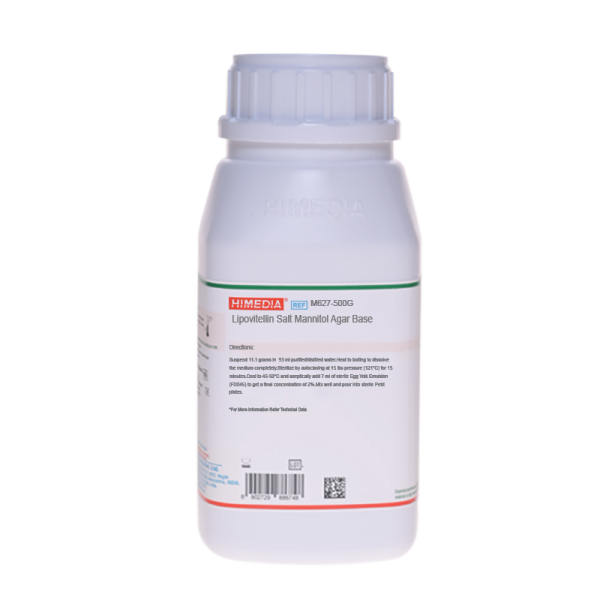
Suspend 11.1 grams in 93 ml purified/distilled water. Heat to boiling to dissolve the medium completely. Sterilize by autoclaving at 15 lbs pressure (121°C) for 15 minutes. Cool to 45-50°C and aseptically add 7 ml of sterile Egg Yolk Emulsion (FD045) to get a final concentration of 2%. Mix well and pour into sterile Petri plates.
The coagulase-positive species of Staphylococcus i.e. Staphylococcus aureus is well-documented as a human opportunistic pathogen (1). S.aureus is also isolated from recreational water like swimming pools, and are thus indicators of health risk (2-5). S.aureus is relatively resistant to the effect of disinfectant like chlorine and sodium chloride. Lipovitellin Salt Mannitol Agar Base, recommended by APHA (6) is used for the selective isolation and identification of pathogenic S.aureus by detecting lipase production and mannitol fermentation.
HM Peptone B and peptone special serve as source of nitrogenous and carbonaceous compounds, long chain amino acids vitamins and other essential nutrients required for bacterial growth. Sodium chloride in higher concentration makes the medium selective for Staphylococcus by inhibiting accompanying flora. D-Mannitol is the fermentable carbohydrate, fermentation of which leads to acid production, detected by the pH indicator dye, namely phenol red. Lipovitellin is a lipo phosphoprotein, which is combined with lecithin in the yolk of eggs. It is also known as vitellin or ovovitellin and is inhibitory to majority of bacteria except Staphylococcus. Egg yolk emulsion serves as a source of lipids for lipase activity. Inoculate tubes of M-Staphylococcus Broth (M1120). Incubate at 35-37°C for 24 hours. Streak plates of Lipovitellin Salt Mannitol Agar Base with a loopful of culture from positive (turbid) tubes. Incubate at 35-37°C for 24-48 hours. Opaque, yellow zones around the colonies are positive evidence of Lipovitellin + lipase activity (opaque) and mannitol fermentation (yellow)(6).
Clinical samples - skin exudates, pus samples, etc.; Food samples; Water samples
For clinical samples follow appropriate techniques for handling specimens as per established guidelines (7,8).
For food samples, follow appropriate techniques for sample collection and processing as per guidelines (9).
For water samples, follow appropriate techniques for sample collection, processing as per guidelines and local standards (6).
After use, contaminated materials must be sterilized by autoclaving before discarding.
In Vitro diagnostic Use. For professional use only. Read the label before opening the container. Wear protective gloves/protective clothing/eye protection/ face protection. Follow good microbiological lab practices while handling specimens and culture. Standard precautions as per established guidelines should be followed while handling clinical specimens. Safety guidelines may be referred in individual safety data sheets.
Performance of the medium is expected when used as per the direction on the label within the expiry period when stored at recommended temperature.
Appearance
Light yellow to pink homogeneous free flowing powder
Gelling
Firm, comparable with 1.5% Agar gel
Colour and Clarity of prepared medium
Basal medium: Red coloured clear to slightly opalescent gel After addition of 2% Egg Yolk Emulsion :Pink coloured opaque forms in Petri plates
Reaction
Reaction of 11.1% w/v aqueous solution at 25°C. pH: 7.4±0.2
pH
7.20-7.60
Cultural characteristics observed with added egg yolk emulsion, after an incubation at 35-37°C for 24-48 hours.
| Organism | Inoculum (CFU) | Growth | Recovery | Colour of colony | Lipase activity |
|---|---|---|---|---|---|
| Staphylococcus aureus subsp. aureus ATCC 25923 (00034*) | 50-100 | good to luxuriant | >=70% | yellow colonies with yellow opaque zone around the colonies | positive, irridescent sheen on the colony surface and medium |
Key: *Corresponding WDCM numbers.
Store between 10-30°C in a tightly closed container and the prepared medium at 2-8°C. Use before expiry date on the label. On opening, product should be properly stored dry, after tightly capping the bottle in order to prevent lump formation due to the hygroscopic nature of the product. Improper storage of the product may lead to lump formation. Store in dry ventilated area protected from extremes of temperature and sources of ignition Seal the container tightly after use. Product performance is best if used within stated expiry period.
User must ensure safe disposal by autoclaving and/or incineration of used or unusable preparations of this product. Follow established laboratory procedures in disposing of infectious materials and material that comes into contact with clinical sample must be decontaminated and disposed of in accordance with current laboratory techniques (7,8).
| Product Name | Lipovitellin Salt Mannitol Agar Base |
|---|---|
| SKU | M627 |
| Product Type | Regular |
| Physical Form | Powder |
| Origin | Animal |
| Packaging type | HDPE |
| References | 1. Murray P. R., Baron J. H., Pfaller M. A., Jorgensen J. H. and Yolken R. H., (Eds.), 2003, Manual of Clinical Microbiology,8th Ed., American Society for Microbiology, Washington, D.C. 2.Seyfreied P. L., Tobin R. S., Brown N. E. and Ness P. F., 1985, Am. J. Pub. Health 75:1071. 3.Klaps N. A., and Vesley D., 1988, Appl. Environ. Microbiol., 52:589. 4.Covert T. C. and Scarpino P.V., 1987, Abstr. Annu. Meeting, American Soc. Microbiology, Atlanta, Ga. ASM, Washington,D.C. 5.Charoenca N. and Fujioka R. S., 1995, Water Sci. Technol. 32: 6.Baird R.B., Eaton A.D., and Rice E.W., (Eds.), 2015, Standard Methods for the Examination of Water andWastewater, 23rd ed., APHA, Washington, D.C. 7.Salfinger Y., and Tortorello M.L. Fifth (Ed.), 2015, Compendium of Methods for the Microbiological Examination of Foods, 5th Ed., American Public Health Association, Washington, D.C. 8.Isenberg, H.D. Clinical Microbiology Procedures Handbook. 2nd Edition. 9.Jorgensen,J.H., Pfaller , M.A., Carroll, K.C., Funke, G., Landry, M.L., Richter, S.S and Warnock., D.W. (2015)Manual of Clinical Microbiology, 11th Edition. Vol. 1. |