Plot No. C40, Road No. 21Y, MIDC, Wagle Industrial Estate,
Thane(W)-400604, MH, India.
Plot No. C40, Road No. 21Y, MIDC, Wagle Industrial Estate,
Thane(W)-400604, MH, India.

 Your enquiry has been submitted
Something problem with the server. Try again.

| Ingredients | Gms/Litre |
|---|---|
| Malt extract | 15.000 |
| Peptic digest of animal tissue | 0.780 |
| Maltose | 12.750 |
| Dextrin | 2.750 |
| Dipotassium phosphate | 1.000 |
| Ammonium chloride | 1.000 |
| Agar | 15.000 |
| Final pH (at 25°C) | 4.8±0.2 |
Formula adjusted, standardized to suit performance parameters
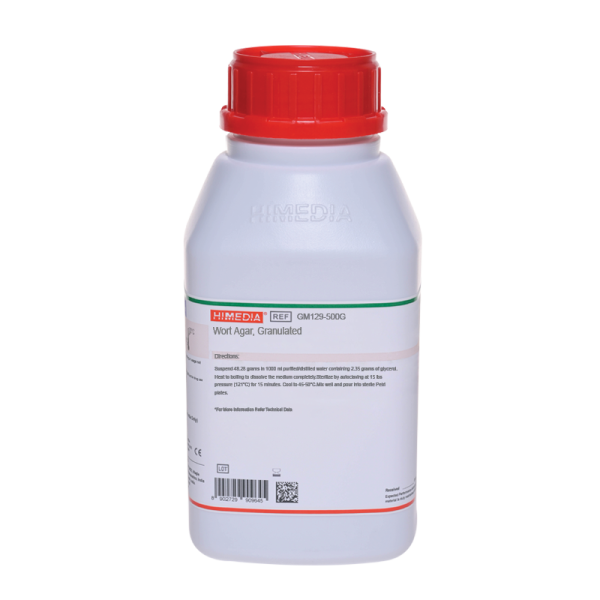
Suspend 48.28 grams in 1000 ml distilled water containing 2.35 grams of glycerol. Heat to boiling to dissolve the medium completely. Sterilize by autoclaving at 15 lbs pressure (121°C) for 15 minutes. Cool to 45-50°C. Mix well and pour into sterile Petri plates.
Wort Agar is used for the cultivation, isolation and enumeration of yeast and moulds. According to Rapp (1), addition of certain dyes to Wort Agar allows differentiation between yeast and bacterial colonies. It is particularly well adapted for counting osmophillic yeast in butter, sugar and syrups, in lemonades and more generally in sweet or soft drinks. Wort Agar is a medium equivalent to the medium described by Parfitt (2) and equally suitable for the cultivation and enumeration of yeasts. Parfitt investigated the relative merits of Wort Agar and other media for the count of yeasts and moulds in butter, and recommended the use of dehydrated whey, malt or wort for the purpose. Scarr (3) employed a modified Wort Agar (Osmophilic Agar) for the examination of sugar products for presence of osmophilic yeasts. For more selective utilization, it is possible to adjust the pH to 4.5 or 3.5 by adding 10 ml/l of a 10% solution of lactic acid or tartaric acid before sterilization.
Yeasts grow well in culture media containing dextrose or maltose in an acidic environment. In this medium, peptic digest of animal tissue and malt extract provide nitrogenous and other nutrients for the growth of yeasts. Dextrin and maltose are the fermentable carbohydrates. The agar medium should not be re-liquified as it causes alteration with hydrolysis of agar at low pH and results in failure of agar to gel when cooled (4).
For the microbiological examination of butter, make suitable dilutions in quarter strength Ringer solution. Transfer 1 ml of each dilution to a separate Petri dish; add 15 ml of melted Wort Agar, cooled to 45-48°C, mix by rotary movements in a horizontal plane. Incubate the plates and subsequently count the colonies.
Appearance
Light yellow to brownish yellow coloured granular medium
Gelling
Firm, comparable with 1.5% Agar gel.
Colour and Clarity of prepared medium
Yellow coloured Opalescent gel forms with flocculant precipitate in Petri plates.
Reaction
Reaction of 4.83% w/v aqueous solution at 25°C. pH: 4.8±0.2
pH
4.60-5.00
Cultural characteristics observed with added glycerol after an incubation at 25-30°C for 40-48 hours.
| Organism | Inoculum (CFU) | Growth | Recovery |
|---|---|---|---|
| *Aspergillus brasiliensis ATCC 16404 | 50-100 | luxuriant | - |
| Candida albicans ATCC 10231 | 50-100 | luxuriant | >=70% |
| Saccharomyces cerevisiae ATCC 9763 | 50-100 | luxuriant | >=70% |
| Saccharomyces uvarum ATCC 28098 | 50-100 | luxuriant | >=70% |
Key:-*- Formerly known as Aspergillus niger
Store below 30°C in tightly closed container and the prepared medium at 2 - 8°C. Use before expiry date on the label.
| Product Name | Wort Agar, Granulated |
|---|---|
| SKU | GM129 |
| Product Type | Granulated |
| Physical Form | Granular |
| Origin | Animal |
| Packaging type | HDPE |
| References | 1.Rapp M., 1974, Indikatorzusatze zur Keimdifferenzierung auf Wurze-und Malzextrakt-Agar, Milchwis, 29; 341-344. 2.Parfitt E. H., 1933, J. Dairy Sci., 19: 141. 3.Scarr M., 1959, J. Sci. Food. Agric., 10 (12), 678-681. 4.MacFaddin J. F., 1985, Media for Isolation-Cultivation- Identification-Maintenance of Medical Bacteria, Vol. 1, Williamsand Wilkins, Baltimore. |