Plot No. C40, Road No. 21Y, MIDC, Wagle Industrial Estate,
Thane(W)-400604, MH, India.
Plot No. C40, Road No. 21Y, MIDC, Wagle Industrial Estate,
Thane(W)-400604, MH, India.

 Your enquiry has been submitted
Something problem with the server. Try again.
 Your enquiry has been submitted
Recommended for cultivation of common aerobes and sterility testing of solutions and biological products without mercurial preservatives.
| Ingredients | Gms / Litre |
|---|---|
| Proteose peptone | 20.000 |
| HM peptone B # | 3.000 |
| Yeast extract | 3.000 |
| Malt extract | 3.000 |
| Dextrose (Glucose) | 5.000 |
| Ascorbic acid | 0.200 |
| Final pH (at 25°C) | 7.2±0.2 |
Formula adjusted, standardized to suit performance parameters
# Equivalent to Beef extract
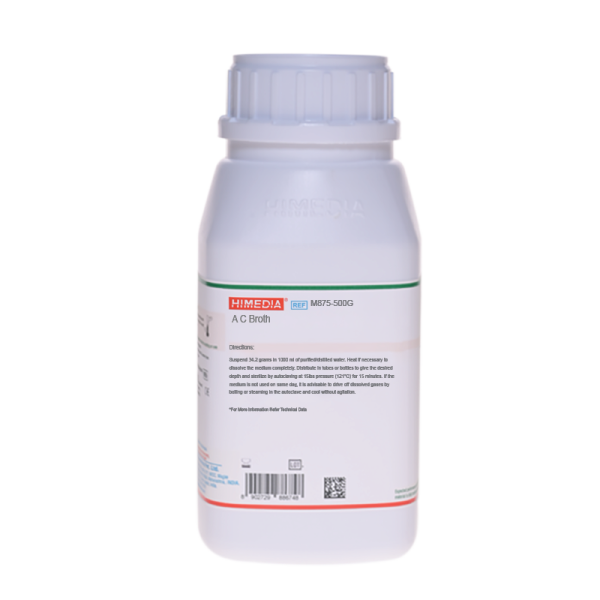
Suspend 34.2 grams in 1000 ml of purified / distilled water. Heat if necessary to dissolve the medium completely. Distribute in tubes or bottles to give the desired depth and sterilize by autoclaving at 15 lbs pressure (121°C) for 15 minutes.
If the medium is not used on same day, it is advisable to drive off dissolved gases by boiling or steaming in the autoclave and cool without agitation.
AC Broth support an early and luxuriant growth of aerobic, anaerobic and microaerophilic microorganisms. Many pathogenic and saprophytic aerobes can also be cultivated using AC Broth (4). This medium can also be used for sterility testing of solutions and biological products not containing mercurial preservatives. Some of the media containing sodium thioglycollate exhibit toxicity for some organisms. This toxicity is not seen in the case of AC Broth as reported by Christensen (1) and Malin and Finn (5). Earlier studies performed have reported the usefulness of using this medium for the cultivation of a wide variety of organisms (6,7).
Proteose peptone, HM peptone B, yeast extract and malt extract serve as the carbon and nitrogen sources in addition to being a source of vitamins and cofactors. Dextrose serves as the fermentable carbohydrate and source of energy. Ascorbic acid in the media helps to improve the clarity of the medium.
Pharmaceutical samples- Environmental monitoring
After use, contaminated materials must be sterilized by autoclaving before discarding.
Read the label before opening the container. Wear protective gloves/protective clothing/eye protection/ face protection. Follow good microbiological lab practices while handling specimens and culture. Standard precautions as per established guidelines should be followed while handling specimens. Safety guidelines may be referred in individual safety data sheets.
Performance of the medium is expected when used as per the direction on the label within the expiry period when stored at recommended temperature.
Appearance: Cream to yellow homogeneous free flowing powder
Colour and Clarity of prepared medium: Medium amber coloured clear to slightly opalescent solution.
Reaction: Reaction of 3.42% w/v aqueous solution at 25°C. pH: 7.2±0.2
pH: 7.00-7.40
Cultural characteristics observed after an incubation at 35-37°C for 18-24 hours (Clostridium species incubated anaerobically).
| Organism | Inoculum (CFU) |
Growth |
|---|---|---|
| Clostridium perfringens ATCC 12919 | 50-100 | luxuriant |
| Escherichia coli ATCC 25922 (00013*) | 50-100 | luxuriant |
| Neisseria meningitidis ATCC 13090 | 50-100 | luxuriant |
| Staphylococcus aureus subsp. aureus ATCC 25923 (00034*) | 50-100 | luxuriant |
| Streptococcus mitis ATCC 9811 | 50-100 | luxuriant |
| Streptococcus pneumoniae ATCC 6303 | 50-100 | luxuriant |
Key: (*) Corresponding WDCM numbers.
Store between 10-30°C in a tightly closed container and the prepared medium at 15-25°C. Use before expiry date on the label. On opening, product should be properly stored dry, after tightly capping the bottle inorder to prevent lump formation due to the hygroscopic nature of the product. Improper storage of the product may lead to lump formation. Store in dry ventilated area protected from extremes of temperature and sources of ignition Seal the container tightly after use. Product performance is best if used within stated expiry period.
User must ensure safe disposal by autoclaving and/or incineration of used or unusable preparations of this product. Follow established laboratory procedures in disposing of infectious materials and material that comes into contact with sample must be decontaminated and disposed of in accordance with current laboratory techniques (2,3).
| Product Name | AC Broth |
|---|---|
| SKU | M875 |
| Product Type | Regular |
| Physical Form | Powder |
| Origin | Animal |
| Packaging type | HDPE |
| References | 1. MacFaddin J. F., 1985, Media for Isolation-Cultivation-Identification-Maintenanceof Medical Bacteria, Vol. I. Williams & Wilkins, Baltimore, Md. |