Plot No. C40, Road No. 21Y, MIDC, Wagle Industrial Estate,
Thane(W)-400604, MH, India.
Plot No. C40, Road No. 21Y, MIDC, Wagle Industrial Estate,
Thane(W)-400604, MH, India.

 Your enquiry has been submitted
Something problem with the server. Try again.

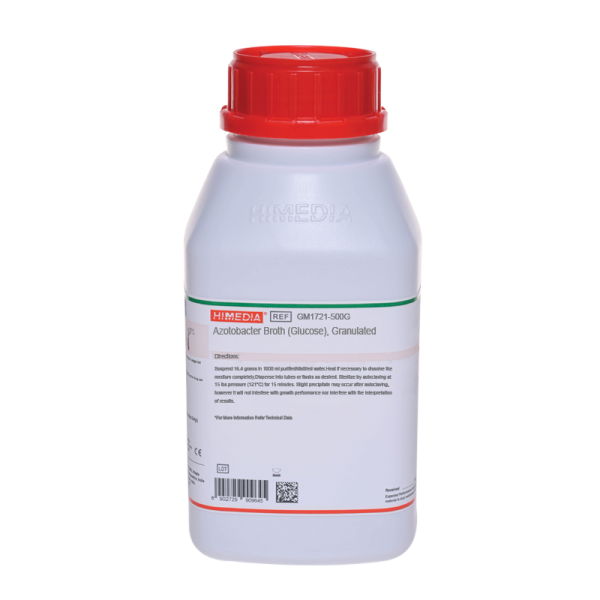
Azotobacter Broth (Glucose),granulated is recommended for cultivation of Glucose positive Azotobacter species from soil.
| Ingredients | Gms / Litre |
|---|---|
| Dipotassium hydrogen phosphate | 1.000 |
| Magnesium sulphate | 0.200 |
| Sodium chloride | 0.200 |
| Ferrous sulphate | 0.005 |
| Soil extract | 5.000 |
| Glucose | 10.000 |
| Final pH (at 25°C) | 7.6±0.2 |
**Formula adjusted, standardized to suit performance parameters
Suspend 16.4 grams in 1000 ml distilled water. Heat if necessary to dissolve the medium completely. Dispense into tubes or flasks as desired. Sterilize by autoclaving at 15 lbs pressure (121°C) for 15 minutes. Slight precipitate may occur after autoclaving, however it will not interfere with growth performance nor interfere with the interpretation of results.
Azotobacter is a free-living nitrogen-fixing bacterium, which is known to be used as a biofertilizer in the cultivation of most crops. Azotobacter is found on neutral to alkaline soils, in aquatic environments, in the plant rhizosphere and phyllosphere. Azotobacters are gram-negative aerobic soil-dwelling bacteria and are usually motile, oval, or spherical bacteria, form thick-walled cysts, and may produce large quantities of capsular slime. They are typically polymorphic, i.e. of different sizes and shapes. Their size of the cells ranges from 2-10 µm long and 1-2 µm wide. Plant needs nitrogen for its growth and Azotobacter fixes atmospheric nitrogen non-symbiotically. Therefore, all plants, trees, vegetables, get benefited. Beyond Azotobacter's use as a model it has biotechnological applications like use for alginate production and for nitrogen production in batch fermentations. This medium contains necessary nutrients for growth of Azotobacter species. For cultivation of glucose positive Azotobacter species from soil Azotabcter broth (Glucose) can be used (1). It is used for cultivation of glucose positive or mannitol positive Azotobacter species from soil. It can also be useful for maintenance of Azotobacter species by adding extra 1% glucose or 1% Mannitol to the medium containing agar i.e solid media as specified by the American Type Culture Collection (2).
Appearance
Off-white to beige coloured granular medium
Colour and Clarity of prepared medium
Yellow coloured, clear to slightly opalescent solution with slight precipitate forms in tubes
Reaction
Reaction of 1.64% w/v aqueous solution at 25°C pH: 7.6±0.2
pH
7.40-7.80
Cultural characteristics observed after an incubation at 25-30°C for 24-48 hours.
| Organism | Inoculum (CFU) | Growth |
|---|---|---|
| Azotobacter beijerinckii ATCC 12981 | 50-100 | luxuriant |
| Azotobacter nigricans ATCC 50-100 35009 |
luxuriant |
On receipt store between 10 - 30°C in tightly closed container and the prepared medium at 2 - 8°C. Use before expiry date on the label.
| Product Name | Azotobacter Broth (Glucose), Granulated |
|---|---|
| SKU | GM1721 |
| Product Type | Granulated |
| Physical Form | Granular |
| Origin | Chemically defined |
| Packaging type | HDPE |
| References | 1.Pelczar M. Jr., 1957, Manual of Microbiological Methods.2.ATCC Catalogue of Bacteria and Bacteriophages, 1992, 18th ed, American Type Culture Collection, Rockville, MD. |