Plot No. C40, Road No. 21Y, MIDC, Wagle Industrial Estate,
Thane(W)-400604, MH, India.
Plot No. C40, Road No. 21Y, MIDC, Wagle Industrial Estate,
Thane(W)-400604, MH, India.

 Your enquiry has been submitted
Something problem with the server. Try again.

Recommended for studying soil microorganisms such as Rhizobium species.
| Ingredients | Milligrams / Litre |
|---|---|
| Calcium carbonate | 3000.000 |
| Calcium chloride hexahydrate | 446.000 |
| Potassium chloride | 165.000 |
| Potassium dihydrogen phosphate | 200.000 |
| Magnesium sulphate heptahydrate | 700.000 |
| Sodium sulphate | 200.000 |
| Potassium iodide | 0.750 |
| Ferric chloride hexahydrate | 2.500 |
| Boric acid | 1.500 |
| Sodium molybdate dihydrate | 0.250 |
| Manganese sulphate tetrahydrate | 6.640 |
| Zinc sulphate heptahydrate | 2.670 |
| Copper sulphate pentahydrate | 0.070 |
**Formula adjusted, standardized to suit performance parameters
Suspend 4.14 grams (the equivalent weight of dehydrated medium per litre) in 1000 ml purified / distilled water. Heat just to boiling. Sterilize by autoclaving at 15 lbs pressure (121°C) for 15 minutes. Mix well and dispense as desired. Note: Due to presence of calcium carbonate, the medium forms opalescent solution with white precipitate.
Rhizobia are nitrogen-fixing bacteria, which live freely in soil and in the root region of both leguminous and non-leguminous plants. These bacteria are capable of forming complex symbiotic relationships with only leguminous plants. In an effective symbiosis, the bacteria infect the plant roots and induce the formation of specialized structures called nodules. In the nodules, the bacteria multiply, form specialized cells called bacteroids and subsequently convert atmospheric nitrogen to ammonia. Energy for the reduction of nitrogen is provided by the plant, through photosynthesis and the resultant product provides a nitrogen source for the plant (1). Inorganic Salt Medium (5) modified as per Bunting and Horrocks (2) is used for studying and isolation of soil microorganisms, such as Rhizobium species. Calcium stimulates nodulation when present as chloride or sulphate. Molybdenum is essential for symbiotic nitrogen fixation and stimulates the nitrogen fixing activity of the nodular tissue. Inorganic Salt Medium is used to moisten the sand (or used as such) into which the suspended roots grow.
Soil sample- root system of the leguminous plant
For soil samples follow appropriate techniques for handling specimens as per established guidelines (5). After use, contaminated materials must be sterilized by autoclaving before discarding.
Read the label before opening the container. Wear protective gloves/protective clothing/eye protection/ face protection. Follow good microbiological lab practices while handling specimens and culture. Standard precautions as per established guidelines should be followed while handling specimens. Safety guidelines may be referred in individual safety data sheets.
Performance of the medium is expected when used as per the direction on the label within the expiry period when stored at recommended temperature.
Appearance
White to light yellow homogeneous free flowing powder
Colour and Clarity of prepared medium
Light yellow clear solution with heavy white precipitate at bottom.
Cultural Response
Cultural characteristics observed after an incubation at 25-30°C for upto 7 days.
| Organism | Growth |
|---|---|
| Rhizobium leguminosarum ATCC 10004 | luxuriant |
| Rhizobium phaseoli ATCC 14482 | luxuriant |
| Rhizobium trifolii ATCC 14480 | luxuriant |
Store between 10-30°C in a tightly closed container and the prepared medium at 20-30°C. Use before expiry date on the label. On opening, product should be properly stored dry, after tightly capping the bottle in order to prevent lump formation due to the hygroscopic nature of the product. Improper storage of the product may lead to lump formation. Store in dry ventilated area protected from extremes of temperature and sources of ignition. Seal the container tightly after use. Product performance is best if used within stated expiry period.
User must ensure safe disposal by autoclaving and/or incineration of used or unusable preparations of this product. Follow established laboratory procedures in disposing of infectious materials and material that comes into contact with sample must be decontaminated and disposed of in accordance with current laboratory techniques (3,4).
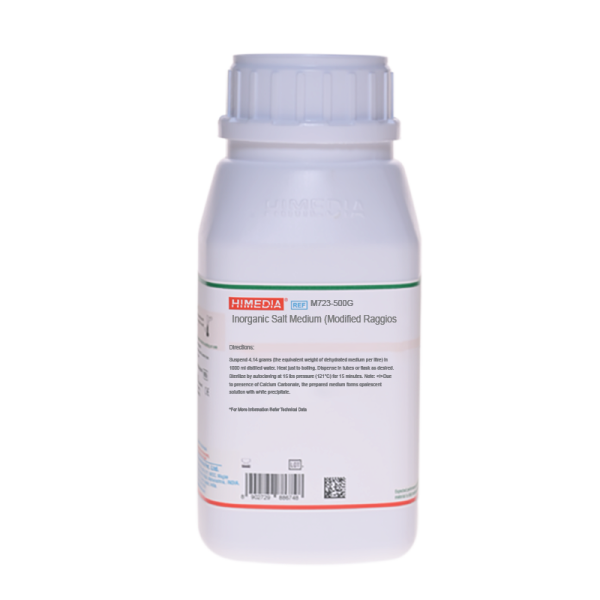
| Product Name | Inorganic Salt Medium (Modified Raggios Medium) |
|---|---|
| SKU | M723 |
| Product Type | Regular |
| Physical Form | Powder |
| Origin | Chemically defined |
| Packaging type | HDPE |
| References | 1.Balows A., Truper H. G., Dworkin M., Harder W., Schleifer K. H., (Eds.), The Prokaryotes, 2nd Edition, Vol. III, Springer-Verlag. 2.Subba Rao N. S., 1977, Soil Microorganisms and Plant Growth, Oxford and IBH publishing Co., New Delhi. 3.Bunting A. H. and Horrocks J., 1964, Ann. Bot., 28:229. |
| Customized Product Available | No |