Plot No. C40, Road No. 21Y, MIDC, Wagle Industrial Estate,
Thane(W)-400604, MH, India.
Plot No. C40, Road No. 21Y, MIDC, Wagle Industrial Estate,
Thane(W)-400604, MH, India.

 Your enquiry has been submitted
Something problem with the server. Try again.

Used for isolation and identification of Clostridia and certain other anaerobes.
| Ingredients | g/L |
|---|---|
| Proteose peptone | 40.000 |
| Disodium hydrogen phosphate | 5.000 |
| Potassium dihydrogen phosphate | 1.000 |
| Sodium chloride | 2.000 |
| Magnesium sulphate | 0.100 |
| Dextrose (Glucose) | 2.000 |
| Hemin | 0.005 |
| Agar | 25.000 |
| Final pH (at 25°C) | 7.6±0.2 |
**Formula adjusted, standardized to suit performance parameters
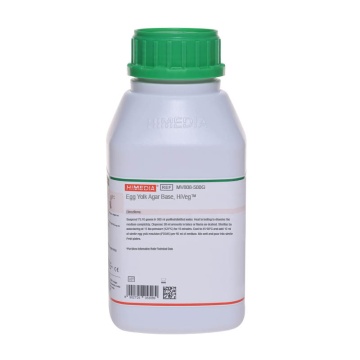
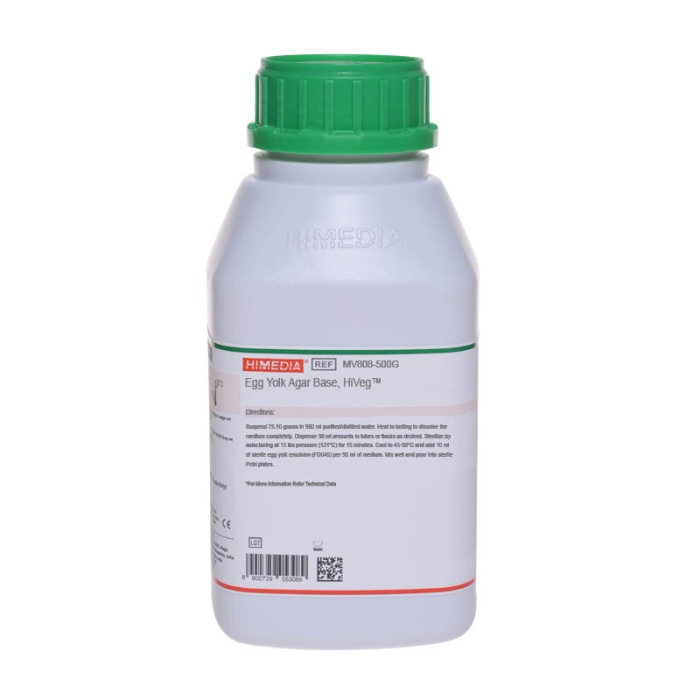
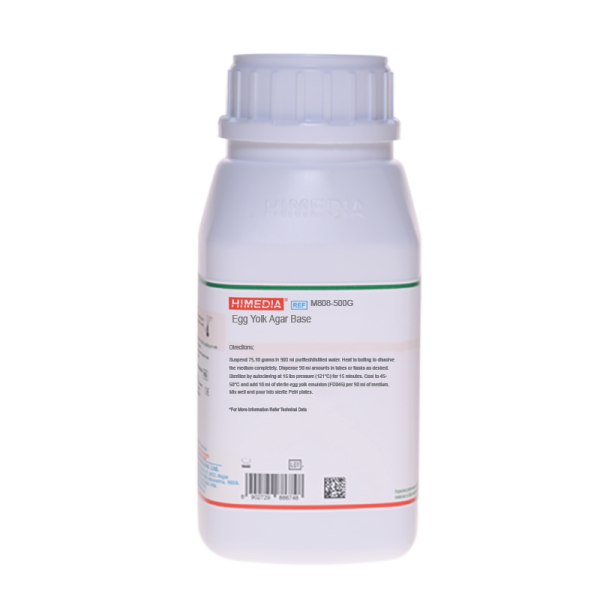
Suspend 75.10 grams in 900 ml purified/distilled water. Heat to boiling to dissolve the medium completely. Dispense 90 ml amounts in tubes or flasks as desired. Sterilize by autoclaving at 15 lbs pressure (121°C) for 15 minutes. Cool to 45-50°C and add 10 ml of sterile egg yolk emulsion (FD045) per 90 ml of medium. Mix well and pour into sterile Petri plates.
Clostridium perfringens food poisoning is one of the most common types of human food borne illness (1). The foods usually involved are cooked meat or poultry products containing large numbers of viable cells. A heat-labile enterotoxin produced only by sporulating cells (2) induces the major symptoms of diarrhea in perfringens poisoning.
Egg Yolk Agar Base is a slight modification (3) of McClung Toabe Agar Base (4) used for isolation and detection of Clostridium perfringens. Egg Yolk Agar Base differs from the original formula by the inclusion of hemin.
Proteose peptone provide the essential nutrients along with carbonaceous and nitrogenous substances. Phosphates buffer the medium whereas sodium chloride maintains the osmotic equilibrium. Magnesium sulphate serves as a source of divalent cations along with sulphates. Glucose serves as a source of energy. Hemin help to enhance the growth of anaerobic organisms. Organisms producing lecithinase break down lecithin present in the egg yolk emulsion producing an insoluble opaque precipitate around the colonies. Lipase-producing organisms break down free fatty acids (in the egg yolk emulsion) forming an iridescent sheen on the surface of the colonies. Lipase activity may be delayed, therefore plates should not be discarded as negative before incubation for a week. Proteolytic activity is seen as clear zones around the colonies (5). The media should be directly inoculated with the test specimen.
Clinical- stool, abscess, etc.; Food samples.
Prior to inoculation, media plates should be reduced by placing in an anaerobic jar for 18-24 hours. An enrichment broth should be simultaneously inoculated with the test sample to detect small number of anaerobic organisms. Standard procedures for the isolation of organism should be referred. Incubation should be carried out for 18-48 hours and continued for 7 days. After use, contaminated materials must be sterilized by autoclaving before discarding.
In Vitro diagnostic use. For professional use only. Read the label before opening the container. Wear protective gloves/protective clothing/eye protection/face protection. Follow good microbiological lab practices while handling specimens and culture. Standard precautions as per established guidelines should be followed while handling clinical specimens. Safety guidelines may be referred in individual safety data sheets.
Performance of the medium is expected when used as per the direction on the label within the expiry period when stored at recommended temperature.
Cream to yellow homogeneous free flowing powder
Firm, comparable with 2.5% Agar gel.
Basal medium: Medium amber coloured, clear to slightly opalescent gel After addition of egg yolk emulsion (FD045): Yellow coloured opaque gel forms in Petri plates
Reaction of 7.5% w/v aqueous solution at 25°C. pH: 7.6±0.2
7.40-7.80
Cultural characteristics observed with added Egg yolk emulsion (FD045), after an incubation at 35-37°C for 48-72 hours when incubated anaerobically. (*- Plates should be incubated up to 7 days before regarding them as negative)
| Organism | Inoculum (CFU) | Growth | Recovery | Lecithinase | Lipase activity* | Proteolytic activity |
|---|---|---|---|---|---|---|
| Bacteroides fragilis ATCC 25285 | 50-100 | good-luxuriant | >=50% | negative reaction | negative,no irridescent sheen on the colony surface and medium | negative,no clear zone surrounding colonies |
| Clostridium botulinum ATCC 25763 | 50-100 | good-luxuriant | >=50% | negative reaction | negative,no irridescent sheen on the colony surface and medium | positive, clear zone surrounding colonies |
| Clostridium butyricum ATCC 13732 | 50-100 | good-luxuriant | >=50% | negative reaction | negative,no irridescent sheen on the colony surface and medium | positive,clear zone surrounding colonies |
| Clostridium perfringens ATCC 12924 | 50-100 | good-luxuriant | >=50% | positive,opaque zone around the colony | negative,no irridescent sheen on the colony surface and medium | negative,no clear zone surrounding colonies |
| Clostridium sporogenes ATCC 11437 | 50-100 | good-luxuriant | >=50% | negative reaction | positive,irridescent sheen on the colony surface and medium. | positive,clear zone surrounding colonies |
Store between 10-30°C in a tightly closed container and the prepared medium at 2-8°C. Use before expiry date on the label. On opening, product should be properly stored dry, after tightly capping the bottle inorder to prevent lump formation due to the hygroscopic nature of the product. Improper storage of the product may lead to lump formation. Store in dry ventilated area protected from extremes of temperature and sources of ignition Seal the container tightly after use. Product performance is best if used within stated expiry period.
User must ensure safe disposal by autoclaving and/or incineration of used or unusable preparations of this product. Follow established laboratory procedures in disposing of infectious materials and material that comes into contact with clinical sample must be decontaminated and disposed of in accordance with current laboratory techniques (6,7).
| Product Name | Egg Yolk Agar Base |
|---|---|
| SKU | M808 |
| Product Type | Regular |
| Physical Form | Powder |
| Origin | Animal |
| Packaging type | HDPE |
| References | 1. Labbe R., 1989, Clostridium perfringens, In Foodborne Bacterial Pathogens Ed., Doyle M. P., P.191, Marcel Dekker, NewYork , N.Y., |