Plot No. C40, Road No. 21Y, MIDC, Wagle Industrial Estate,
Thane(W)-400604, MH, India.
Plot No. C40, Road No. 21Y, MIDC, Wagle Industrial Estate,
Thane(W)-400604, MH, India.

 Your enquiry has been submitted
Something problem with the server. Try again.

Tomato juice medium is recommended for isolation and identification of Lactobacilli encountered in wine.
| Ingredients | Gms / Litre |
|---|---|
| Peptone, special | 5.000 |
| Yeast extract | 5.000 |
| Dextrose | 10.000 |
| Monopotassium phosphate | 0.500 |
| Potassium chloride | 0.125 |
| Calcium chloride | 0.125 |
| Sodium chloride | 0.125 |
| Magnesium sulphate | 0.125 |
| Manganese sulphate | 0.003 |
| Bromo cresol green | 0.030 |
| Tomato juice solids, from | 150.000 |
| Agar | 15.000 |
| Final pH (at 25°C) | 5.0±0.2 |
**Formula adjusted, standardized to suit performance parameters
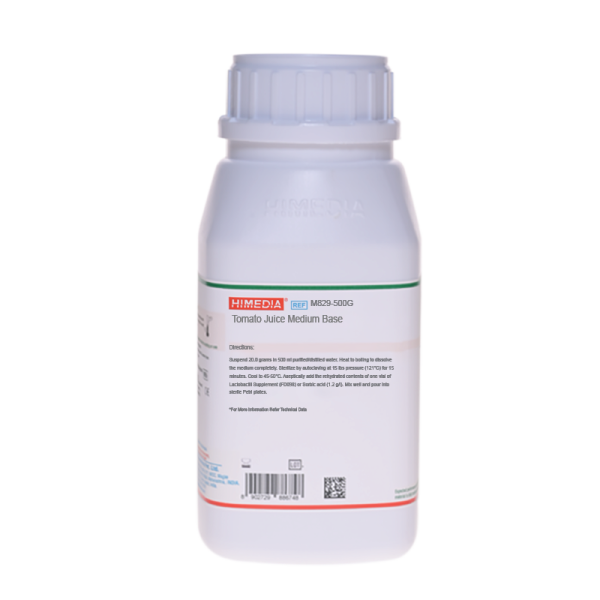
Suspend 20 grams in 500 ml distilled water. Heat to boiling to dissolve the medium completely. Sterilize by autoclaving at 15 lbs pressure (121°C) for 15 minutes. Aseptically add the rehydrated contents of one vial of Lactobacilli Supplement, FD098 or Sorbic acid (1.2g/l). Mix well and pour into sterile Petri plates.
Wine may also be made from fruit and fruit juices (1). Mickle and Breed (2) first described the use of tomato juice in the culture media for Lactobacilli. Tomato Juice Medium Base is the modification of the medium devised by Yoshizumi (3), used for isolation of the slow growing Lactobacilli from wines. These Lactobacilli take part in the malolactic fermentation and spoilage. Ability of tomato juice to enhance the recovery of Lactobacilli was observed by Kulp (4).
Tomato juice acts as a source of carbon, nutrients and proteins. Peptone special and yeast extract provide nitrogenous compounds and amino acids which stimulate the growth of spoilage strains (3). Low pH of the medium encourages growth of Lactobacilli while inhibiting the growth of accompanying bacteria. Bromocresol green acts as an inhibitory dye. Cycloheximide and sorbic acid act as fungistats, inhibiting the growth of yeasts (5, 6). Monopotassium phosphate buffers the medium. Magnesium sulphate, manganese sulphate and potassium chloride provide inorganic ions. Sodium chloride maintains osmotic balance in the medium.
Appearance
Cream to light green homogeneous free flowing powder
Gelling
Firm, comparable with 1.5% Agar gel
Colour and Clarity of prepared medium
Bluish green coloured clear to slightly opalescent gel forms in Petri plates.
Reaction
Reaction of 4.0% w/v aqueous solution at 25°C. pH : 5.0±0.2
pH
4.80-5.20
M829: Cultural characteristics observed with added one vial of Lactobacilli Supplement (FD098)/Sorbic acid after an incubation at 35-37°C after 18-48 hours.
| Organism | Inoculum (CFU) |
Growth | Recovery |
|---|---|---|---|
| Lactobacillus bulgaricus ATCC 11842 |
50-100 | luxuriant | >=50% |
| Lactobacillus casei ATCC 7469 |
50-100 | luxuriant | >=50% |
Store below 30°C in tightly closed container and the prepared medium at 2 - 8°C. Use before expiry date on the label.
| Product Name | Tomato Juice Medium Base |
|---|---|
| SKU | M829 |
| Product Type | Regular |
| Physical Form | Powder |
| Origin | Animal |
| Packaging type | HDPE |
| References | 1. Alcamo I. E., 2001, Fundamentals of Microbiology, 6th Ed., Jones and Bartlett Publishers |