 Plot No. C40, Road No. 21Y, MIDC, Wagle Industrial Estate,
Thane(W)-400604, MH, India.
Plot No. C40, Road No. 21Y, MIDC, Wagle Industrial Estate,
Thane(W)-400604, MH, India.

 Your enquiry has been submitted
Something problem with the server. Try again.

| Ingredients | Gms / Litre |
|---|---|
| Peptic digest of animal tissue | 5.000 |
| Yeast Extract | 1.500 |
| Beef extract | 1.500 |
| Skim milk powder | 1.000 |
| Starch, soluble | 1.000 |
| Agar | 15.000 |
| Final pH (at 25°C) | 7.2±0.2 |
**Formula adjusted, standardized to suit performance parameters
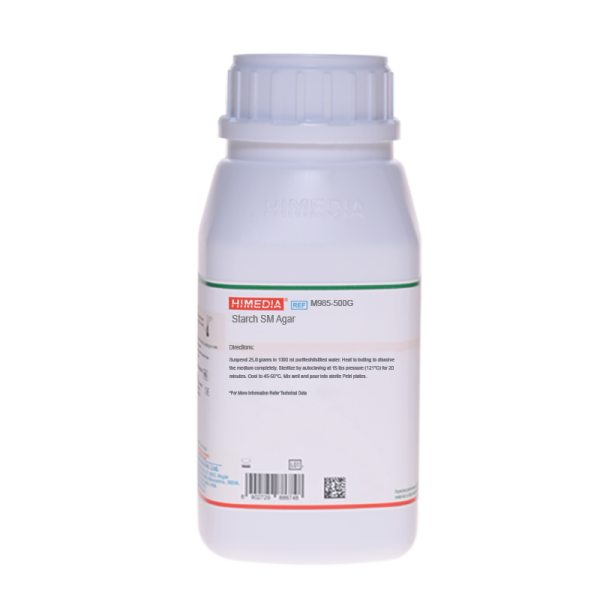
Suspend 25.0 grams in 1000 ml distilled water. Heat to boiling to dissolve the medium completely. Sterilize by autoclaving at 15 lbs pressure (121°C) for 20 minutes. Mix well before pouring into sterile Petri plates.
The milk secreted in an uninfected cows udder is sterile. Contamination of this milk can occur during milking, cooling and storage (2). Milk is an excellent medium for bacteria, yeast and moulds. Their rapid growth can cause marked deterioration, spoiling the milk for liquid consumption or manufacture into dairy products. Human infection can occur by consumption of such contaminated milk or milk products. Spore-forming bacteria can survive food-processing treatments. In the dairy industry, Bacillus and Clostridium species determine the shelf-life of a variety of heat-treated milk products, mainly if the level of post-process contamination is low.
Starch Milk Agar is used for the detection of spores in heated milk and milk products (1). It helps in the demonstration of starch hydrolysis and proteolytic activity of spore producing organisms in milk and milk products. Proteolytic bacteria will be surrounded by a clear zone, due to the conversion of casein into soluble nitrogenous compounds (3).
Peptic digest of animal tissue, beef extract and yeast extract are sources of nitrogen and other growth factors. Skim milk powder acts a source of casein while starch serves as an energy source which also neutralizes the toxic metabolites. Agar is the solidifying agent.
Appearance
Cream to yellow coloured homogeneous free flowing powder
Gelling
Firm, comparable with 1.5% Agar gel
Colour and Clarity of prepared medium
Light yellow coloured slightly opalescent gel forms in Petri plates.
Reaction
Reaction of 2.5% w/v aqueous solution at 25°C. pH: 7.2±0.2
pH
7.00-7.40
M985: Cultural characteristics observed after an incubation at 35-37°C for 18-48 hours.
| Organism | Inoculum (CFU) | Growth | Recovery |
|---|---|---|---|
| Bacillus cereus ATCC 10876 | 50-100 | luxuriant | >=70% |
| Bacillus coagulans ATCC 8038 | 50-100 | luxuriant | >=70% |
| Bacillus subtilis ATCC 6633 | 50-100 | luxuriant | >=70% |
| Bacillus thuringiensis ATCC 10792 | 50-100 | luxuriant | >=70% |
Store below 30°C in tightly closed container and the prepared medium at 2-8°C. Use before expiry date on the label.
| Product Name | Starch SM Agar |
|---|---|
| SKU | M985 |
| Product Type | Regular |
| Physical Form | Powder |
| Origin | Animal |
| Packaging type | HDPE |
| References | 1.Harrigan W.F., Laboratory Methods in Food Microbiology.2.Collee J. G., Fraser A. G., Marimon B. P., Simmons A., (Eds.), Mackie and McCartney, Practical Medical Microbiology,1996, 14th Edition, Churchill Livingstone.3.Methods of Microbiological Examination for Dairy Purposes, Diluents, Media and Apparatus and their Preparation andSterilization, BS4285, Sec. 1.2. |
| Customized Product Available | No |