Plot No. C40, Road No. 21Y, MIDC, Wagle Industrial Estate,
Thane(W)-400604, MH, India.
Plot No. C40, Road No. 21Y, MIDC, Wagle Industrial Estate,
Thane(W)-400604, MH, India.

 Your enquiry has been submitted
Something problem with the server. Try again.
 Your enquiry has been submitted
Recommended for isolation and detection of Clostridium perfringens on the basis of motility and nitrate test.
| Ingredients | Gms/Litre |
|---|---|
| Peptone | 5.000 |
| HM peptone B # | 3.000 |
| Galactose | 5.000 |
| Potassium nitrate | 1.000 |
| Disodium hydrogen phosphate | 2.500 |
| Agar | 3.000 |
| Final pH (at 25°C) | 7.4±0.2 |
**Formula adjusted, standardized to suit performance parameters
# Equivalent to Beef extract
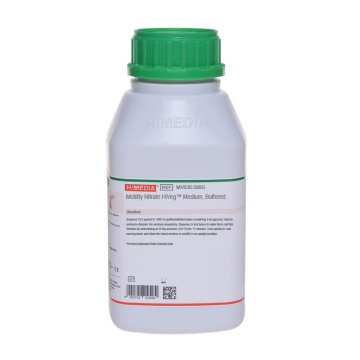
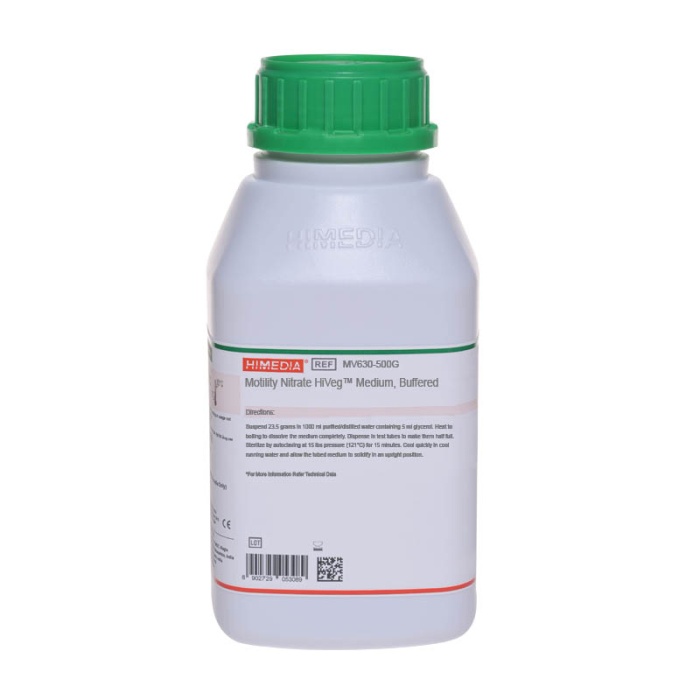
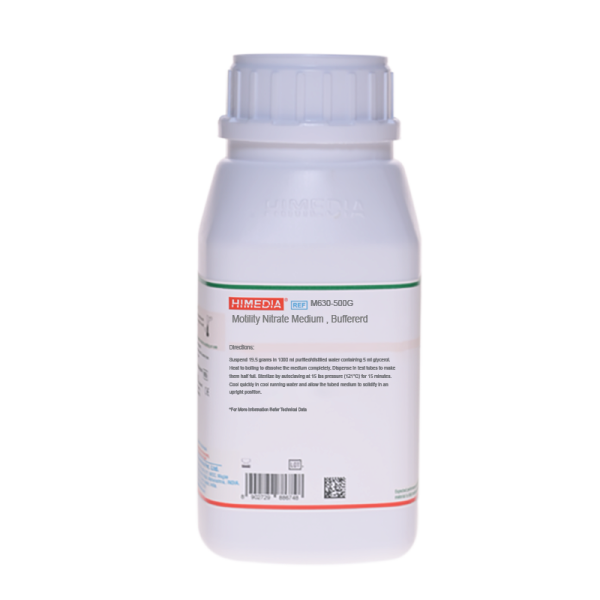
Suspend 19.5 grams in 1000 ml purified / distilled water containing 5 ml glycerol. Heat to boiling to dissolve the medium completely. Dispense in test tubes to make them half full. Sterilize by autoclaving at 15 lbs pressure (121°C) for 15 minutes. Cool quickly in cool running water and allow the tubed medium to solidify in an upright position.
Clostridium perfringens food poisoning is one of the most common type of human foodborne illness. The foods usually involved are cooked meat or poultry products containing large number of viable cells. Clostridium perfringens is a gram-positive, rod shaped anaerobic, spore-forming bacteria that produces enterotoxin. This toxin if ingested, can cause food poisoning. Motility Nitrate Medium, Buffered formulated in accordance with FDA (2) and APHA (6), is recommended for the detection of C. perfringens on the basis of motility and nitrate test.
Peptone and HM peptone B supply amino acids and other complex nitrogenous substances. Agar is added to obtain a semisolid gel that helps to demonstrate motility of the organism along the stab line of inoculation. Growth of motile organisms extends out from the line of inoculation. The medium contains 0.5% each of glycerol and galactose to improve the consistency of the nitrate reduction reaction with different strains of the organisms (3). Potassium nitrate serves as a base for nitrate reduction. A red or orange colour formation on addition of nitrate reagents indicates reduction of nitrate to nitrite.
Motility is indicated by turbidity extending out from the line of stab inoculation. Non-motile organisms grow only in the inoculated area. After 3-8 hours of incubation, a small puffball of motility may be seen around the line of inoculation. If this is not observed, tubes should be re-incubated for 24-48 hours and compared for turbidity to an un-inoculated tube. Negative motility reactions should be confirmed by a hanging drop preparation.
In the nitrate reduction test, a pink to red color develops after addition of the reagents if nitrite is present. Colour development indicates that nitrate reduction has occurred in the tube. Some organisms further reduce nitrite to ammonia that can be detected by the addition of a small amount of zinc dust to the tubes exhibiting no colour. A pink colour in this part of the test indicates no nitrate reduction. A colourless reaction indicates that nitrates have been completely reduced.
Inoculate 2 grams of food sample in 15 to 20 ml of Chopped Liver Broth (M606) or Tryptone Glucose Yeast Extract Broth (M952). After an incubation at 35-37°C for 20-24 hours, isolate on Perfringens Agar Base (TSC/SFP Agar Base) (M837). Presumptive C.perfringens colonies are confirmed biochemically by inoculating into Motility Nitrate Medium, Buffered to detect motility and nitrate reduction.
Isolated Microorganism from food and water samples
For food and dairy samples, follow appropriate techniques for sample collection and processing as per guidelines (1,6,7). For water samples, follow appropriate techniques for sample collection, processing as per guidelines and local standards.(3) After use, contaminated materials must be sterilized by autoclaving before discarding.
Read the label before opening the container. Wear protective gloves/protective clothing/eye protection/ face protection. Follow good microbiological lab practices while handling specimens and culture. Standard precautions as per established guidelines should be followed while handling specimens. Safety guidelines may be referred in individual safety data sheets.
Performance of the medium is expected when used as per the direction on the label within the expiry period when stored at recommended temperature.
Appearance
Cream to yellow homogeneous free flowing powder
Gelling
Semisolid, comparable with 0.3% Agar gel.
Colour and Clarity of prepared medium
Light amber coloured clear to slightly opalescent gel forms in tubes as butts
Reaction
Reaction of 1.95% w/v aqueous solution at 25°C. pH: 7.4±0.2
pH
7.20-7.60
Cultural Response
Cultural characteristics observed after an incubation at 35-37°C for 24-48 hours.
| Organism | Inoculum (CFU) | Growth | Motility | Nitrate reduction |
|---|---|---|---|---|
| Clostridium absonum ATCC 27555 | 50-100 | luxuriant | weakly motile | weak or negative reaction |
| Clostridium perfringens ATCC 12924 | 50-100 | luxuriant | negative, growth along the stabline, surrounding medium remains clear | positive, red-violet colour developed within 1-2 minutes |
Store between 10-30°C in a tightly closed container and the prepared medium at 15-25°C. Use before expiry date on the label. On opening, product should be properly stored dry, after tightly capping the bottle in order to prevent lump formation due to the hygroscopic nature of the product. Improper storage of the product may lead to lump formation. Store in dry ventilated area protected from extremes of temperature and sources of ignition Seal the container tightly after use. Product performance is best if used within stated expiry period.
User must ensure safe disposal by autoclaving and/or incineration of used or unusable preparations of this product. Follow established laboratory procedures in disposing of infectious materials and material that comes into contact with sample must be decontaminated and disposed of in accordance with current laboratory techniques (4,5).
| Product Name | Motility Nitrate Medium, Buffered |
|---|---|
| SKU | M630 |
| Product Type | Regular |
| Physical Form | Powder |
| Origin | Animal |
| Packaging type | HDPE |
| References | 1.Bacteriological Analytical Manual, Food and Drug Administration, 1995, 8th Ed., AOAC International, Gaithersburg, Md.,USA. 2.Downes F. P. and Ito K., (Ed.), 2001, Compendium of Methods for the Microbiological Examination of Foods, 4th Ed.,American Public Health Association, Washington, D.C. |
| Customized Product Available | No |