Plot No. C40, Road No. 21Y, MIDC, Wagle Industrial Estate,
Thane(W)-400604, MH, India.
Plot No. C40, Road No. 21Y, MIDC, Wagle Industrial Estate,
Thane(W)-400604, MH, India.

 Your enquiry has been submitted
Something problem with the server. Try again.

For rapid, selective isolation of Clostridium botulinum from food and clinical samples.
| Ingredients | g/L |
|---|---|
| Tryptone | 40.000 |
| Yeast extract | 5.000 |
| Dextrose (Glucose) | 2.000 |
| Disodium hydrogen phosphate | 5.000 |
| Sodium chloride | 2.000 |
| Magnesium sulphate | 0.010 |
| Agar | 20.000 |
| Final pH (at 25°C) | 7.4±0.2 |
**Formula adjusted, standardized to suit performance parameters
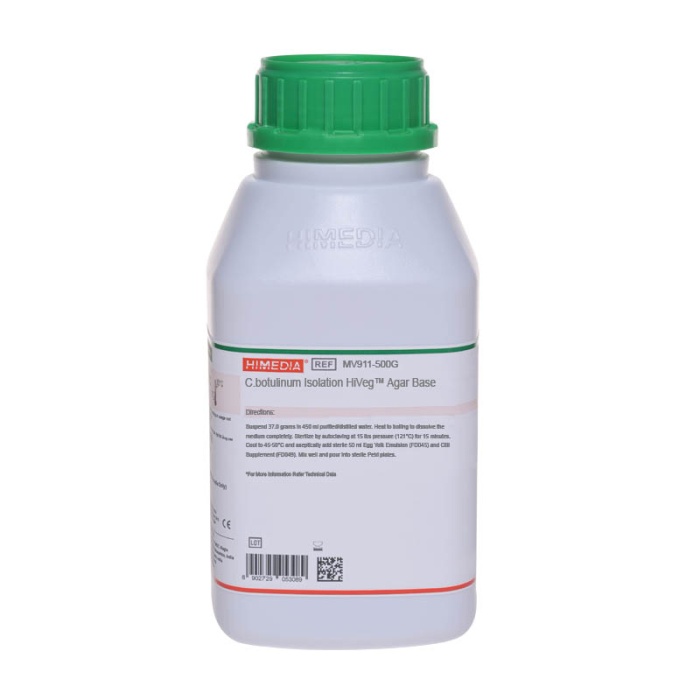
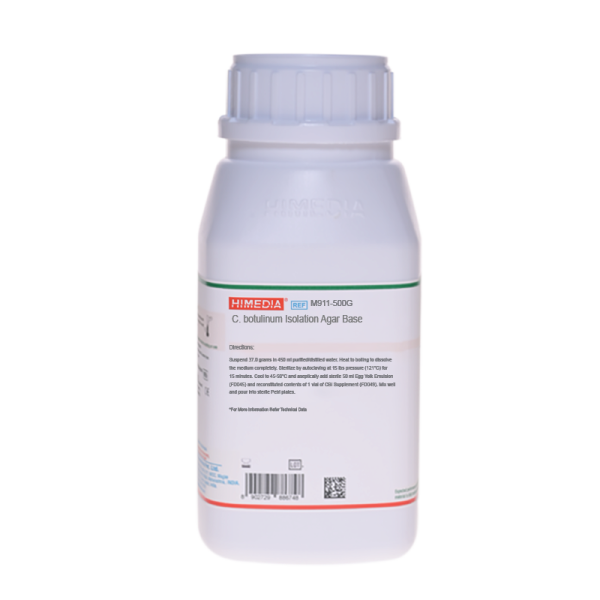
Suspend 37.0 grams in 450 ml purified / distilled water. Heat to boiling to dissolve the medium completely. Sterilize by autoclaving at 15 lbs pressure (121°C) for 15 minutes. Cool to 45-50°C and aseptically add sterile 50 ml Egg Yolk Emulsion (FD045) and reconstituted contents of 1 vial of CBI Supplement (FD049). Mix well and pour into sterile Petri plates.
Clostridium botulinum is an anaerobic, spore forming bacteria that produces a neurotoxin protein botulin. Severe food poisoning results from the consumption of this protein (toxin), which may be produced in foods contaminated with Clostridium botulinum. C.botulinum Isolation Agar Base is formulated as per the recommendation of APHA (1) for the selective isolation of C.botulinum from food samples.
The antibiotic supplement (FD049) containing the broad spectrum antibiotics namely cycloserine, sulphamethoxazole and trimethoprim makes the medium very selective. Egg yolk emulsion helps in detecting lecithinase, lipase and proteolytic activity. Lecithinase degrades lecithin present in the egg yolk producing an insoluble, opaque precipitate in the medium surrounding the growth (2). Lipase break down free fats present in the egg yolk causing an iridescent (oil on water) sheen to form on the surface of the colonies. Tryptone and yeast extract supply amino acids and other nitrogenous substances and vitamin B complex. Dextrose is the fermentable carbohydrate. Disodium phosphate helps in buffering the medium while magnesium sulphate helps for the sporulation of the organisms. Sodium chloride maintains the osmotic equilibrium of the medium.
Botulinal toxin is heat-labile. Therefore the test samples and cultures should be maintained at refrigeration temperatures. The pH of the toxic material should also be maintained at a slightly acidic pH since botulinal toxin is less stable at alkaline pH. Inoculate 1-2 grams of solid or 1-2 ml of liquid food per 15 ml of enrichment broth. The enrichment broth employed is Cooked Meat Medium (M149). After an incubation at 35°C for 7 days, observe for turbidity, gas production and meat digestion. Carry out gram staining and spore staining. To isolate C.botulinum mix enrichment broth with equal amount of sterile ethanol (alcohol treatment). The alcohol treated culture is further streaked on C.botulinum Isolation Agar Base (M911) Alternatively untreated enrichment cultures or stool can be streaked directly on C.botulinum Isolation Agar Base (1).
Food samples; Clinical samples - stool samples, abscess, etc.
For clinical samples follow appropriate techniques for handling specimens as per established guidelines (3,4).
For food and dairy samples, follow appropriate techniques for sample collection and processing as per guidelines (1,5,6).
After use, contaminated materials must be sterilized by autoclaving before discarding.
In Vitro diagnostic Use. For professional use only. Read the label before opening the container. Wear protective gloves/protective clothing/eye protection/ face protection. Follow good microbiological lab practices while handling specimens and culture. Standard precautions as per established guidelines should be followed while handling clinical specimens. Safety guidelines may be referred in individual safety data sheets.
Performance of the medium is expected when used as per the direction on the label within the expiry period when stored at recommended temperature.
Appearance
Cream to yellow homogeneous free flowing powder
Gelling
Firm, comparable with 2.0% Agar gel.
Colour and Clarity of prepared medium
Basal medium: Yellow coloured clear to slightly opalescent gel. After addition of egg yolk emlusion: Light yellow coloured, opaque gel forms in Petri plates
Reaction
Reaction of medium (7.4 gm in 90 ml distilled water) at 25°C. pH: 7.4±0.2
pH
7.20-7.60
Cultural characteristics observed under anaerobic condition, with added Egg Yolk Emulsion (FD045) and CBI Supplement (FD049), after an incubation at 35-37°C for 48 hours.
| Organism | Inoculum (CFU) | Growth | Recovery | Lecithinase |
|---|---|---|---|---|
| Clostridium botulinum ATCC 25763 | 50-100 | good-luxuriant | >=50% | positive reaction, opaque zone around the colony |
Store between 10-30°C in a tightly closed container and the prepared medium at 2-8°C. Use before expiry date on the label. On opening, product should be properly stored dry, after tightly capping the bottle in order to prevent lump formation due to the hygroscopic nature of the product. Improper storage of the product may lead to lump formation. Store in dry ventilated area protected from extremes of temperature and sources of ignition Seal the container tightly after use. Product performance is best if used within stated expiry period.
User must ensure safe disposal by autoclaving and/or incineration of used or unusable preparations of this product. Follow established laboratory procedures in disposing of infectious materials and material that comes into contact with clinical sample must be decontaminated and disposed of in accordance with current laboratory techniques (3,4).
| Product Name | C. botulinum Isolation Agar Base |
|---|---|
| SKU | M911 |
| Product Type | Regular |
| Physical Form | Powder |
| Origin | Animal |
| Packaging type | HDPE |
| References | 1. Vanderzant C. and Splittstoesser D. F., (Eds.), 1992, Compendium of Methods for the Microbiological Examination of foods,3rd Ed., APHA, Washington, D.C. |
| Customized Product Available | No |