Plot No. C40, Road No. 21Y, MIDC, Wagle Industrial Estate,
Thane(W)-400604, MH, India.
Plot No. C40, Road No. 21Y, MIDC, Wagle Industrial Estate,
Thane(W)-400604, MH, India.

 Your enquiry has been submitted
Something problem with the server. Try again.

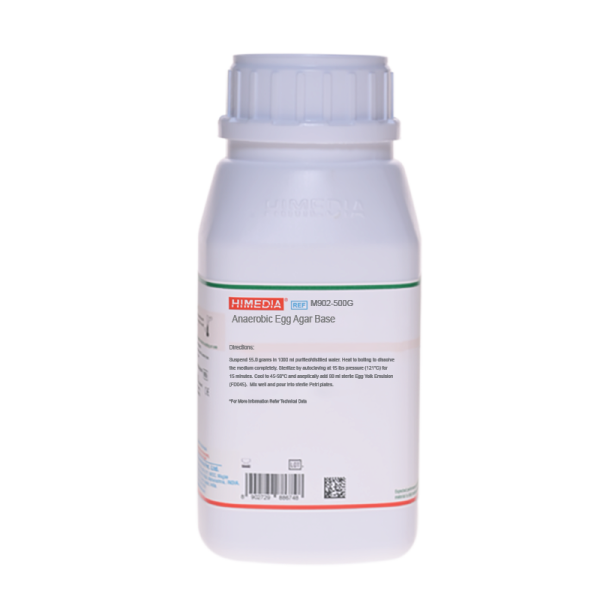
Anaerobic Egg Agar Base supplemented with egg yolk emulsion is recommended for detection of Clostridium perfringens in foods.
| Ingredients | Gms/Litre |
|---|---|
| Proteose peptone | 20.000 |
| Tryptone | 5.000 |
| Yeast extract | 5.000 |
| Sodium chloride | 5.000 |
| Agar | 20.000 |
| Final pH (at 25°C) | 7.0±0.2 |
**Formula adjusted, standardized to suit performance parameters
Suspend 55 grams in 1000 ml purified / distilled water. Heat to boiling to dissolve the medium completely. Sterilize by autoclaving at 15 lbs pressure (121°C) for 15 minutes. Cool to 45-50°C and aseptically add 80 ml sterile Egg Yolk Emulsion (FD045). Mix well and pour into sterile Petri plates.
Clostridium perfringens, ranked behind Salmonella species and Staphylococcus aureus, has been the third most common etiological agent of food-borne disease (2). Clostridium species are spore forming, gram-positive rods occurring naturally in soil (3). C. perfringens food poisoning results from eating contaminated food. The major virulence factor of C. perfringens is the CPE enterotoxin, which is secreted upon invasion of the host gut, and contributes to food poisoning and other gastrointestinal illnesses (3). C.perfringens cells may lose viability if the suspected food samples are refrigerated, thereby making it difficult to incriminate the organisms in food poisoning outbreaks (9). Anaerobic Egg Agar is one of the media recommended by APHA (8) for detecting C. perfringens in foods. Tryptone and proteose peptone supply long chain amino acids and other complex nitrogenous nutrients. Yeast extract provides essential B-complex vitamins. Egg yolk emulsion is added to the medium by which the lipase and lecithinase activity can be observed. Lecithinase of C. perfringens degrades lecithin of egg yolk, forming an insoluble opaque precipitate (4). Lipase breaks down free fats present in the egg yolk causing iridescent sheen to form on the colony surface. For the lipase reaction, plates may be kept upto a week for incubation (4). Proteolysis is indicated by clear zones in the medium surrounding the growth (7).
Food and dairy samples
For food and dairy samples, follow appropriate techniques for sample collection and processing as per guidelines (1,8). After use, contaminated materials must be sterilized by autoclaving before discarding.
Read the label before opening the container. Wear protective gloves/protective clothing/eye protection/ face protection. Follow good microbiological lab practices while handling specimens and culture. Standard precautions as per established guidelines should be followed while handling specimens. Safety guidelines may be referred in individual safety data sheets.
Performance of the medium is expected when used as per the direction on the label within the expiry period when stored at recommended temperature.
Appearance
Cream to yellow homogeneous free flowing powder
Gelling
Firm, comparable with 2.0% Agar gel.
Colour and Clarity of prepared medium
Basal medium -Light yellow coloured, clear to very slightly opalescent gel. After addition of Egg Yolk Emulsion -Light yellow coloured, opaque gel forms in Petri plates
Reaction
Reaction of 5.5% w/v aqueous solution at 25°C. pH: 7.0±0.2
pH
6.80-7.20
Cultural characteristics observed with addded Egg Yolk Emulsion (FD045) when incubated anaerobically, at 35-37°C for 18-24 hours.
| Organism | Inoculum (CFU) | Growth | Recovery | Lecithinase | Lipase |
|---|---|---|---|---|---|
| Clostridium perfringens ATCC 12924 | 50-100 | good-luxuriant | >=50% | positive reaction, opaque zone around the colony | negative reaction |
| Clostridium sporogenes ATCC 11437 | 50-100 | good-luxuriant | >=50% | negative reaction | positive reaction, irridescent sheen on the colony |
Store between 10-30°C in a tightly closed container and the prepared medium at 20-30°C. Use before expiry date on the label. On opening, product should be properly stored dry, after tightly capping the bottle in order to prevent lump formation due to the hygroscopic nature of the product. Improper storage of the product may lead to lump formation. Store in dry ventilated area protected from extremes of temperature and sources of ignition Seal the container tightly after use. Product performance is best if used within stated expiry period.
User must ensure safe disposal by autoclaving and/or incineration of used or unusable preparations of this product. Follow established laboratory procedures in disposing of infectious materials and material that comes into contact with sample must be decontaminated and disposed of in accordance with current laboratory techniques (5,6).
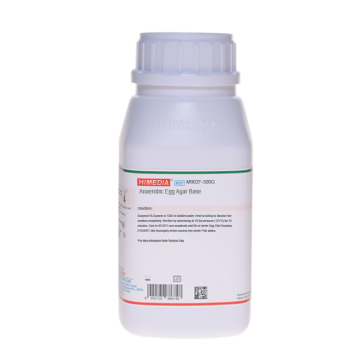
| Product Name | Anaerobic Egg Agar Base |
|---|---|
| SKU | M902 |
| Product Type | Regular |
| Physical Form | Powder |
| Origin | Animal |
| Packaging type | HDPE |
| References | 1. Centre for Disease Control, 1982, CDC Surveillance Summaries, 35:7SS-16SS, 1986. |
| Customized Product Available | No |