Plot No. C40, Road No. 21Y, MIDC, Wagle Industrial Estate,
Thane(W)-400604, MH, India.
Plot No. C40, Road No. 21Y, MIDC, Wagle Industrial Estate,
Thane(W)-400604, MH, India.

 Your enquiry has been submitted
Something problem with the server. Try again.
 Your enquiry has been submitted
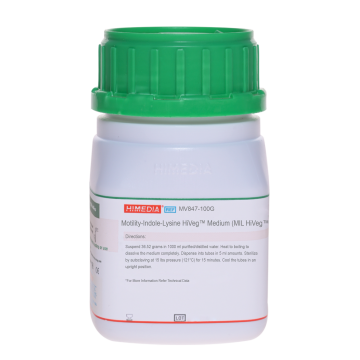
Recommended for identification of members of Enterobacteriaceae on the basis of motility, lysine decarboxylase, lysine deaminase and indole production.
| Ingredients | g/L |
|---|---|
| Peptone | 10.000 |
| Tryptone | 10.000 |
| Yeast extract | 3.000 |
| L-Lysine hydrochloride | 10.000 |
| Dextrose (Glucose) | 1.000 |
| Ferric ammonium citrate | 0.500 |
| Bromocresol purple | 0.020 |
| Agar | 2.000 |
| Final pH (at 25°C) | 6.6±0.2 |
**Formula adjusted, standardized to suit performance parameters
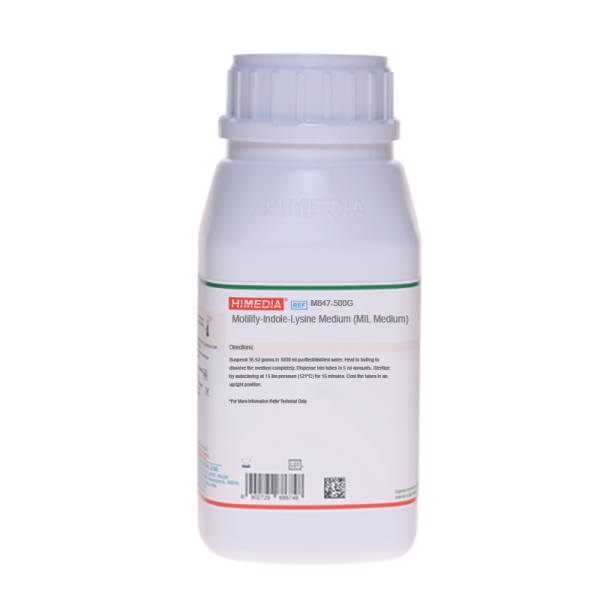
Suspend 36.52 grams in 1000 ml purified / distilled water. Heat to boiling to dissolve the medium completely. Dispense into tubes in 5 ml amounts. Sterilize by autoclaving at 15 lbs pressure (121°C) for 15 minutes. Cool the tubes to 45-50°C in an upright position.
MIL Medium is prepared as per the formulation of Reller and Merrett (1). It is a highly useful medium in the identification of Enterobacteriaceae as it provides four differential reactions in a single culture tube. It is recommended to be used along with Triple Sugar Iron Agar (TSI) (M021) and Urea Agar (M112) so as to enable presumptive identification of members of Enterobacteriaceae from faecal specimens (2-5).
Peptone, Tryptone and yeast extract supply amino acids and other complex nitrogenous substances. Dextrose is a source of energy. A small amount of agar is added for demonstration of motility along the stab line of inoculation. Growth of motile organisms extends out from the line of inoculation, while non-motile organisms grow only along the stab line. Bromocresol purple serves as the pH indicator.
When inoculated with an organism that ferments dextrose, acids are produced that lower the pH, causing the indicator in the medium to change from purple to yellow. The acidic pH also stimulates decarboxylase enzyme activity. Organisms that possess a specific decarboxylase degrade the amino acid provided in the medium, yielding a corresponding amine. Lysine decarboxylation yields cadaverine. The production of these amines elevates the pH and causes the medium in the bottom portion of the tube to revert to a purple color. The medium in the upper portion of the tube remains acidic because of the higher oxygen tension. If the organism being tested does not produce the required decarboxylase, the medium remains yellow (acidic) throughout or yellow with a purple or red reaction near the top. Lysine deamination produces a colour change in the upper portion of the medium. Oxidative deamination of lysine yields a compound that reacts with ferric ammonium citrate, producing a burgundy red or red-brown color in the top centimeter of the medium (the bottom portion of the medium remains acidic) (3).
This reaction can only be detected if lysine decarboxylase is not produced, which is the case with Proteus, Morganella and Providencia species. Indole is produced in this medium by organisms that possess the enzyme tryptophanase. Tryptophanase degrades typtophan present in the casein peptone, yielding indole. It can be detected in the medium by adding Kovacs reagent to the agar surface. Indole combines with the p-dimethylaminobenzaldehyde of Kovacs reagent and produces a red complex. Cultures are stab-inoculated and incubated at 37°C for 18-24 hours. Motility, lysine deamination and lysine decarboxylation reactions are read before testing indole reaction, since addition of Kovacs reagent causes the colour of the medium to change to yellow. Therefore positive lysine decarboxylase reaction could be misinterpreted as negative.
Isolated Microorganism from clinical and non-clinical samples
For clinical samples follow appropriate techniques for handling specimens as per established guidelines (6,7). After use, contaminated materials must be sterilized by autoclaving before discarding.
In Vitro diagnostic use only. For professional use only. Read the label before opening the container. Wear protective gloves/protective clothing/eye protection/ face protection. Follow good microbiological lab practices while handling specimens and culture. Standard precautions as per established guidelines should be followed while handling clinical specimens. Safety guidelines may be referred in individual safety data sheets.
Performance of the medium is expected when used as per the direction on the label within the expiry period when stored at recommended temperature.
Appearance
Cream to greenish yellow homogeneous free flowing powder
Gelling
Semisolid, comparable with 0.2% Agar gel.
Colour and Clarity of prepared medium
Reddish purple coloured clear to slightly opalescent gel forms in tubes as butts
Reaction
Reaction of 3.65% w/v aqueous solution at 25°C. pH: 6.6±0.2
pH
6.40-6.80
Cultural characteristics observed after an incubation at 35-37°C for 18-24 hours.
| Organism | Motility | Indole production | Lysine Deaminase | Lysine decarboxylase |
|---|---|---|---|---|
| # Klebsiella aerogenes ATCC 13048 (00175*) | positive, growth away from stabline | negative reaction | negative | positive reaction, purple colour |
| Escherichia coli ATCC 25922 (00013*) | positive, growth away from stabline | positive, red ring at the interface of the medium on addition of Kovac's reagent | negative | positive reaction, purple colour |
| Klebsiella pneumoniae ATCC 13883 (00097*) | negative, occasional growth along the stabline | negative reaction | negative | positive reaction, purple colour negative reaction |
| Proteus mirabilis ATCC 25933 | positive, growth away from stabline | negative reaction | positive reaction, red-brown colour reaction at the top | |
| Shigella flexneri ATCC 12022 (00126*) | negative, growth along the stabline | occasional reaction | negative | negative reaction |
| ## Proteus hauseri ATCC 13315 | positive, growth away from stabline | positive reaction, red ring at the interface of the medium on addition of Kovac's reagent | positive reaction, red-brown colour reaction at the top | negative reaction |
| Salmonella Enteritidis ATCC 13076 (00030*) | positive, growth away from stabline | negative reaction | negative | positive reaction, purple colour |
Key: *Corresponding WDCM numbers
## Formerly known as Proteus vulgaris
(#) Formerly known as Enterobacter aerogenes
Store between 10-30°C in a tightly closed container and the prepared medium at 20 - 30°C. Use before expiry date on the label. On opening, product should be properly stored dry, after tightly capping the bottle in order to prevent lump formation due to the hygroscopic nature of the product. Improper storage of the product may lead to lump formation. Store in dry ventilated area protected from extremes of temperature and sources of ignition Seal the container tightly after use. Product performance is best if within stated expiry period.
User must ensure safe disposal by autoclaving and/or incineration of used or unusable preparations of this product. Follow established laboratory procedures in disposing of infectious materials and material that comes into contact with clinical sample must be decontaminated and disposed of in accordance with current laboratory techniques (6,7).
| Product Name | Motility-Indole-Lysine Medium (MIL Medium) |
|---|---|
| SKU | M847 |
| Product Type | Regular |
| Physical Form | Powder |
| Origin | Animal |
| Packaging type | HDPE |
| References | 1. Reller L. B. and Mirrett S., 1975, J. Clin. Microbiol., 2:247. |
| Customized Product Available | No |