Plot No. C40, Road No. 21Y, MIDC, Wagle Industrial Estate, Thane(W)-400604, MH, India

 Your enquiry has been submitted
Something problem with the server. Try again.

| Ingredients | Gms/Litre |
|---|---|
| Casein enzymic hydrolysate | 10.000 |
| Yeast extract | 5.000 |
| Sucrose | 10.000 |
| Dipotassium phosphate | 2.000 |
| Agar | 15.000 |
| Final pH (at 25°C) | 6.8±0.2 |
**Formula adjusted, standardized to suit performance parameters
Suspend 42 grams in 1000 ml distilled water. Heat to boiling to dissolve the medium completely. Sterilize by autoclaving at 15 lbs pressure (121°C) for 15 minutes.
Yoghurt is a fermented milk product in which Streptococcus thermophilus and Lactobacillus bulgaricus are the essential microbial species and are active in a symbiotic relationship. To obtain optimum consistency, flavour and odour, the two species should be present in about equal numbers in the culture. Dominance by either species can cause defects. Equal numbers of both the species produce desirable yoghurt.
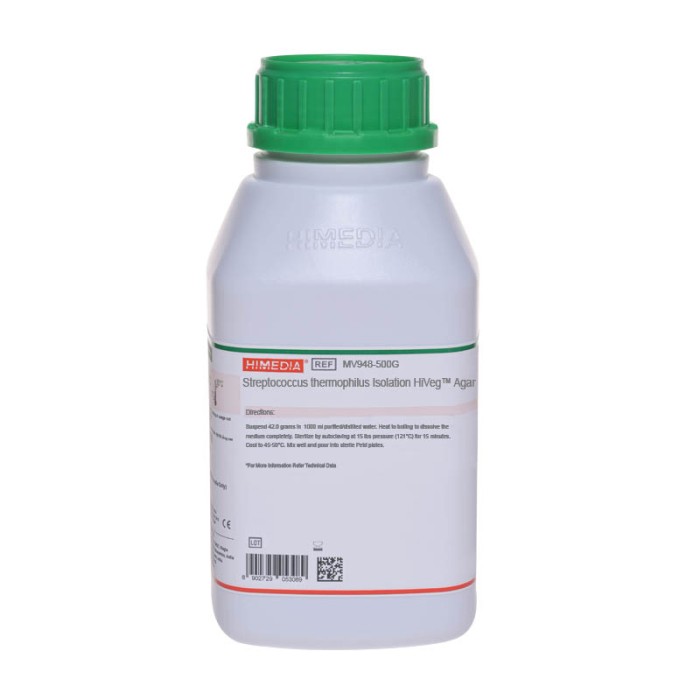
Streptococcus Thermophilus Isolation Agar, recommended by APHA (1), is used for determining the ratio of S. thermophilus and L. bulgaricus in yoghurt.
Streptococcus Thermophilus Isolation Agar is based on the formulation originally developed by Lee et al (2). However later on Driessen et al (3) reported two separate media to enumerate cocci and rods respectively from mixed cultures where S. thermophilus is grown on Streptococcus Thermophilus Isolation Agar (M948) and L. bulgaricus is cultivated on Lactococcus Bulgaricus Agar (LB Agar, M927).
The medium contains sucrose, which is not fermented by majority of the L. bulgaricus strains but is readily utilized by S. thermophilus. However if lactose is incorporated in this medium it is utilized by both the species. With a suitable combination of sucrose and lactose, the rate of acid production by S. thermophilus is enhanced while that of L. bulgaricus is restricted. Casein enzymic hydrolysate and yeast extract provide nitrogenous nutrients, vitamin B complex and trace elements for the growth of S. thermophilus. Dipotassium phosphate prevents pH imbalance in the medium.
Appearance
Cream to yellow homogeneous free flowing powder
Gelling
Firm, comparable with 1.5% Agar gel
Colour and Clarity of prepared medium
Light yellow coloured clear to slightly opalescent gel forms in Petri plates
Reaction
Reaction of 4.2% w/v aqueous solution at 25°C. pH: 6.8±0.2
pH
6.60-7.00
M948: Cultural characteristics observed after an incubation at 35-37°C for 48-72 hours.
| Organism | Inoculum (CFU) | Growth | Recovery |
|---|---|---|---|
| Lactobacillus bulgaricus ATCC 11842 | 50-100 | luxuriant | >=50% |
| Streptococcus thermophilus ATCC 14485 | 50-100 | luxuriant | >=50% |
Store below 30°C in tightly closed container and the prepared medium at 2 - 8°C. Use before expiry date on the label.
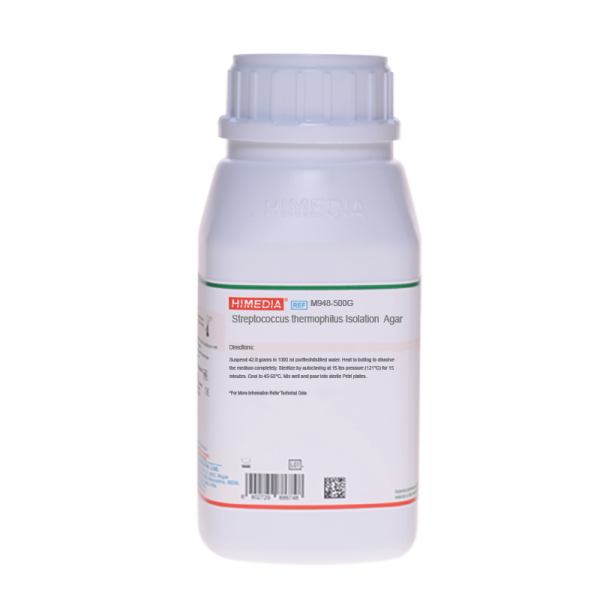
| Product Name | Streptococcus thermophilus Isolation Agar |
|---|---|
| SKU | M948 |
| Product Type | Regular |
| Physical Form | Powder |
| Origin | Animal |
| Packaging type | HDPE |
| References | 1. Downes F. P. and Ito K., (Eds.), 2001, Compendium of Methods for the Microbiological Examination of Foods, 4th Ed.,APHA, Washington, D.C. |