Plot No. C40, Road No. 21Y, MIDC, Wagle Industrial Estate, Thane(W)-400604, MH, India

 Your enquiry has been submitted
Something problem with the server. Try again.

Recommended for selective enrichment of Salmonella species
| Ingredients | g / L |
|---|---|
| Peptone | 5.000 |
| Yeast extract | 5.000 |
| Buffer mixture | 10.000 |
| Growth mixture | 5.000 |
Final pH ( at 25°C) 7.0±0.2
**Formula adjusted, standardized to suit performance parameters
Suspend 25 grams in 1000 ml purified / distilled water. Heat if necessary to dissolve the medium completely. Sterilize by autoclaving at 15 lbs pressure (121°C) for 15 minutes. Cool to 45-50°C and aseptically add the rehydrated contents of one vial of NO 12 Selective Supplement (FD275). Mix well and dispense as desired.
Salmonella are ubiquitous in the environment. These organisms are usually present in small numbers compared to coliforms; therefore it is necessary to examine a relatively large sample to isolate the organisms (1). Salmonella present in food samples may be sublethally damaged during various stages of food processing where they may be exposed to low temperatures, heat drying, radiations, various chemicals (2). These damaged cells are able to cause spoilage, and if ingested cause diseases under favourable conditions. Therefore it is important to resuscitate these damaged bacteria before enumeration.
Salmonella Enrichment Broth Base is recommended for the selective enrichment of Salmonella species within 18-24 hours.
Food samples.
For food samples, follow appropriate techniques for sample collection and processing as per guidelines (3).
After use, contaminated materials must be sterilized by autoclaving before discarding.
Read the label before opening the container. Wear protective gloves/protective clothing/eye protection/ face protection. Follow good microbiological lab practices while handling specimens and culture. Standard precautions as per established guidelines should be followed while handling specimens. Safety guidelines may be referred in individual safety data sheets.
Performance of the medium is expected when used as per the direction on the label within the expiry period when stored at recommended temperature.
Appearance Cream to yellow homogeneous free flowing powder
Colour and clarity of prepared medium Light yellow coloured clear solution without any precipitate
Reaction Reaction of 2.5% w/v aqueous solution 25°C. pH : 7.0±0.2
pH 6.80-7.20
Cultural Response Cultural characteristics observed with added NO 12 Selective Supplement (FD275) after an incubation at 35-37°C for 18-24 hours.
| Organism | Inoculum (CFU) | Growth |
|---|---|---|
| Salmonella Typhimurium ATCC 14028 (00031*) | 50 -100 | good-luxuriant |
| Salmonella Enteritidis ATCC 13076 (00030*) | 50 -100 | good-luxuriant |
| Salmonella Abony NCTC 6017 (00029*) | 50 -100 | good-luxuriant |
| Staphylococcus aureus subsp. aureus ATCC 25923 (00034*) | >=104 | inhibited |
Key : (*) Corresponding WDCM numbers.
Store between 10-30°C in a tightly closed container and the prepared medium at 2-8°C. Use before expiry date on the label. On opening, product should be properly stored dry, after tightly capping the bottle in order to prevent lump formation due to the hygroscopic nature of the product. Improper storage of the product may lead to lump formation. Store in dry ventilated area protected from extremes of temperature and sources of ignition Seal the container tightly after use. Product performance is best if used within stated expiry period.
User must ensure safe disposal by autoclaving and/or incineration of used or unusable preparations of this product. Follow established laboratory procedures in disposing of infectious materials and material that comes into contact with sample must be decontaminated and disposed of in accordance with current laboratory techniques (4,5).
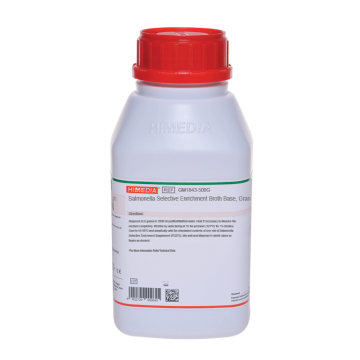
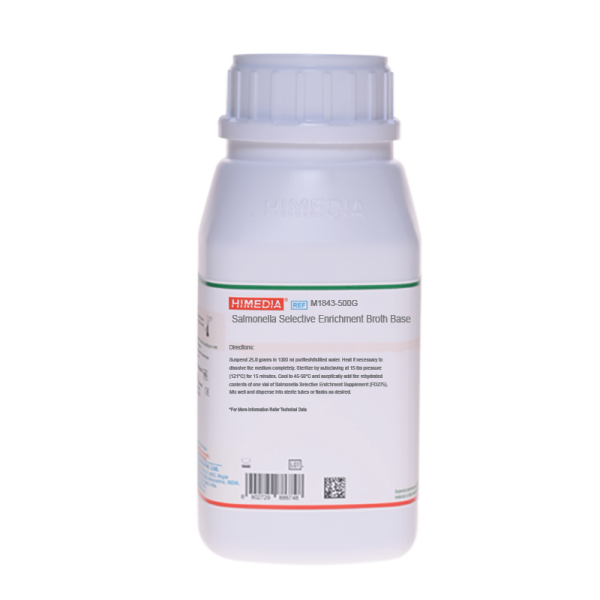
| Product Name | Salmonella Selective Enrichment Broth base |
|---|---|
| SKU | M1843 |
| Product Type | Regular |
| Physical Form | Powder |
| Origin | Animal |
| Packaging type | HDPE |
| References | 1.Murray P. R., Baron J. H., Pfaller M. A., Jorgensen J. H. and Yolken R. H., (Ed.), 2003, Manual of Clinical Microbiology,8th Ed., American Society for Microbiology, Washington, D.C.2.Rambach A., 1990, Appl. Environ. Microbiol., 56:301. |