Plot No. C40, Road No. 21Y, MIDC, Wagle Industrial Estate, Thane(W)-400604, MH, India


 Your enquiry has been submitted
Something problem with the server. Try again.
 Your enquiry has been submitted
Recommended for differentiating Salmonella arizonae from the Bethesda Ballerup group of Enterobacteriaceae.
| Ingredients | g / L |
|---|---|
| Peptone | 5.000 |
| Yeast extract | 3.000 |
| Dextrose (Glucose) | 1.000 |
| L-Lysine hydrochloride | 5.000 |
| Bromocresol purple | 0.020 |
Final pH ( at 25°C): 6.8±0.2
**Formula adjusted, standardized to suit performance parameters
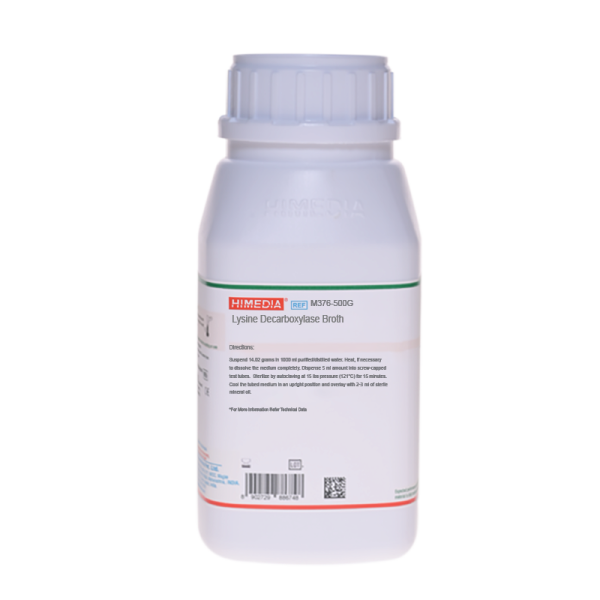
Suspend 14.02 grams in 1000 ml purified / distilled water. Heat, if necessary to dissolve the medium completely. Dispense 5 ml amount into screw-capped test tubes. Sterilize by autoclaving at 15 lbs pressure (121°C) for 15 minutes. Cool the tubed medium in an upright position and overlay with 2-3 ml of sterile mineral oil.
Decarboxylase media were first described by Moeller (1,2,3) for detecting lysine and ornithine decarboxylase and arginine dihydrolase. Falkow developed a lysine decarboxylase medium for the identification and differentiation of Salmonella and Shigella (4). Lysine Decarboxylase Broth is especially suited to study the decarboxylase reactions for members of Enterobacteriaceae other than Klebsiella and Enterobacter. Lysine Decarboxylase Broth is also recommended by APHA (5,6) and other standard methods (5,7).
During the initial stages of incubation, following inoculation, fermentation of dextrose by the organisms leads to acid production, which causes a subsequent colour change of the bromocresol purple indicator to yellow. The acidic condition thus generated stimulates decarboxylase activity, which leads to decarboxylation of lysine to cadaverine. The alkaline conditions generated due to cadaverine production cause the bromocresol purple indicator (changed to yellow) to revert to purple colour. If the organisms do not produce decarboxylase enzyme, the colour of the medium remains yellow. Dextrose non-utilizers will not show any change in the medium colour. Use light inocula and do not read the tests after 24 hours incubation, as some organisms require longer incubation time of upto 4 days.
Clinical samples, Food samples; Water samples.
For clinical samples follow appropriate techniques for handling specimens as per established guidelines (4,8).
For food samples, follow appropriate techniques for sample collection and processing as per guidelines (7). For water samples, follow appropriate techniques for sample collection, processing as per guidelines and local standards. (6) After use, contaminated materials must be sterilized by autoclaving before discarding.
In Vitro diagnostic device. For professional use only. Read the label before opening the container. Wear protective gloves/protective clothing/eye protection/ face protection. Follow good microbiological lab practices while handling specimens and culture. Standard precautions as per established guidelines should be followed while handling specimens. Safety guidelines may be referred in individual safety data sheets.
Performance of the medium is expected when used as per the direction on the label within the expiry period when stored at recommended temperature.
Appearance Light yellow to greenish yellow homogeneous free flowing powder
Colour and Clarity of prepared medium Purple coloured clear solution without any precipitate
Reaction Reaction of 1.4% w/v aqueous solution at 25°C. pH : 6.8±0.2
pH 6.60-7.00
Cultural characteristics observed after an incubation at 35-37°C for 18-24 hours. (Inoculated tubes are overlayed with sterile mineral oil).
| Organism | Lysine decarboxylation |
|---|---|
| Citrobacter freundii ATCC 8090 | variable reaction |
| Escherichia coli ATCC 25922 (00013*) | variable reaction |
| # Klebsiella aerogenes ATCC 13048 (00175*) | positive reaction, purple colour |
| Klebsiella pneumoniae ATCC 13883 (00097*) | positive reaction, purple colour |
| Proteus mirabilis ATCC 25933 | negative reaction, yellow colour |
| $ Proteus hauseri ATCC 13315 | negative reaction, yellow colour |
| Salmonella Arizonae ATCC 13314 | Positive reaction, purple colour |
| Salmonella Paratyphi A ATCC 9150 | negative reaction, yellow colour |
| Salmonella Typhi ATCC 6539 | positive reaction, purple colour |
| Serratia marcescens ATCC 8100 | positive reaction, purple colour |
| Shigella dysenteriae ATCC 13313 | negative reaction, yellow colour |
Key : (*) Corresponding WDCM numbers. (#) Formerly known as Enterobacter aerogenes $ Formerly known as Proteus vulgaris
Store between 10-30°C in a tightly closed container and the prepared medium at 15-30°C. Use before expiry date on the label. On opening, product should be properly stored dry, after tightly capping the bottle in order to prevent lump formation due to the hygroscopic nature of the product. Improper storage of the product may lead to lump formation. Store in dry ventilated area protected from extremes of temperature and sources of ignition. Seal the container tightly after use. Product performance is best if used within stated expiry period.
User must ensure safe disposal by autoclaving and/or incineration of used or unusable preparations of this product. Follow established laboratory procedures in disposing of infectious materials and material that comes into contact with sample must be decontaminated and disposed of in accordance with current laboratory techniques (4,8).
| Product Name | Lysine Decarboxylase Broth |
|---|---|
| SKU | M376 |
| Product Type | Regular |
| Physical Form | Powder |
| Origin | Animal |
| Packaging type | HDPE |
| References | 1. Murray P. R., Baron J. H., Pfaller M. A., Jorgensen J. H. and Yolken R. H., (Eds.), 2003, Manual of Clinical Microbiology,8th Ed., American Society for Microbiology, Washington, D.C. 2.Carter G. R., 1979, Diagnostic Procedures in Veterinary Bacteriology and Mycology, 3rd Ed., Charles C., Thomas,Springfield, III. 3.Cleveland L. R. and Sanders E. P., 1930, Arch. Protietenkd. 70:223. 4.Forbes B. A., Sahm A. S., and Weissfeld D. F., Bailey & Scotts Diagnostic Microbiology, 10th Ed., 1998, Mosby, Inc., St. Louis, Mo. 5.Isenberg H. D., (Ed.), 1995, Clinical Microbiology Procedures Handbook, Vol. I, ASM, Washington, D.C. |