HiMedia Laboratories GmbH, Marie-Curie-Str. 3, 64683, Einhausen, Germany.

 Your enquiry has been submitted
Something problem with the server. Try again.
 Your enquiry has been submitted
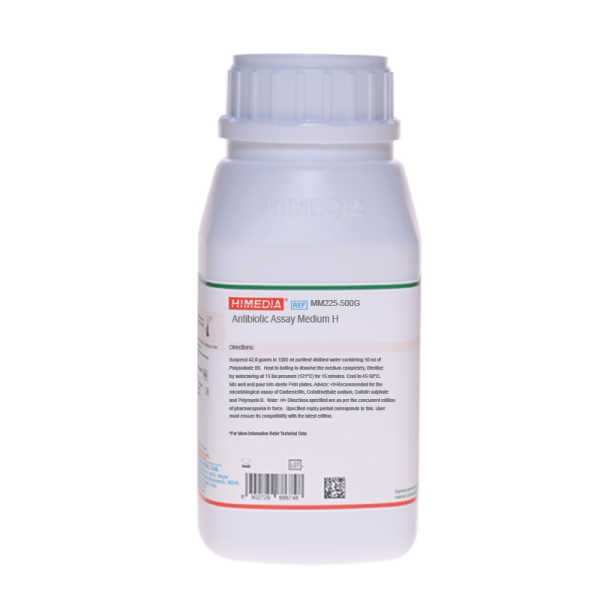
Antibiotic Assay Medium H is used as seed layer for microbiological assay of Carbenicillin, Colistimethate sodium, Colistin sulphate and Polymyxin B in accordance with Indian Pharmacopoeia.
| Ingredients | Gms / Litre |
|---|---|
| Tryptone # | 17.000 |
| Soya peptone ## | 3.000 |
| Dextrose (Glucose) | 2.500 |
| Sodium chloride | 5.000 |
| Dipotassium hydrogen phosphate | 2.500 |
| Agar | 12.000 |
| Final pH (after sterilization) | 7.2±0.1 |
**Formula adjusted, standardized to suit performance parameters
# Pancreatic digest of casein
## Papaic digest of soyabean
Suspend 42 grams in 1000 ml purified / distilled water containing 10 ml of Polysorbate 80. Heat to boiling to dissolve the medium completely. Sterilize by autoclaving at 15 lbs pressure (121°C) for 15 minutes or as per validated cycle. Cool to 45-50°C. Mix well and pour into sterile Petri plates.
This medium is used as seed agar for assay of Carbenicillin, Colistimethate sodium, Colistin sulphate and Polymyxin B. The medium composition is in accordance to IP and CFR (4,7) and numerically identical with the name assigned by Groove and Randall (3).
Combination of tryptone and soya peptone provides nitrogenous and carbonaceous compounds, long chain amino acids, vitamins and other essential nutrients for the growth of test organisms. Natural soya sugars enhance microbial growth. Dextrose (Glucose) provides the carbon source, enhances the growth of test organism. Phosphates in the medium enhance buffering action and sodium chloride maintains osmotic equilibrium. Polymyxin are reported to have slow diffusion in agar giving smaller zone of inhibition (1). Hence the reduced agar concentration (1.2%) in this medium improves the diffusion of polymyxin in the medium. Polysorbate 80 are reported to function synergistically with polymyxin on spheroplasts of Pseudomonas aeruginosa. Polysorbate 80 enhances the penetration of Polymyxin to the cytoplasmic membrane and hence is an appropriate ingredient in the medium used for assay of Polymyxin (2). Freshly prepared plates should be used for antibiotic assays. Test organisms are inoculated in sterile seed agar pre-cooled to 40-45°C and spread evenly over the surface of solidified base agar. All conditions in the microbiological assay must be controlled carefully. The use of standard culture media in the test is one of the important step for the good results.
Pharmaceutical samples
For pharmaceutical samples, follow appropriate techniques for sample collection, processing as per guidelines (5,6). After use, contaminated materials must be sterilized by autoclaving before discarding.
Read the label before opening the container. Wear protective gloves/protective clothing/eye protection/face protection. Follow good microbiological lab practices while handling specimens and culture. Standard precautions as per established guidelines should be followed while handling specimens. Safety guidelines may be referred in individual safety data sheets.
Performance of the medium is expected when used as per the direction on the label within the expiry period when stored at recommended temperature.
Appearance
Cream to yellow homogeneous free flowing powder
Gelling
Firm,comparable with 1.2% Agar gel.
Colour and Clarity of prepared medium
Medium amber coloured clear to slightly opalescent gel forms in Petri plates.
pH
7.10-7.30
Cultural Response
Cultural characteristics observed after an incubation for 24 hours at different temperatures.
| Organism | Inoculum (CFU) | Incubation Temperature | Growth | Recovery | Antibiotics assayed |
|---|---|---|---|---|---|
| Bordetella bronchiseptica ATCC 4617 | 50-100 | 32-35°C | luxuriant | >=50% | Polymyxin B, Colistimethate sodium, Colistin sulphate |
| Pseudomonas aeruginosa ATCC 25619 | 50-100 | 36-37.5°C | luxuriant | >=70% | Carbenicillin |
| Escherichia coli ATCC 10536 | 50-100 | 35-39°C | luxuriant | >=70% | Colistimethate sodium, Colistin sulphate |
Store between 10-30°C in a tightly closed container and use freshly prepared medium. Use before expiry date on the label. On opening, product should be properly stored dry, after tightly capping the bottle in order to prevent lump formation due to the hygroscopic nature of the product. Improper storage of the product may lead to lump formation. Store in dry ventilated area protected from extremes of temperature and sources of ignition Seal the container tightly after use. Product performance is best if used within stated expiry period.
User must ensure safe disposal by autoclaving and/or incineration of used or unusable preparations of this product. Follow established laboratory procedures in disposing of infectious materials and material that comes into contact with sample must be decontaminated and disposed of in accordance with current laboratory techniques (5,6).
| Product Name | Antibiotic Assay Medium H |
|---|---|
| SKU | MM225 |
| Product Type | Regular |
| Physical Form | Powder |
| Origin | Animal |
| Packaging type | HDPE |
| References | 1. Indian Pharmacopeia 2014, Ministry of Health and Family welfare, Government of India, New Delhi 2.Tests and Methods of Assay of Antibiotics and Antibiotic containing Drugs, FDA, CFR, 1983 Title 21, Part 436,Subpart D,Washington, D.C.: U.S. Government Printing Office, paragraphs 436, 100-436, 106, p. 242-259, (April1). 3.Grove and Randall, 1955, Assay Methods of Antibiotics Medical Encyclopedia, Inc. New York. 4.Barry, 1991, Procedure and theoritical considerations for testing antimicrobial agents in agar media.Antibiotics in Laboratorymedicine, New York pp 3 5.Brown & Winsley, 196 6.Isenberg, H.D. Clinical Microbiology Procedures Handbook. 2nd Edition. 7.Jorgensen,J.H., Pfaller , M.A., Carroll, K.C., Funke, G., Landry, M.L., Richter, S.S and Warnock., D.W. (2015)Manual of Clinical Microbiology, 11th Edition. Vol. 1. |
| Customized Product Available | No |