HiMedia Laboratories GmbH, Marie-Curie-Str. 3, 64683, Einhausen, Germany.

 Your enquiry has been submitted
Something problem with the server. Try again.
 Your enquiry has been submitted
| Ingredients | Gms / Litre |
|---|---|
| HiVeg® hydrolysate | 17.000 |
| Papaic digest of soyabean meal | 3.000 |
| Sodium chloride | 5.000 |
| Dextrose | 2.500 |
| Dipotassium phosphate | 2.500 |
| Agar | 12.000 |
| Final pH (at 25°C) | 7.2±0.2 |
Formula adjusted, standardized to suit performance parameters
Suspend 42 grams in 1000 ml purified/distilled water containing 10 ml of Polysorbate 80. Heat to boiling to dissolve the medium completely. Sterilize by autoclaving at 15 lbs pressure (121°C) for 15 minutes.
Antibiotic HiVeg® Assay Medium No. 10 is prepared by incorporating vegetable peptones in place of animal peptones, making the medium BSE-TSE risks free. This can be used for the same purpose of Antibiotic Assay Medium No. 10 for the performance of various antibiotic assays. Grove and Randall have elaborately elucidated the methods to perform these assays and various media used for that (1). Schmidt and Moyer have reported the use of antibiotic assay medium for the liquid formulation used in the performance of antibiotic assay (2). Antibiotic HiVeg® Assay Medium No. 10 is used as a seed agar for assay of Polymyxin B, Colistin methate sodium, Colistin & carbenicillin.
All conditions in the microbiological assay must be carefully controlled. Test organisms are inoculated in sterile seed agar cooled to 40-45°C and spread evenly over the surface of solidified base agar. After incubation, the concentration of the antibiotic being assayed is determined by measuring the zone of inhibition obtained, with that of reference standard antibiotic Polymyxins are reported to have slow diffusion in agar giving smaller zone of inhibition (3). However, the reduced agar concentration (1.2%) in this medium improves the diffusion of Polymyxin in the medium. Polysorbate 80 is reported to function synergistically with Polymyxins against spheroplasts of Pseudomonas aeruginosa. Polysorbate 80 enhances the penetration of Polymyxin through the cytoplasmic membrane and hence is an appropriate ingredient in the medium used for assay of Polymyxin (4).
Nutrients and growth factors are supplied by the ingredients like casein enzymic HiVeg® hydrolysate and papaic digest of soyabean meal. Sodium chloride maintains the osmotic equilibrium. Dipotassium phosphate provides the buffering system. Dextrose serves as the source of energy.
Appearance: Cream to yellow homogeneous free flowing powder
Gelling: Firm,comparable with 1.2% Agar gel.
Colour and Clarity of prepared medium: Medium amber coloured clear to slightly opalescent gel forms in Petri plates
Reaction of 4.2% w/v aqueous solution containing 1% polysorbate 80 at 25°C. pH: 7.2±0.2
7.00-7.40
Cultural characteristics observed after an incubation at 35-37°C for 18-24 hours.
| Organism | Inoculum (CFU) | Growth | Recovery | Antibiotics assayed |
|---|---|---|---|---|
| Bordetella bronchiseptica ATCC 4617 | 50-100 | luxuriant | >=50% | Polymyxin B, Colistimethate sodium, Colistin |
| Pseudomonas aeruginosa ATCC 25619 | 50-100 | luxuriant | >=70% | Carbenicillin |
Store below 30°C in tightly closed container and use freshly prepared medium. Use before expiry date on the label.
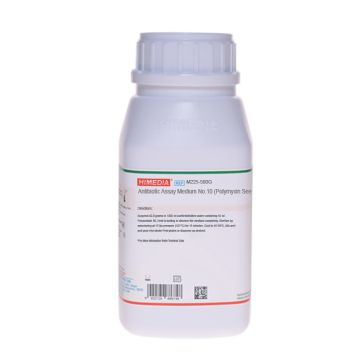
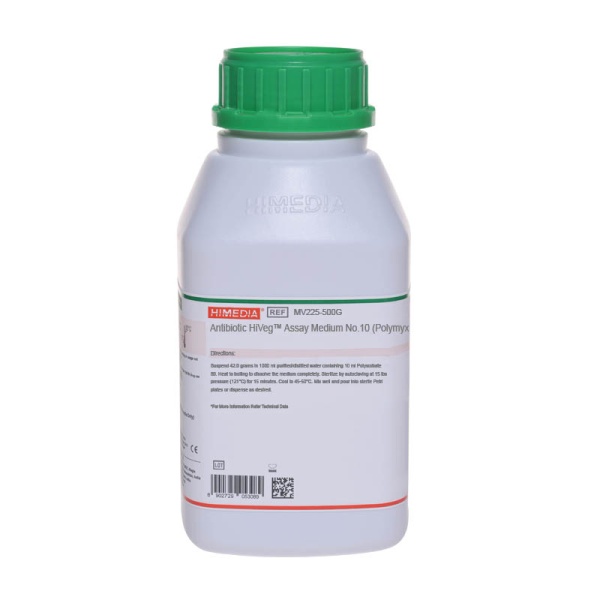
| Product Name | Antibiotic HiVeg® Assay Medium No. 10 (Polymyxin Seed HiVeg® Agar) |
|---|---|
| SKU | MV225 |
| Product Type | HiVeg™ |
| Physical Form | Powder |
| Origin | Animal Free (Veg) |
| Packaging type | HDPE |
| References | 1. Grove and Randall, 1955, Assay Methods of Antibiotics Medical Encyclopedia, Inc<(>,<)>New York. 2.Schmidt and Moyer, 1944; J. Bact, 47:199. |
| Customized Product Available | No |