HiMedia Laboratories GmbH, Marie-Curie-Str. 3, 64683, Einhausen, Germany.


 Your enquiry has been submitted
Something problem with the server. Try again.
 Your enquiry has been submitted
| Ingredients | Gms / Litre |
|---|---|
| HiCynth™ Peptone No.5* | 3.000 |
| HiCynth™ Peptone No.4* | 10.000 |
| Lactose | 10.000 |
| Sucrose | 10.000 |
| Sodium chloride | 5.000 |
| Phenol red | 0.080 |
| Brilliant green | 0.0125 |
| Agar | 20.000 |
| Final pH (at 25°C) | 6.9±0.2 |
**Formula adjusted, standardized to suit performance parameters
*Chemically defined peptones.
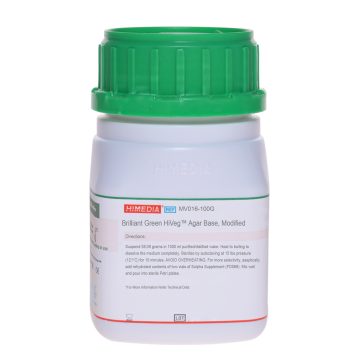
Suspend 29.05 grams in 500 ml distilled water. Heat to boiling to dissolve the medium completely. Sterilize by autoclaving at 15 lbs pressure (121°C) for 15 minutes. AVOID OVERHEATING. Cool to 45-50°C. For more selectivity, aseptically add rehydrated contents of 1 vial of Sulpha Supplement (FD068). Mix well and pour into sterile Petri plates.
Salmonella species cause many types of infections, from mild self-limiting gastroenteritis to life threatening typhoid fever. The most common form of Salmonella disease is self-limiting gastroenteritis with fever lasting less than 2 days and diarrhoea lasting less than 7 days.
Brilliant Green HiCynth™ Agar Base, Modified, as a primary plating medium for isolation of Salmonella species was first described by Kristensen et. al. (1) and further modified by Kauffmann (2). Brilliant Green Agar is also recommended by APHA (3,4) FDA (5) and described in EP, BP and IP (6,7,8).
This medium contains brilliant green, which inhibits growth of majority of Gram-negative and Gram-positive bacteria. Salmonella Typhi, Shigella species, Escherichia coli, Pseudomonas species, Staphylococcus aureus are mostly inhibited. Clinical specimens can be directly plated on this medium. However, being highly selective, it is recommended that this medium should be used along with a less inhibitory medium to increase the chances of recovery.
The medium contains HiCynth™ Peptone No.4 and HiCynth™ Peptone No.5 as sources of carbon, nitrogen, long chain amino acids, vitamins and essential nutrients. The two sugars namely lactose and sucrose serve as energy sources. Fermentation of lactose and/or sucrose in the medium results in the formation of acidic pH which is detected by phenol red indicator. Sodium chloride maintains the osmotic equilibrium. Brilliant green helps to inhibit the contaminating microflora. The medium can further supplemented with sulphacetamide (1g/l) and sodium mandelate (0.25g/l) to inhibit contaminating microorganisms when the sample is suspected to contain large number of competing organisms along with Salmonella species.
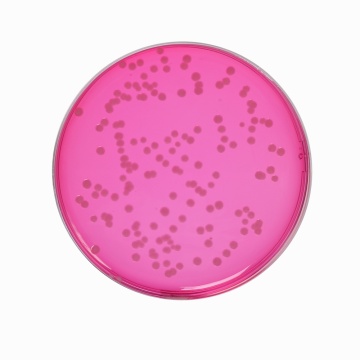
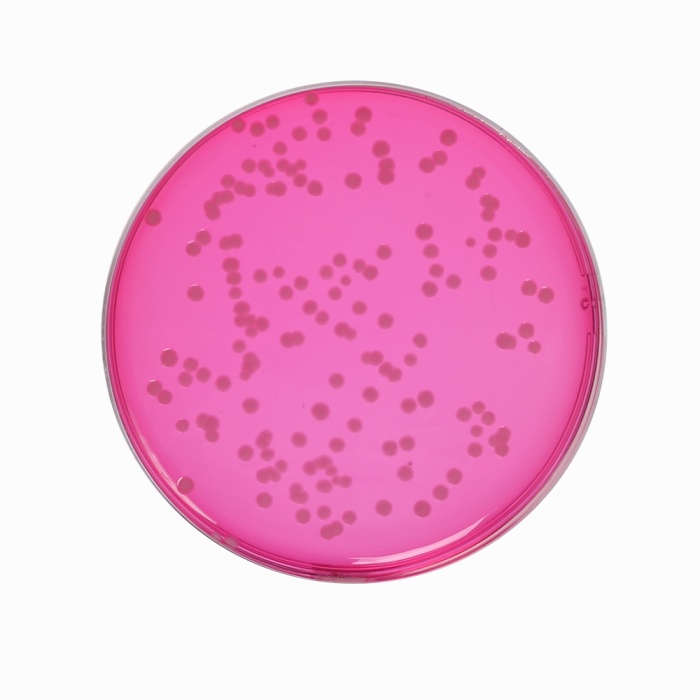
Non-lactose fermenting bacteria develop white to pinkish red colonies within 18-24 hours of incubation. Salmonella Typhi and Shigella species may not grow on this medium. Moreover Proteus, Pseudomonas and Citrobacter species may mimic enteric pathogens by producing small red colonies.
Light yellow to light pink homogeneous free flowing powder
Firm, comparable with 2.0% agar gel.
Greenish brown clear to slightly opalescent gel forms in Petri plates
Reaction of 5.81% w/v aqueous solution at 25°C. pH: 6.9±0.2
6.70-7.10
Cultural response was carried out after an incubation at 30-35°C for 24-48 hours. Recovery rate is considered as 100% for bacteria growth on Soyabean Casein Digest Agar.
| Organism | Inoculum (CFU) | Growth | Lot value (CFU) | Recovery | Colour of Colony |
|---|---|---|---|---|---|
| Salmonella Typhimurium ATCC 14028 | 50-100 | good-luxuriant | 25-100 | >=50% | pinkish white |
| Salmonella Abony NCTC 6017 | 50-100 | good-luxuriant | 25-100 | >=50% | pinkish white |
| Salmonella Enteritidis ATCC 13076 | 50-100 | luxuriant | 25-100 | >=50% | pinkish white |
| Salmonella Typhi ATCC 6539 | 50-100 | fair-good | 15-40 | 30-40% | reddish pink |
| Escherichia coli ATCC 25922 | 50-100 | none-poor | 0-10 | 0-10% | yellowish green |
| Escherichia coli ATCC 8739 | 50-100 | none-poor | 0-10 | 0-10% | yellowish green |
| Escherichia coli NCTC 9002 | 50-100 | none-poor | 0-10 | 0-10% | yellowish green |
| Staphylococcus aureus ATCC 25923 | >=10³ | inhibited | 0 | 0% | |
| Staphylococcus aureus ATCC 6538 | >=10³ | inhibited | 0 | 0% |
Store below 30°C in a tightly closed container and the prepared medium between 2 - 8°C. Use before expiry date on the label.
| Product Name | Brilliant Green HiCynth™ Agar Base, Modified |
|---|---|
| SKU | MCD016 |
| Product Type | HiCynth™ |
| Physical Form | Powder |
| Origin | Chemically defined (HiCynth™), Lactose |
| Packaging type | HDPE |
| References | 1. Kristensen M., Lester V, and Jurgens A., 1925, Brit.J.Exp.Pathol.,6:291. 2.Kauffman F., 1935, Seit F. Hyg. 177:26. 3.Salfinger Y., and Tortorello M.L. Fifth (Ed.), 2015, Compendium of Methods for the Microbiological Examination ofFoods, 5th Ed., American Public Health Association, Washington, D.C. 4.Standard Methods for the Microbiological Examination of Dairy Products, 1995, 19th Ed, APHA, Washington, D.C. 5.Bacteriological Analytical Manual, 5th Ed, 1978, AOAC, Washington D.C. 6.The European Pharmacopoeia, 2008, Council or Europe, Strasbourg. 7.The British Pharmacopoeia, 2008 vol. II, London. 8.Indian Pharmacopoeia, 2010, Ministry of Health and Family Welfare, Govt., of India, 10.Wehr H. M. and Frank J. H., 2004, Standard Methods for the Microbiological Examination of Dairy Products, 17th Ed.,APHA Inc., Washington, D.C. 11. Baird R.B., Eaton A.D., and Rice E.W., (Eds.), 2015, Standard Methods for the Examination of Water and Wastewater,23rd ed., APHA, Washington, D.C. 12..Isenberg, H.D. Clinical Microbiology Procedures Handb0ook. 2nd Edition.1 3.Jorgensen,J.H., Pfaller , M.A., Carroll, K.C., Funke, G., Landry, M.L., Richter, S.S and Warnock., D.W. (2015)Manual of Clinical Microbiology, 11th Edition. Vol. 1. |
| Customized Product Available | No |