HiMedia Laboratories GmbH, Marie-Curie-Str. 3, 64683, Einhausen, Germany.

 Your enquiry has been submitted
Something problem with the server. Try again.
 Your enquiry has been submitted
Brilliant Green, Phenol Red, Lactose Monohydrate, Sucrose Agar is used for selective isolation of Salmonellae other than Salmonella Typhi from faeces, foods, dairy products etc in accordance with British Pharmacopoeia.
| Ingredients | Gms/Litre |
|---|---|
| HMC peptone ~ | 10.000 |
| Yeast extract | 3.000 |
| Lactose monohydrate | 10.000 |
| Sucrose | 10.000 |
| Sodium chloride | 5.000 |
| Phenol red | 0.080 |
| Brilliant green | 0.0125 |
| Agar | 20.000 |
| pH after sterilization | 6.9±0.2 |
**Formula adjusted, standardized to suit performance parameters
~ - Equivalent to Peptone (meat or casein)
Suspend 57.59 grams (the equivalent weight of dehydrated medium per litre) in 1000 ml purified/distilled water. Heat to boiling to dissolve the medium completely. Sterilize by autoclaving at 15 lbs pressure (121°C) for 15 minutes. AVOID OVERHEATING.
The composition of medium is as per British Pharmacopoeia and is cited as Agar medium L (1). Brilliant Green, Phenol Red, Lactose monohydrate, Sucrose Agar is used as a primary plating medium for isolation of Salmonella species was first described by Kristensen et al as medium for differentiation of paratyphoid B from other Gram negative enteric bacteria (2). It was further modified by Kauffmann for isolation of Salmonella from stool samples (3). Brilliant green agar is also recommended by APHA (4,5) FDA (6). This medium is employed in testing clinical specimens. Heavy inocula and heavily contaminated samples can be analyzed due to the outstanding selectivity of this medium. Brilliant Green Agar is used in the microbial limits test and with novobiocin for testing food samples.
HMC peptone and yeast extract supplies essential amino acids and long chains of peptides for enhanced growth. Sodium chloride maintains the osmotic equilibrium. Lactose monohydrate and sucrose are the fermentable carbohydrate sources. Phenol red serves as an acid base indicator giving yellow colour to lactose and or sucrose fermenting bacteria. This medium also contains brilliant green, which inhibits growth of majority of Gram-negative and Gram-positive bacteria. Salmonella Typhi, Shigella species, Escherichia coli, Proteus species, Pseudomonas species, and Staphylococcus aureus are mostly inhibited.
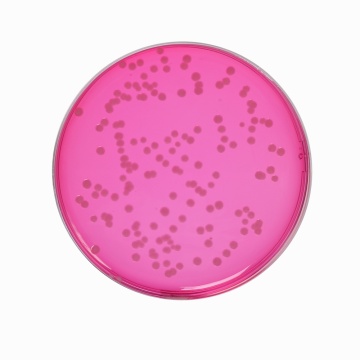
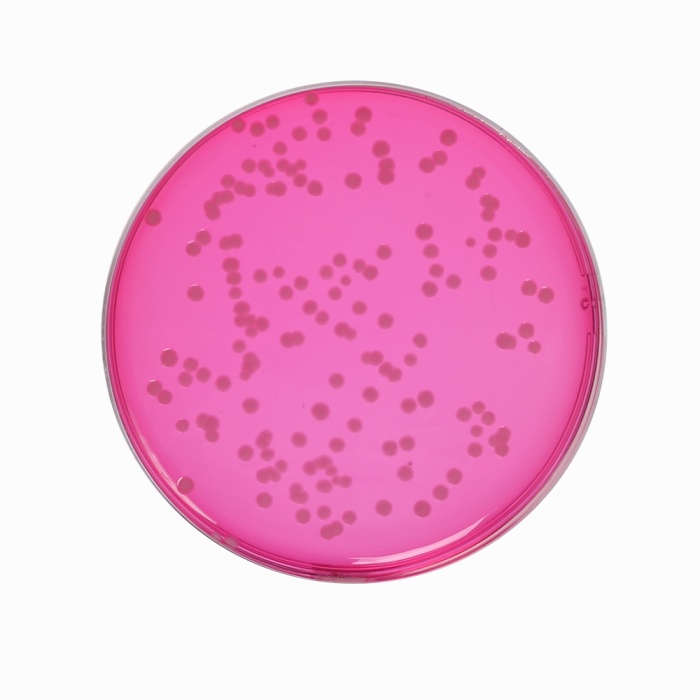
However, being highly selective, it is recommended that this medium should be used along with a less inhibitory medium to increase the chances of recovery. Often cultures enriched in Selenite or Tetrathionate Broth are plated on Brilliant Green Agar along with Bismuth Sulphite Agar, SS Agar, MacConkey Agar. Non-lactose fermenting bacteria develop white to pinkish red colonies within 18-24 hours of incubation.
Food and dairy samples; Pharmaceutical samples.
For food and dairy samples, follow appropriate techniques for sample collection and processing as per guidelines (4,5,6). For pharmaceutical samples, follow appropriate techniques for sample collection, processing as per guidelines and local standards (1). After use, contaminated materials must be sterilized by autoclaving before discarding.
Read the label before opening the container. Wear protective gloves/protective clothing/eye protection/ face protection. Follow good microbiological lab practices while handling specimens and culture. Standard precautions as per established guidelines should be followed while handling specimens. Safety guidelines may be referred in individual safety data sheets.
Performance of the medium is expected when used as per the direction on the label within the expiry period when stored at recommended temperature.
Appearance Light yellow to light pink homogeneous free flowing powder
Gelling Firm, comparable with 2.0% agar gel.
Colour and Clarity of prepared medium Greenish brown coloured clear to slightly opalescent gel forms in Petri plates
pH 6.70-7.10
Growth Promotion Test Growth Promotion is carried out in accordance with BP. Cultural response was observed after an incubation at 35-37°C for 18-72 hours. Recovery rate is considered as 100% for bacteria growth on Soyabean Casein Digest Agar.
| Organism | Inoculum (CFU) | Growth | Lot value (CFU) | Recovery | Colour of Colony |
|---|---|---|---|---|---|
| Growth Promotion Test | |||||
| Salmonella Typhimurium ATCC 14028 (00031*) | 50-100 | luxuriant | 25-100 | >=50% | pinkish white |
| Salmonella Abony NCTC 6017 (00029*) | 50-100 | luxuriant | 25-100 | >=50% | pinkish white |
| Additional Microbiological testing | |||||
| Salmonella Enteritidis ATCC 13076 (00030*) | 50-100 | luxuriant | 25-100 | >=50% | pinkish white |
| Salmonella Typhi ATCC 6539 | 50-100 | fair-good | 15-40 | 30-40% | reddish pink |
| Escherichia coli ATCC 8739 (00012*) | 50-100 | none to poor | 0-10 | 0-10% | yellowish green |
| Escherichia coli ATCC 25922 (00013*) | 50-100 | none-poor | 0-10 | 0-10% | yellowish green |
| Staphylococcus aureus subsp. aureus ATCC 6538 (00032*) | >=103 | inhibited | 0 | 0% | |
| Staphylococcus aureus subsp. aureus ATCC 25923 (00034*) | >=103 | inhibited | 0 | 0% | |
Key: *Corresponding WDCM numbers.
Store between 10-30°C in a tightly closed container and the prepared medium at 20-30°C. Use before expiry date on the label. On opening, product should be properly stored dry, after tightly capping the bottle in order to prevent lump formation due to the hygroscopic nature of the product. Improper storage of the product may lead to lump formation. Store in dry ventilated area protected from extremes of temperature and sources of ignition Seal the container tightly after use.
Product performance is best if used within stated expiry period.
User must ensure safe disposal by autoclaving and/or incineration of used or unusable preparations of this product. Follow established laboratory procedures in disposing of infectious materials and material that comes into contact with clinical sample must be decontaminated and disposed of in accordance with current laboratory techniques (7,8).
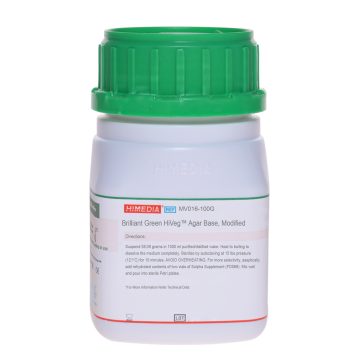
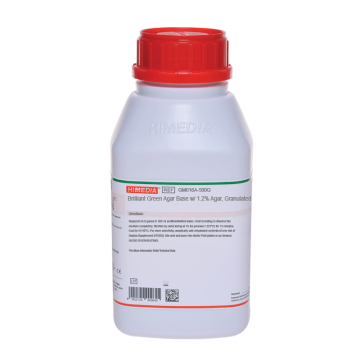
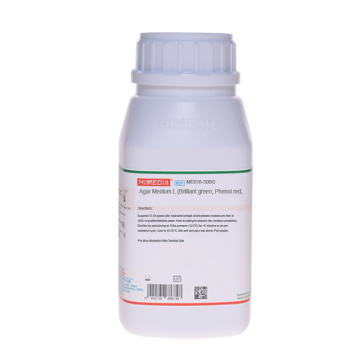
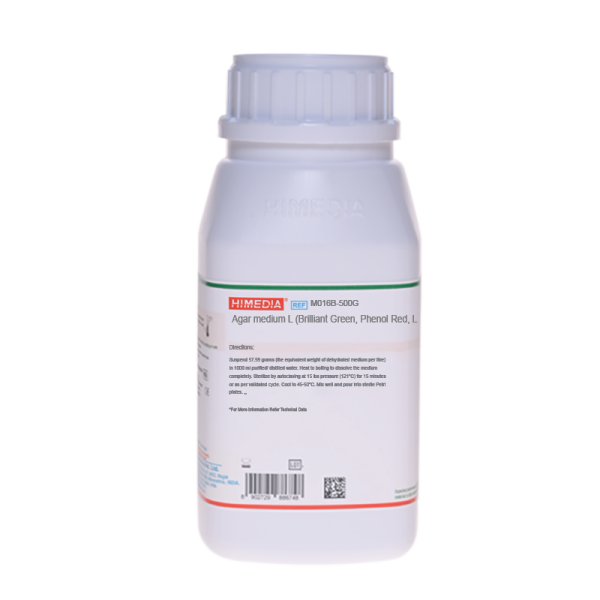
| Product Name | Agar Medium L (Brilliant Green, Phenol Red, Lactose Monohydrate, Sucrose Agar) |
|---|---|
| SKU | M016B |
| Product Type | Regular |
| Physical Form | Powder |
| Origin | Animal |
| Packaging type | HDPE |
| References | 1. Kristensen M., Lester V, and Jurgens A., 1925, Brit.J.Exp.Pathol.,6:291. 2.Kauffman F., 1935, Seit F. Hyg. 177:26. 3.Salfinger Y., and Tortorello M.L. Fifth (Ed.), 2015, Compendium of Methods for the Microbiological Examination ofFoods, 5th Ed., American Public Health Association, Washington, D.C. 4.Standard Methods for the Microbiological Examination of Dairy Products, 1995, 19th Ed, APHA, Washington, D.C. 5.Bacteriological Analytical Manual, 5th Ed, 1978, AOAC, Washington D.C. 6.The European Pharmacopoeia, 2008, Council or Europe, Strasbourg. 7.The British Pharmacopoeia, 2008 vol. II, London. 8.Indian Pharmacopoeia, 2010, Ministry of Health and Family Welfare, Govt., of India, 10.Wehr H. M. and Frank J. H., 2004, Standard Methods for the Microbiological Examination of Dairy Products, 17th Ed.,APHA Inc., Washington, D.C. 11. Baird R.B., Eaton A.D., and Rice E.W., (Eds.), 2015, Standard Methods for the Examination of Water and Wastewater,23rd ed., APHA, Washington, D.C. 12..Isenberg, H.D. Clinical Microbiology Procedures Handb0ook. 2nd Edition.1 3.Jorgensen,J.H., Pfaller , M.A., Carroll, K.C., Funke, G., Landry, M.L., Richter, S.S and Warnock., D.W. (2015)Manual of Clinical Microbiology, 11th Edition. Vol. 1. |
| Customized Product Available | No |