HiMedia Laboratories GmbH, Marie-Curie-Str. 3, 64683, Einhausen, Germany.

 Your enquiry has been submitted
Something problem with the server. Try again.

| Ingredients | Gms/Litre |
|---|---|
| Casein enzymic hydrolysate | 10.000 |
| Proteose peptone | 10.000 |
| Dipotassium phosphate | 1.500 |
| Magnesium sulphate | 1.500 |
| Agar | 15.000 |
| Final pH (at 25°C) | 7.0±0.2 |
Formula adjusted, standardized to suit performance parameters
Suspend 38 grams in 1000 ml distilled water containing 10 ml glycerol. Heat to boiling to dissolve the medium completely. Sterilize by autoclaving at 15 lbs pressure (121°C) for 15 minutes. Cool to 45-50°C.Mix well and pour into sterile Petri plates.
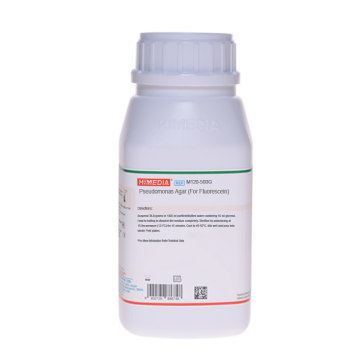
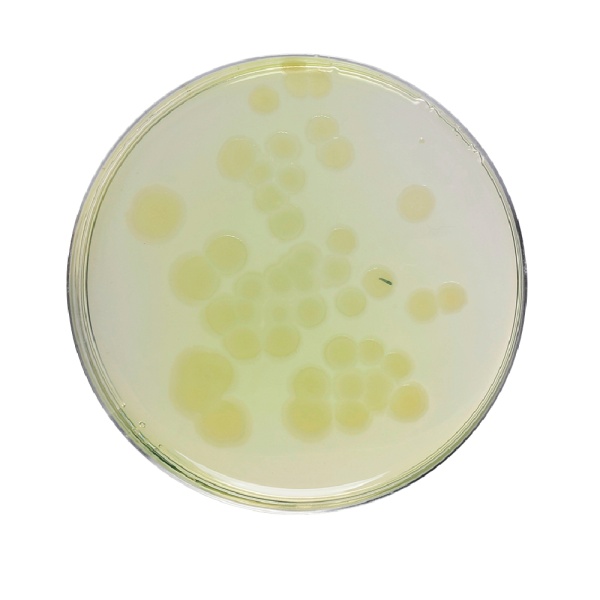
Pseudomonas Agar (For Fluorescein) is based on the formula described by King et al (1) and as modified in the U.S. Pharmacopeia (2) for the detection of fluorescein production a water soluble, chloroform insoluble fluorescent pigment by Pseudomonas species (3). The medium enhances the elaboration of fluorescein by Pseudomonas and inhibits the pyocyanin formation. The fluorescein pigment diffuses from the colonies of Pseudomonas into the agar and shows yellow fluorescent colouration. Some Pseudomonas strains produce small amounts of pyocyanin resulting in a yellow-green colouration.
Casein enzymic hydrolysate and proteose peptone provide the essential nitrogenous nutrients, carbon, sulphur and trace elements for the growth of Pseudomonas. Dipotassium phosphate buffers the medium while magnesium sulphate provides necessary cations for the activation of fluorescein production. Salt concentration exceeding 2% affects pigment production. UV illumination may be bactericidal, so make sure that there is good growth before placing culture under UV light (3).
A pyocyanin-producing Pseudomonas strain will usually also produce fluorescein. It must, therefore, be differentiated from other simple fluorescent pseudomonads by other means. Temperature can be a determining factor as most other fluorescent strains will not grow at 35°C. Rather, they grow at 25-30°C (3).
Appearance: Cream to yellow coloured granular medium
Gelling: Firm, comparable with 1.5% Agar gel
Colour and Clarity of prepared medium: Yellow coloured clear to slightly opalescent gel forms in Petri plates
Reaction: Reaction of 3.8% w/v aqueous solution (containing 1% v/v glycerol) at 25°C. pH: 7.0±0.2
pH: 6.80-7.20
Cultural characteristics observed with added 1% glycerol after an incubation at 35-37°C for 18-24 hours.
| Organism | Inoculum (CFU) | Growth | Recovery | Colour of colony |
|---|---|---|---|---|
| Pseudomonas aeruginosa ATCC 17934 | 50-100 | luxuriant | >=70% | greenish yellow |
| Pseudomonas aeruginosa ATCC 27853 | 50-100 | luxuriant | >=70% | greenish yellow |
| Pseudomonas aeruginosa ATCC 9027 | 50-100 | luxuriant | >=70% | greenish yellow |
Store below 30°C in tightly closed container and the prepared medium at 2 - 8°C. Use before expiry date on the label.
| Product Name | Pseudomonas Agar, Granulated (For Fluorescein) |
|---|---|
| SKU | GM120 |
| Product Type | Granulated |
| Physical Form | Granular |
| Origin | Animal |
| Packaging type | HDPE |
| References | 1. King, Ward and Raney, 1954, J. Lab. Clin. Med., 44 : 301. 2.The United States Pharmacopoeia, 2006, USP29/NF24, The United States Pharmacopeial Convention, Rockville, MD. 3.MacFaddin J., 1985, Media for Isolation-Cultivation-Identification-Maintenance of Medical Bacteria, Vol. I, Williams andWilkins, Baltimore. |
| Customized Product Available | No |