HiMedia Laboratories GmbH, Marie-Curie-Str. 3, 64683, Einhausen, Germany.

 Your enquiry has been submitted
Something problem with the server. Try again.
 Your enquiry has been submitted
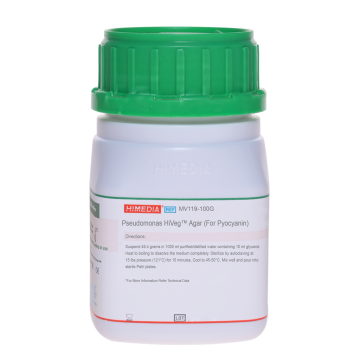
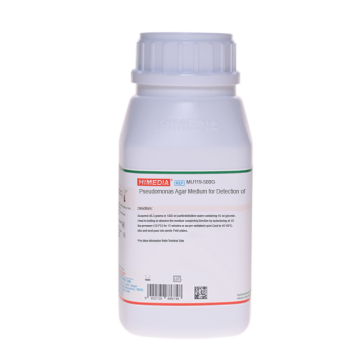
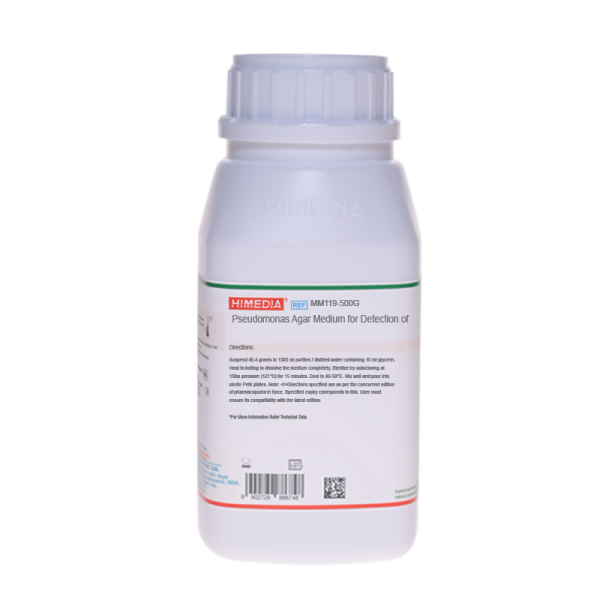
Pseudomonas Agar for detection of Pyocyanin is recommended for the detection of pyocyanin production by Pseudomonas species in accordance with Indian Pharmacopoeia, 2007.
| Ingredients | Gms/Litre |
|---|---|
| Pancreatic digest of gelatin | 20.000 |
| Anhydrous potassium sulphate | 10.000 |
| Anhydrous magnesium chloride | 1.400 |
| Agar | 15.000 |
| pH after sterilization( at 25°C) | 7.2±0.2 |
**Formula adjusted, standardized to suit performance parameters
Suspend 46.4 grams in 1000 ml purified / distilled water containing 10 ml glycerin. Heat to boiling to dissolve the medium completely. Sterilize by autoclaving at 15 lbs pressure (121°C) for 15 minutes or as per validated cycle.
Pseudomonas Agar is based on the formulation described by King et al (1) and as recommended in Indian Pharmacopoeia (2) for detecting pyocyanin, a water soluble pigment by Pseudomonas species from pharmaceutical preparation and clinical specimens such as stools, wounds, and urine. (3). Pseudomonas species are commonly isolated pathogen and is the significant causative agent of nosocomial, skin and burn infections. Pseudomonas strains are reported to produce phenazine pigments like Pyocyanin- blue green redox-active secondary metabolite pigment, pyorubin-rust brown pigment, -oxyphenzine- a breakdown product of Pyocyanin, pyoverdin-a water soluble yellow green pigments also known as fluorescein. Pyocyanin is readily recovered in large quantities in sputum from patients with cystic fibrosis, an infection caused by Pseudomonas (4,5). This medium enhances the formation of Pyocyanin and/or pyorubin and reduces that of fluorescein
Pancreatic digest of gelatin provides essential nutrients for growth of Pseudomonas, while glycerol provides carbon and energy to the cell. The pyocyanin pigment diffuses from the colonies of Pseudomonas into the agar and shows blue colouration. Potassium sulphate and magnesium chloride enhances the pyocyanin production and suppresses the fluorescein production. Low content of phosphorous in the medium also aids in inhibiting the production of fluorescein. Some Pseudomonas strains produce small amounts of fluorescein resulting in a blue-green colouration.
Strains of Pseudomonas aeruginosa that may fail to produce Pyocyanin are not detected in this medium. Production of other pigments may mask the presence of Pyocyanin.
Appearance
Cream to yellow homogeneous free flowing powder
Gelling
Firm, comparable with 1.5% Agar gel
Colour and Clarity of prepared medium
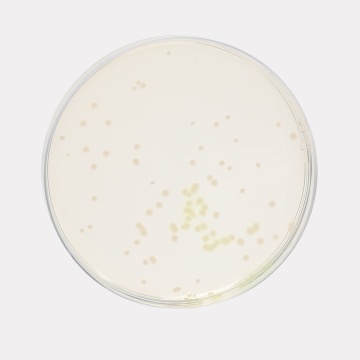
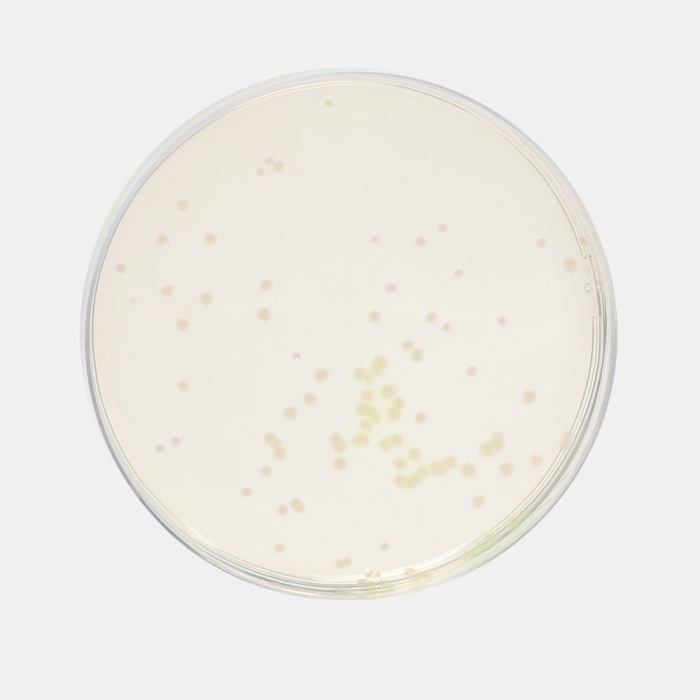
Yellow coloured clear to slightly opalescent gel forms in Petri plates
pH
7.00-7.40
Growth Promotion is carried out in accordance with the harmonized method of IP. Cultural response was observed after an incubation at 33-37°C for not less than 3 days. Recovery rate is considered as 100% for bacteria growth on Soyabean Casein Digest Agar.
| Organism | Inoculum (CFU) | Observed Lot Recovery value (CFU) | Characteristic colonial morphology | Fluorescence in UV light | Growth | |
|---|---|---|---|---|---|---|
| Test for Pseudomonas aeruginosa | ||||||
| Pseudomonas aeruginosa ATCC 9027 | 50-100 | 35-100 | >=70% | Generally greenish | positive | positive |
| Additional Microbiological Testing | ||||||
| Pseudomonas aeruginosa ATCC 27853 | 50-100 | 35-100 | >=70% | Generally greenish | positive | positive |
Store below 30°C in tightly closed container and the prepared medium at 2 - 8°C. Use before expiry date on the label.
| Product Name | Pseudomonas Agar Medium For Detection of Pyocyanin Medium 21 (In accordance with IP 2007) |
|---|---|
| SKU | MM119 |
| Product Type | Regular |
| Physical Form | Powder |
| Origin | Animal |
| Packaging type | HDPE |
| References | 1.King, Ward and Raney, 1954, J.Lab. and Clin. Med., 44:3012.Indian Pharmacopoeia, 2007, Govt. of India, Ministry of Health and Family Welfare, New Delhi, India. 3.MacFaddin J., 1985, Media for Isolation-Cultivation-Identification-Maintenance of Medical Bacteria, Vol. I, Williams andWilkins, Baltimore. 4.Daly J A, Boshard R, and Matsen J M, 1984, J Clin Microbiol. 19: 742 5.Lau GW, Hassett DJ, Ran H, Kong F., 200 4.Trends Mol Med. 10:599 |
| Customized Product Available | No |