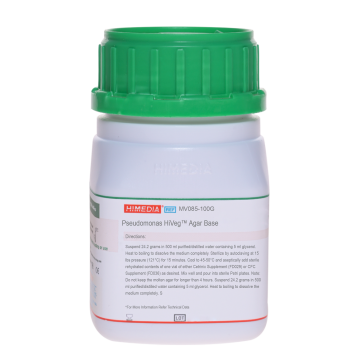
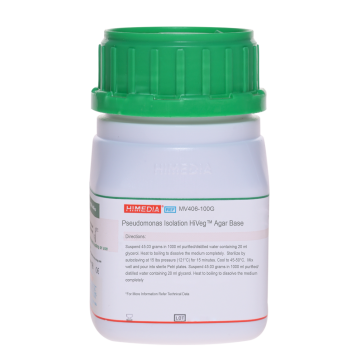
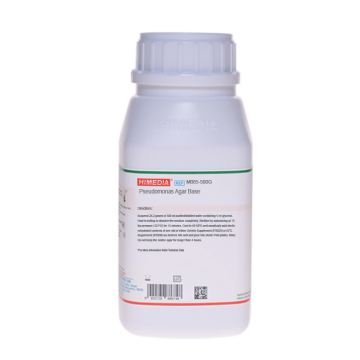
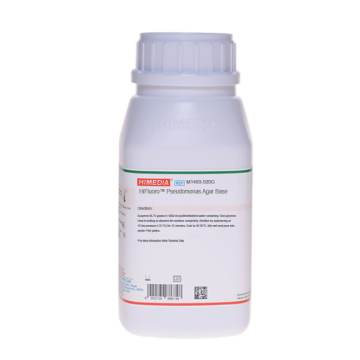
HiMedia Laboratories GmbH, Marie-Curie-Str. 3, 64683, Einhausen, Germany.

 Your enquiry has been submitted
Something problem with the server. Try again.
 Your enquiry has been submitted
Recommended for selective isolation and identification of Pseudomonas aeruginosa from clinical and non-clinical specimens.
| Ingredients | g/L |
|---|---|
| HiCynth™ Peptone No.4* | 20.000 |
| Magnesium chloride | 1.400 |
| Potassium sulphate | 10.000 |
| Triclosan (Irgasan) | 0.025 |
| Agar | 13.600 |
| Final pH (at 25°C) | 7.0±0.2 |
**Formula adjusted, standardized to suit performance parameters
* Chemically defined peptones
Suspend 45.03 gram in 1000 ml purified / distilled water containing 20 ml glycerol. Heat to boiling to dissolve the medium completely. Sterilize by autoclaving at 15 lbs pressure (121°C) for 15 minutes. Cool to 45-50°C. Mix well and pour into sterile Petri plates.
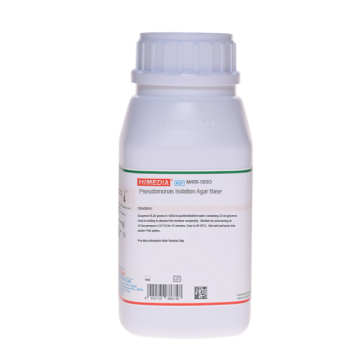
Pseudomonas Isolation HiCynth™ Agar Base is used for the selective isolation and identification of P. aeruginosa, is a modification of Medium A, originally formulated by King, Ward and Raney (1). It is prepared by replacing animal and vegetable peptones with chemically defined peptones to avoid BSE/TSE risks associated with animal peptones.
Pseudomonas aeruginosa is an important human pathogen commonly found in nosocomial infections. It successfully combines adaptability to a variety of moist environments with a collection of potent virulence factors (2). Pseudomonas infections usually occur at any site where moisture tends to accumulate e. g. tracheostomies, in-dwelling catheters, burns, the external ear and weeping cutaneous wounds (3). The medium contains pigment-enhancing components and the selective agents, triclosan (4,5) which selectively inhibits gram-positive and gram-negative bacteria. The pigment-enhancers i.e. potassium sulphate and magnesium chloride enhance the blue or blue-green pigment production by P. aeruginosa, thus aiding in its identification. Some pyocyanin producing strains may also produce small amounts of fluorescein, resulting in the production of a blue-green to green pigment. HiCynth™ Peptone No.4 provides nitrogenous compounds and other essential growth nutrients. Glycerol is a source of energy and promotes pyocyanin i.e. pigment production which is characteristic of Pseudomonas (5,8). Presumptive Pseudomonas should be further confirmed by performing biochemical tests, as some strains of Pseudomonas do not produce pyocyanin (8).
Food samples; Water samples
For food samples, follow appropriate techniques for sample collection and processing as per guidelines (9).
For water samples, follow appropriate techniques for sample collection, processing as per guidelines and local standards (10).
After use, contaminated materials must be sterilized by autoclaving before discarding.
Read the label before opening the container. The media should be handled by trained personnel only. Wear protective gloves/protective clothing/eye protection/ face protection. Follow good microbiological lab practices while handling specimens and culture. Standard precautions as per established guidelines should be followed while handling specimens. Safety guidelines may be referred in individual safety data sheets.
Performance of the medium is expected when used as per the direction on the label within the expiry period when stored at recommended temperature.
Appearance
Cream to yellow homogeneous free flowing powder
Gelling
Firm, comparable with 1.36% Agar gel.
Colour and Clarity of prepared medium
Yellow coloured clear to slightly opalescent gel forms in Petri plates.
Reaction
Reaction of 4.5% w/v aqueous solution at 25°C. pH: 7.0±0.2
pH
6.80-7.20
Cultural characteristics observed after an incubation at 35-37°C for 18-48 hours.
| Organism | Inoculum (CFU) | Growth | Recovery | Colour of colony |
|---|---|---|---|---|
| Escherichia coli ATCC 25922 (00013*) | >=10⁴ | inhibited | 0% | |
| Proteus mirabilis ATCC 25933 | >=10⁴ | inhibited | 0% | |
| Pseudomonas aeruginosa ATCC 10145 (00024*) | 50-100 | luxuriant | >=50% | green |
| Pseudomonas aeruginosa ATCC 27853 (00025*) | 50-100 | luxuriant | >=50% | blue to blue-green |
Key: (*) - Corresponding WDCM numbers
Store between 10-30°C in a tightly closed container and the prepared medium at 20-30°C. Use before expiry date on the label. On opening, product should be properly stored dry, after tightly capping the bottle in order to prevent lump formation due to the hygroscopic nature of the product. Improper storage of the product may lead to lump formation. Store in dry ventilated area protected from extremes of temperature and sources of ignition Seal the container tightly after use. Product performance is best if used within stated expiry period.
User must ensure safe disposal by autoclaving and/or incineration of used or unusable preparations of this product. Follow established laboratory procedures in disposing of infectious materials and material that comes into contact with sample must be decontaminated and disposed of in accordance with current laboratory techniques (9,10).
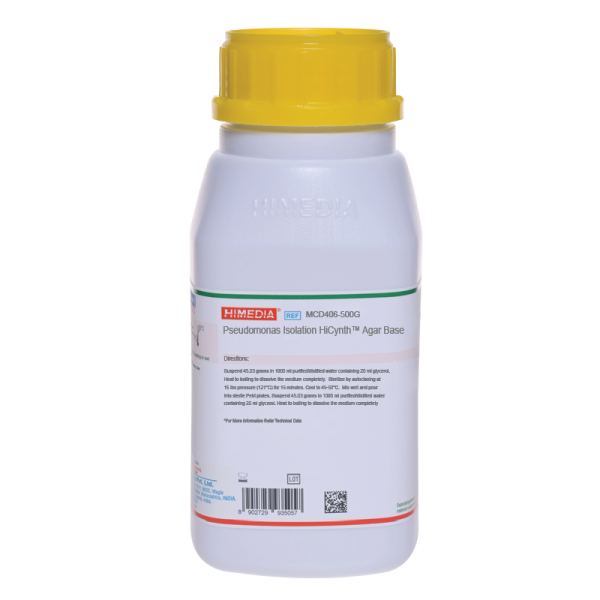
| Product Name | Pseudomonas Isolation HiCynth™ Agar Base |
|---|---|
| SKU | MCD406 |
| Product Type | HiCynth™ |
| Physical Form | Powder |
| Origin | Chemically defined (HiCynth™) |
| Packaging type | HDPE |
| References | 1. Murray P. R., Baron J. H., Pfaller M. A., Jorgensen J. H. and Yolken R. H., (Ed.), 2003, Manual of Clinical Microbiology,8th Ed., American Society for Microbiology, Washington, D.C. ,, 2.Koneman E. W., Allen S. D., Janda W. M., Schreckenberger P. C., Winn W. C. Jr., 1992, Colour Atlas and Textbook ofDiagnostic Microbiology, 4th Ed., J. B. Lippinccott Company 3.King F. O., Ward M. K. and Raney D. E., 1954, J. Lab. Clin. Med., 44 :301. 4.Collee J. G., Fraser A. G., Marmion B. P., Simmons A., (Eds.), Mackie and McCartney, Practical Medical Microbiology,1996, 14th Edition, Churchill Livingstone 5.Finegold S. M. and Baron E. J., 1986, Bailey and Scotts Diagnostic Microbiology, 7th Ed., The C. V. Mosby Co., St. Louis. 6.MacFaddin J. F., 1985, Media for Isolation-Cultivation-Identification-Maintenance of Medical Bacteria, Vol. I, Williamsand Wilkins, Baltimore. 7.Furia T. E. and Schenkel A. G., 1968, Soap and Chemical Specialties 44:47 |
| Customized Product Available | No |