HiMedia Laboratories GmbH, Marie-Curie-Str. 3, 64683, Einhausen, Germany.

 Your enquiry has been submitted
Something problem with the server. Try again.
 Your enquiry has been submitted
With the addition of blood it is recommended for cultivation of Haemophilus species.
| Ingredients | g/L |
|---|---|
| HiVeg® peptone | 10.000 |
| HiVeg® extract | 10.000 |
| Sodium chloride | 5.000 |
| Agar | 20.000 |
| Final pH (at 25°C) | 7.6±0.2 |
Formula adjusted, standardized to suit performance parameters
Suspend 45.0 grams in 1000 ml purified / distilled water. Heat to boiling to dissolve the medium completely. Dispense in 100 ml amounts and sterilize by autoclaving at 15 lbs pressure (121°C) for 15 minutes. Cool to 45-50°C and add 5 ml sterile rabbit or human blood to 100 ml medium. Heat the mixture in boiling water bath. Allow the deposits to settle and dispense clear supernatant.
The genus Haemophilus includes a number of species that cause a wide variety of infections but share a common morphology and a requirement for blood-derived factors during growth that has given the genus its name. Haemophilus influenzae, the major pathogen, is by far the most virulent organism in this group, commonly causing bloodstream invasion and meningitis in children younger than 2 years. Other Haemophilus species cause disease less frequently. The Haemophilus genus represents a large group of gram-negative rods that grow on blood agar. The blood provides two factors, which many Haemophilus species require for growth: factor-X and factor-V (1). Levinthals Medium is used for the cultivation of Haemophilus species. Haemophilus species require haemoglobin for their growth in the culture medium. Levinthal's HiVeg® Medium Base is prepared by completely replacing animal based peptone with vegetable peptones to avoid BSE/TSE risks associate with animal peptones. Whole blood of rabbit or human blood contains two important factors viz factor-X and factor-V, which are necessary for the growth of type species of H. influenzae (2). Factor-X is a heat stable substance, the hemin associated with haemoglobin, whereas factor-V is a heat labile coenzyme Nicotinamide Adenine Dinucleotide (NAD). Other nutrients such as nitrogen compounds are supplied by HiVeg® peptone and HiVeg® extract incorporated in the medium. Sodium chloride helps to maintain osmotic balance of the medium. Pathogenic Haemophilus species may be presumptively identified by determining in vitro growth requirements for X and V factors and by haemolytic reactions.
Please add specimen
After use, contaminated materials must be sterilized by autoclaving before discarding.
Read the label before opening the container. Wear protective gloves/protective clothing/eye protection/face protection. Follow good microbiological lab practices while handling specimens and culture. Standard precautions as per established guidelines should be followed while handling specimens. Safety guidelines may be referred in individual safety data sheets.
Performance of the medium is expected when used as per the direction on the label within the expiry period when stored at recommended temperature.
Appearance
Cream to yellow homogeneous free flowing powder
Gelling
Firm, comparable with 2.0% agar gel.
Colour and Clarity of prepared medium
Basal medium: Light yellow coloured clear to slightly opalescent gel After addition of blood & heating: Chocolate brown coloured, opaque gel forms in Petri plates
Reaction
Reaction of 4.5% w/v aqueous solution at 25°C. pH: 7.6±0.2
pH
7.40-7.80
Cultural characteristics observed with added sterile rabbit or human blood, under 5-10% CO2 and 70% humidity, after an incubation at 35-37°C for 18-24 hours
| Organism | Inoculum (CFU) | Growth | Recovery |
|---|---|---|---|
| Haemophilus influenzae ATCC 35056 | 50-100 | luxuriant | >=70% |
| Staphylococcus aureus subsp. aureus ATCC 25923 (00034*) | 50-100 | luxuriant | >=70% |
| Streptococcus pyogenes ATCC 19615 | 50-100 | luxuriant | >=70% |
Key: (*) Corresponding WDCM numbers.
Store between 10- 30°C in a tightly closed container and the prepared medium at 2 - 8°C. Use before expiry date on the label. On opening, product should be properly stored dry, after tightly capping the bottle in order to prevent lump formation due to the hygroscopic nature of the product. Improper storage of the product may lead to lump formation. Store in dry ventilated area protected from extremes of temperature and sources of ignition Seal the container tightly after use. Product performance is best if used within stated expiry period.
User must ensure safe disposal by autoclaving and/or incineration of used or unusable preparations of this product. Follow established laboratory procedures in disposing of infectious materials and material that comes into contact with clinical sample must be decontaminated and disposed of in accordance with current laboratory techniques (3,4).
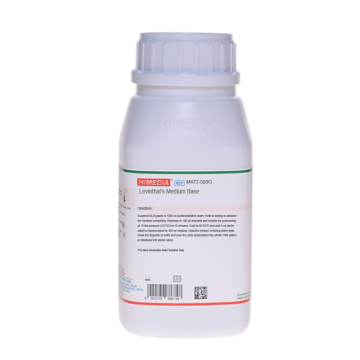
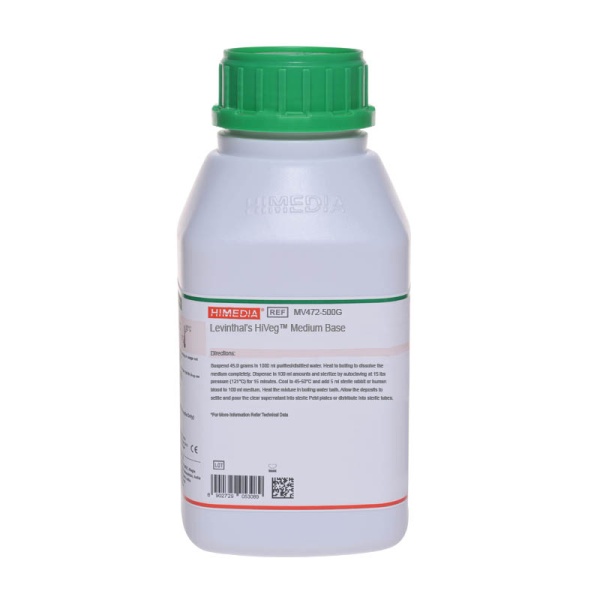
| Product Name | Levinthal's HiVeg® Medium Base |
|---|---|
| SKU | MV472 |
| Product Type | HiVeg™ |
| Physical Form | Powder |
| Origin | Animal Free (Veg) |
| Packaging type | HDPE |
| References | 1. Sell S. H., Wright P. F., (Eds.), Haemophilus influenzae, Epidemiology, Immunology, and Prevention of Disease, ElsevierBiomedical, New York, 1982, St. Geme J. W.,III, Falkow S: Infect and Immun, p.4036, 1990 2.Finegold S. M. and Baron E. J., 1986, Bailey and Scotts Diagnostic Microbiology, 7th Ed., The C.V. Mosby Company,St. Louis. |
| Customized Product Available | No |