HiMedia Laboratories GmbH, Marie-Curie-Str. 3, 64683, Einhausen, Germany.

 Your enquiry has been submitted
Something problem with the server. Try again.
 Your enquiry has been submitted
Azide Dextrose HiVeg® Broth is used as a selective medium for detection and enumeration of Streptococci in water, sewage, food and other material suspected of sewage contamination.
| Ingredients | Grams/Litre |
|---|---|
| HiVeg® special peptone | 15.0 |
| HiVeg® extract | 4.5 |
| Dextrose | 7.5 |
| Sodium chloride | 7.5 |
| Sodium azide | 0.2 |
| Final pH (at 25°C) | 7.2± 0.2 |
Formula adjusted, standardized to suit performance parameters.
Suspend 34.7 grams in 1000 ml distilled water for preparing single strength broth or use 69.4 grams in 1000 ml distilled water for double strength broth. Heat if necessary to ensure complete solution. Dispense in test tubes and sterilize by autoclaving at 12 lbs pressure (118°C) for 15 minutes.
Warning: Sodium Azide has a tendency to form explosive metal azides with plumbing materials. It is advisable to use enough water to flush off the disposables.
The medium contains HiVeg® special peptone and HiVeg® extract (of vegetable origin) in place of Peptone special and Beef extract (of bovine origin) respectively, which makes the medium free of BSE/TSE risks. Azide Dextrose HiVeg® Broth is the modification of Azide Dextrose Broth formulated by Rothe, Mullmann and Seligmann (1) for quantitative determination of Enterococci in water, sewage, foods and other materials suspected of contamination with sewage. It can be used for enumeration of faecal Streptococci by MPN technique as it is similar to conventional Azide Dextrose Broth recommended by APHA (2). It is a highly nutritious medium due to the presence of nutrient rich HiVeg® special peptone, HiVeg® extract and dextrose. Sodium azide inhibits growth of gram-negative bacteria, allowing Enterococci to grow (1, 3, 4). Enterococci are more resistant to chlorine in water, hence are better indicators of sewage pollution than Escherichia coli. When large volumes of water samples are to be examined, double strength medium can be used. Turbidity in tubes indicate presence of Enterococci. It should be further confirmed by inoculation in EVA Broth (M426) or Bromo Cresol Purple Azide Broth (M1212). Alternately an equivalent HiVeg® Media; EVA HiVeg® Broth (MV426) or Bromo Cresol Purple Azide HiVeg® Broth (MV1212) or Glucose Azide HiVeg® Broth (MV982) can be used.
Appearance of powder Light yellow coloured, may have slightly greenish tinge, homogeneous, free flowing powder.
Colour and Clarity Amber coloured, clear solution without any precipitate.
| Vegetable based (Code MV) | Animal based (Code M) | |
|---|---|---|
| Product Code | MV345 | M345 |
| Ingredient 1 | HiVeg® special peptone | Peptone special |
| Ingredient 2 | HiVeg® extract | Beef extract |
Detection and enumeration of Streptococci in water, sewage, food and other material suspected of sewage contamination.
| Quantity for 1 litre | 34.7 g |
|---|---|
| Total yield from 500g pack | 14.40 L |
| pH (25°C) | 7.2± 0.2 |
| Supplement | None |
| Sterilization | 118°C/15 minutes. |
| Storage | Dry Medium - Below 30°C, Prepared Medium 2 - 8°C. |
Reaction of 3.47% w/v aqueous solution is pH 7.2± 0.2 at 25°C.
Cultural characteristics observed after an incubation at 35-37°C for 18-24 hours.
| Organisms (ATCC) | Growth |
|---|---|
| Enterococcus faecalis (29212) | luxuriant |
| Escherichia coli (25922) | inhibited |
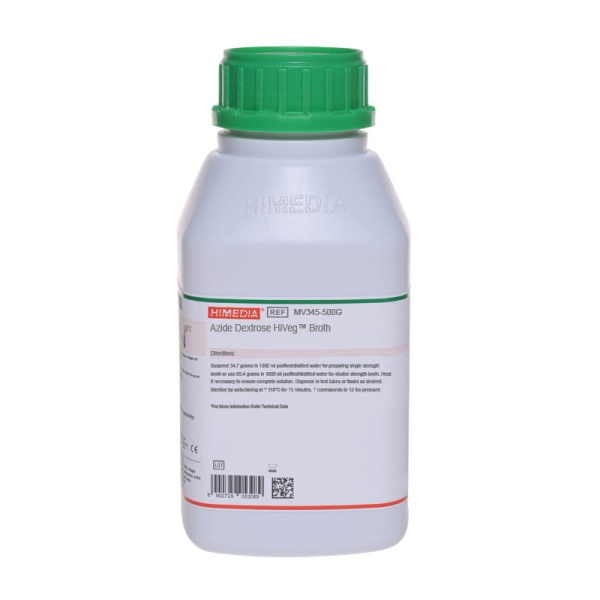
| Product Name | Azide Dextrose HiVeg® Broth |
|---|---|
| SKU | MV345 |
| Product Type | HiVeg™ |
| Physical Form | Powder |
| Origin | Animal Free (Veg) |
| Packaging type | HDPE |
| References | 1. Eaton A.D.,Clesceri L.S., and Greenberg A.E.,(Eds), 1998, Standard Methods for the Examination of Water and Wastewater,20th Ed., APHA, Washington, D.C. 2.Mallmann and Seligmann , 1950, Am. J. Publ. Health, 40:286. 3.Rothe, 1948, Illinois State Health Department. 4.Edwards S.J., 1933, J. Comp. Path. Therap., 46:21 5.Hartman G., 1937, Milchw. Forsch, 18:166. 6.MacFaddin J.F.,1985, Media for Isolation-Cultivation-Identification-Maintenance of Medical bacteria, Vol.1. Williams&Wilkins, Baltimore, Md. 7.Schleider K.H., Kilpper Bolz R., 1984, Int.J.Sys.Bacteriol., 34:31 9.Salfinger Y., and Tortorello M.L. Fifth (Ed.), 2015, Compendium of Methods for the Microbiological Examination ofFoods, 5th Ed., American Public Health Association, Washington, D.C.10.Wehr H. M. and Frank J. H., 2004, Standard Methods for the Microbiological Examination of Dairy Products, 17th Ed.,APHA Inc., Washington, D.C. 11.Baird R.B., Eaton A.D., and Rice E.W., (Eds.), 2015, Standard Methods for the Examination of Water and Wastewater,23rd ed., APHA, Washington, D.C. 12.Isenberg, H.D. Clinical Microbiology Procedures Handb0ook. 2nd Edition. 13.Jorgensen,J.H., Pfaller , M.A., Carroll, K.C., Funke, G., Landry, M.L., Richter, S.S and Warnock., D.W. (2015)Manual of Clinical Microbiology, 11th Edition. Vol. 1. |
| Customized Product Available | No |