HiMedia Laboratories GmbH, Marie-Curie-Str. 3, 64683, Einhausen, Germany.

 Your enquiry has been submitted
Something problem with the server. Try again.
 Your enquiry has been submitted
Recommended for detection and enumeration of faecal Streptococci in waters and for examination of faeces and other materials.
| Ingredients | Gms / Litre |
|---|---|
| Peptone, special | 10.000 |
| Yeast extract | 10.000 |
| Sodium chloride | 5.000 |
| Sodium β-glycerophosphate | 10.000 |
| Sodium carbonate | 0.636 |
| Maltose | 20.000 |
| Lactose | 1.000 |
| Sodium azide | 0.400 |
| Phenol red | 0.018 |
Final pH ( at 25°C) 7.2±0.2
**Formula adjusted, standardized to suit performance parameters
Suspend 57.05 grams in 1000 ml purified/distilled water. Heat if necessary to dissolve the medium completely. Dispense in to tubes or flasks as desired. Sterilize by autoclaving at 15 lbs pressure (121°C) for 10 minutes. Cool to 45-50°C. If desired, for use in the membrane filter technique, 1 ml of 1% 2,3,5 Triphenyl Tetrazolium Chloride (TTC) may be added to each 100 ml of sterile cooled broth.
Streptococci are spherical, gram-positive bacteria and form a part of the normal commensal flora of the mouth, skin, intestine, upper respiratory tract of humans. Streptococci found in the faeces form the faecal Streptococci and constitute of Streptococci with group D Lancefield antigens. The types include Streptococcus faecalis, Streptococcus faecium, Streptococcus bovis and Streptococcus duran. They are low-grade pathogens and rarely cause disease. However, they may cause urinary tract infection in catheterized patients; mixed abdominal wound infections following gut surgery; and endocarditis on abnormal valves. Kenner-Faecal (KF) Medium were developed by Kenner et al (1,2) for detecting Streptococci in water and food materials.
Special peptone along with yeast extract provide nitrogen, carbon, sulphur, amino acids, vitamins and trace ingredients to the faecal Streptococci. Lactose and maltose are the fermentable carbohydrates and therefore serve as energy sources. Sodium azide is a selective agent, which hampers the growth of gram-negative bacteria.
2, 3, 5-Triphenyl Tetrazolium Chloride is reduced to insoluble formazan by actively metabolizing cells, resulting in the formation of pink or red colour. Bacteria resistant to azide, utilize lactose and / or maltose. Bacterial cells reduce TTC to insoluble formazan, resulting in the formation of pink to red colour.
Water sample
For water samples, follow appropriate techniques for sample collection, processing as per guidelines and local standards. (3) After use, contaminated materials must be sterilized by autoclaving before discarding.
Read the label before opening the container. The media should be handled by trained personnel only. Ear protective gloves/protective clothing/eye protection/face protection. Follow good microbiological lab practices while handling specimens and culture. Standard precautions as per established guidelines should be followed while handling clinical specimens. Safety guidelines may be referred in individual safety data sheets.
Performance of the medium is expected when used as per the direction on the label within the expiry period when stored at recommended temperature.
Appearance Light yellow to pinkish beige homogeneous free flowing powder
Colour and Clarity of prepared medium Red coloured, clear solution without any precipitate
Reaction Reaction of 5.7% w/v aqueous solution at 25°C. pH : 7.2±0.2
pH 7.00-7.40
Cultural Response Cultural characteristics observed after an incubation at 35-37°C for 48-72 hours.
| Organism | Inoculum (CFU) | Growth | Colour of medium |
|---|---|---|---|
| Escherichia coli ATCC 25922 (00013*) | >=10⁴ | inhibited | |
| # Klebsiella aerogenes ATCC 13048 (00175*) | >=10⁴ | inhibited | |
| Enterococcus faecalis ATCC 29212 (00087*) | 50-100 | good-luxuriant | yellow |
Key : (*) Corresponding WDCM numbers. (#) Formerly known as Enterobacter aerogenes
Store between 10-30°C in a tightly closed container and the prepared medium at 2-8°C. Use before expiry date on the label. On opening, product should be properly stored dry, after tightly capping the bottle in order to prevent lump formation due to the hygroscopic nature of the product. Improper storage of the product may lead to lump formation. Store in dry ventilated area protected from extremes of temperature and sources of ignition. Seal the container tightly after use. Product performance is best if used within stated expiry period.
User must ensure safe disposal by autoclaving and/or incineration of used or unusable preparations of this product. Follow established laboratory procedures in disposing of infectious materials and material that comes into contact with clinical sample must be decontaminated and disposed of in accordance with current laboratory techniques (4,5).
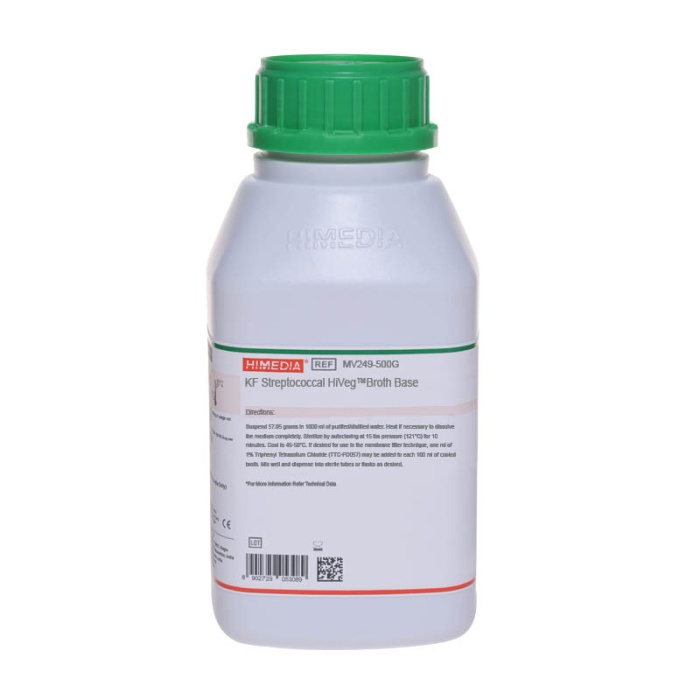
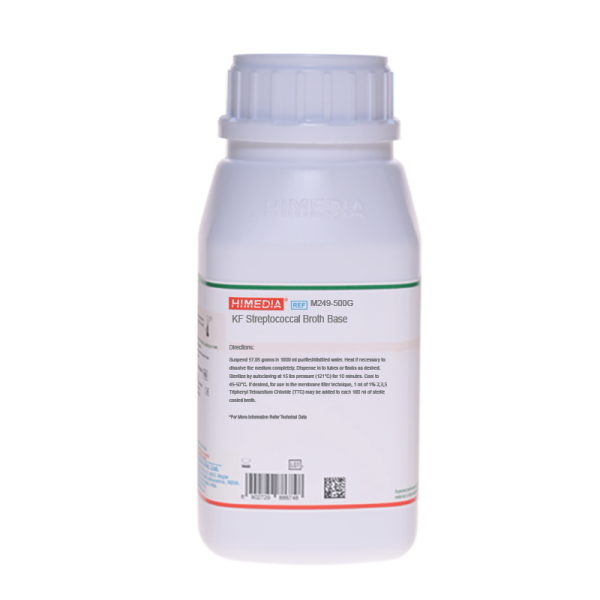
| Product Name | KF Streptococcal Broth Base |
|---|---|
| SKU | M249 |
| Product Type | Regular |
| Physical Form | Powder |
| Origin | Animal |
| Packaging type | HDPE |
| References | 1.Kenner B. A., Clark H. F. and Kabler P. W., 1960, Am. J. Public Health, 50:1553. 2.Kenner B. A., Clark H. F. and Kabler P. W., 1961, Appl. Microbiol., 9:15. 3.Downes F. P. and Ito K., (Eds.), 2001, Compendium of Methods for the Microbiological Examination of Foods, 4th Ed.,APHA, Washington, D.C. 4.MacFaddin J. F., 1985, Media for Isolation-Cultivation-Identification-Maintenance of Medical Bacteria, Vol. 1, Williamsand Wilkins, Baltimore. 5.Facklam R. R. and Moody M. P., 1970, Appl. Microbiol., 20:245 |
| Customized Product Available | No |