HiMedia Laboratories GmbH, Marie-Curie-Str. 3, 64683, Einhausen, Germany.

 Your enquiry has been submitted
Something problem with the server. Try again.
 Your enquiry has been submitted
Soyabean HiVeg® Medium/with 0.1% Agar is recommended for cultivation of anaerobes from root canals, blood and other specimens. With added carbohydrate it can also be used to study fermentation reaction.
| Ingredients | MV322 Grams/Litre | MV323 Grams/Litre |
|---|---|---|
| HiVeg® hydrolysate | 17.0 | 17.0 |
| Papaic digest of soyabean meal | 3.00 | 3.0 |
| Sodium chloride | 5.00 | 5.00 |
| Dipotassium phosphate | 2.50 | 2.50 |
| Dextrose | - | 2.50 |
| Agar | - | 1.00 |
Final pH (at 25°C) 7.3± 0.2
** Formula adjusted, standardized to suit performance parameters.
Vegetable based (Code MV)
Animal based (Code M)
Recommended for : Cultivation of anaerobes from root canals, blood and other specimens. With added carbohydrate it can also be used to study fermentation reaction.
Reconstitution : (MV322) : 27.5 g/l
: (MV323) : 31.0 g/l
Quantity on preparation (500g) : (MV322) : 18.18 L
: (MV323) : 16.12 L
pH (25°C) : 7.3± 0.2
Supplement : None
Sterilization : 121°C / 15 minutes.
Storage : Dry Medium - Below 30°C, Prepared Medium 2 - 8°C.
Suspend 27.5 grams of MV322 or 31 grams of MV323 in 1000 ml distilled water. Heat to boiling to dissolve the medium completely. Dispense as desired and sterilize by autoclaving at 15 lbs pressure (121°C) for 15 minutes.
These media are prepared by completely replacing animal based peptones with vegetable peptones which makes the media free of BSE/TSE risk. Soyabean HiVeg® Medium (MV322) is used as a base for more complex media for the cultivation of various organisms like Neisseria, pathogenic Streptococci etc. With the addition of carbohydrates it can also be used for fermentation studies of fastidious and non-fastidious organisms. Soyabean HiVeg® Medium with 0.1% Agar (MV323) is used for culturing organisms especially anaerobes from root canals, blood and other clinical samples. Inclusion of agar to this medium is useful for isolating anaerobic oral Vibrios (1) and also anaerobic organisms causing nasal sinusitis (2).
HiVeg® hydrolysate and Papaic digest of soyabean meal supplies nitrogenous and carbonaceous compounds, trace minerals etc. Dextrose serves as a source of fermentable carbohydrate for the energy production in MV323. While in MV322 dextrose is omitted from the formula to permit use of the medium in fermentation studies. The carbohydrate concentration used in fermentation reaction frequently is 0.5% or 1%. Sodium chloride maintains osmotic balance while dipotassium phosphate provides buffering capacity. Small percentage of agar helps in creating moderately anaerobic condition in the depth of the medium.
Appearance of powder
Light yellow coloured, homogeneous, free flowing powder.
Colour and Clarity
Yellow coloured, clear solution without any precipitate.
Reaction
Reaction of 2.75% w/v of MV322 or 3.1% w/v of MV323 aqueous solution is pH 7.3± 0.2 at 25°C.
Cultural Response
Cultural characteristics observed after an incubation at 35-37°C for 18-48 hours.
| Organisms (ATCC) | Inoculum (CFU) | Growth |
|---|---|---|
| Staphylococcus epidermidis (12228) | 102-103 | good-luxuriant |
| Streptococcus pneumoniae (6303) | 102-103 | good-luxuriant |
| Streptococcus pyogenes (19615) | 102-103 | good-luxuriant |
| Clostridium perfringens (12924)* | 102-103 | good-luxuriant |
| Bacteroides fragilis (25285)* | 102-103 | good-luxuriant |
| Neisseria meningitidis (13090) | 102-103 | good |
Key: * = Incubated anaerobically
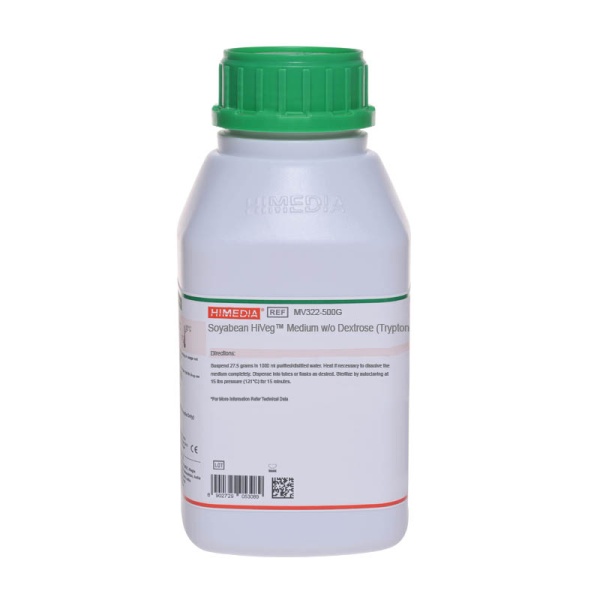
| Product Name | Soyabean HiVeg® Medium w/o Dextrose (Tryptone Soya HiVeg® Broth w/o Dextrose) |
|---|---|
| SKU | MV322 |
| Product Type | HiVeg™ |
| Physical Form | Powder |
| Origin | Animal Free (Veg) |
| Packaging type | HDPE |
| References | 1.MacFaddin J. F., 1985, Media for Isolation-Cultivation-Identification-Maintenance of Medical Bacteria, Vol. 1, Williams& Wilkins, Baltimore, M.d. 2.The United States Pharmacopoeia, 2008, USP31/NF26, The United States Pharmacopoeial Convention, Rockville, MD. 3.Indian Pharmacopoeia, 2007, Govt. of India, Ministry of Health and Family Welfare, New Delhi, India. 4.Forbes B. A., Sahm D. F. and Weissfeld A. S., 1998, Bailey & Scotts Diagnostic Microbiology, 10th Ed., Mosby, Inc. St.Louis, Mo. |
| Customized Product Available | No |