HiMedia Laboratories GmbH, Marie-Curie-Str. 3, 64683, Einhausen, Germany.

 Your enquiry has been submitted
Something problem with the server. Try again.

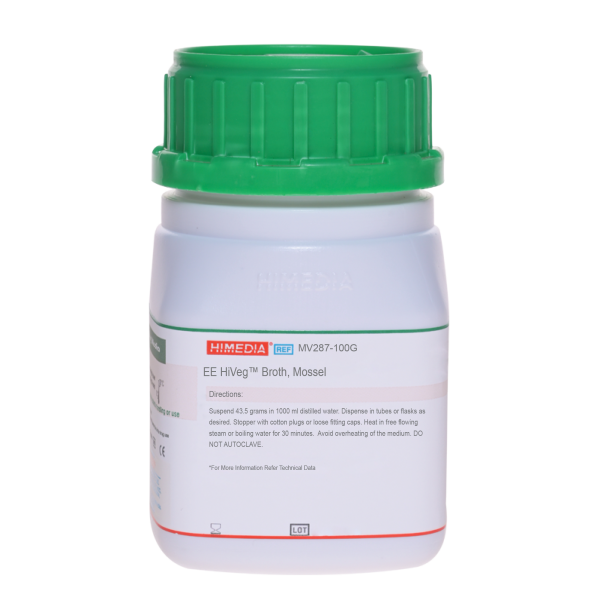
EE HiVeg® Broth / Modified is used for selective enrichment of Enterobacteriaceae in bacteriological examination of foods.
| Ingredients | MV287 Grams/Litrer |
MV287A Grams/Litrer |
|---|---|---|
| HiVeg® peptone | 25.00 | - |
| HiVeg® peptone No.2 | - | 25.00 |
| Dextrose | 5.00 | - |
| Glucose monohydrate | - | 5.00 |
| Synthetic detergent No.Il | 5.00 | 5.00 |
| Disodium phosphate | 6.45 | - |
| Disodium phosphate dihydrate | - | 8.00 |
| Monopotassium phosphate | 2.00 | 2.00 |
| Brilliant green | 0.0135 | 0.15 |
Final pH (at 25°C) 7.2± 0.2
** Formula adjusted, standardized to suit performance parameters
Product Profile :
Recommended for : Selective enrichment of Enterobacteriaceae.
Reconstitution : (MV287): 43.5 g/l
Reconstitution : (MV287A): 45 g/l
Quantity on preparation (500g) : (MV287): 11.49 L
Quantity on preparation (100g) : (MV287): 2.29 L
Quantity on preparation (500g) : (MV287A): 11.11 L
pH (25°C) : 7.2± 0.2
Supplement : None
Sterilization : Boiling (DO NOT AUTOCLAVE)
Storage : Dry Medium Below 30°C, Prepared Medium 2 - 8°C.
Suspend 43.5 grams of MV287 or 45 grams of MV287A in 1000 ml distilled water. Distribute in 100 ml quantities in 250 ml flasks. Stopper with cotton plugs or loose fitting caps. Heat in free flowing steam or boiling water for 30 minutes only. Avoid overheating of the medium as it is heat sensitive. Cool rapidly in cold running water. DO NOT AUTOCLAVE.
These media are prepared with animal peptones being replaced by vegetable peptones which makes the media BSE/TSE risk free. EE HiVeg® Media are the modification of EE Media which was formulated by Mossel et al and is recommended as an enrichment medium for Enterobacteriaceae in bacteriological examination of foods (1) and animal feed stuffs (2).
HiVeg® peptone, HiVeg® peptone No.2 and dextrose favour the growth of most members of Enterobacteriaceae, thus ensuring the detection of Salmonella and other lactose negative organisms. Brilliant green and synthetic detergent No.Il are the selective agents which inhibit gram-positive bacteria. Acid production causes the colour change from green to yellow, while a negative reaction results in no colour change and the medium remains green. Phosphates provides good buffers in the medium.
Enterobacteriaceae can be injured in food processing procedures, which include exposure to low temperature, sub marginal heat, drying, radiation, preservatives or sanitizers(3). Recovery relies on proper resuscitation of damaged cells. The damaged cells are resuscitated in well-aerated Tryptone Soya HiVeg® Broth (MV011) for 2 hours at 25°C prior to enrichment in EE HiVeg® Media.
EE HiVeg® Media is an enrichment broth and should be used in conjunction with Violet Red Glucose HiVeg® Agar (MV581). Subcultures must be made onto lactose differential media as MacConkey HiVeg® Agar (MV081), Deoxycholate Citrate HiVeg® Agar (MV065) or Brilliant Green HiVeg® Agar (MV016) for the detection of lactose negative or delayed lactose fermenters.
Incubation may be carried out at > 42°C for 18 hours, 32°C for 24-48 hours or 4°C for 10 days depending on the temperature characteristics of the organisms to be recovered
Appearance of Powder: Greenish yellow coloured, homogeneous, free flowing powder.
Colour and Clarity: Emerald green coloured, clear solution without any precipitate.
Reaction: Reaction of 4.35% w/v of MV287 or 4.5% w/v MV287A aqueous solution is pH 7.2± 0.2 at 25°C.
Cultural Response: Cultural characteristics was observed after an incubation at 35°C for 20- 24 hours.
| Organisms (ATCC) | Inoculum (CFU) | Growth | Acid |
|---|---|---|---|
| Enterobacter aerogenes (13048) | 102-103 | luxuriant | + |
| Escherichia coli (25922) | 102-103 | luxuriant | + |
| Proteus mirabilis (25933) | 102-103 | luxuriant | + |
| Staphylococcus aureus (25923) | 102-103 | inhibited | - |
| Shigella boydii (12030) | 102-103 | luxuriant | - |
| Salmonella serotype Enteritidis (13076) | 102-103 | luxuriant | ± |
| Product Name | EE HiVeg® Broth, Mossel |
|---|---|
| SKU | MV287 |
| Product Type | HiVeg™ |
| Physical Form | Powder |
| Origin | Animal Free (Veg) |
| Packaging type | HDPE |
| References | 1. Mossel D. A. A., and Harrewijn G. A., 1972, Alimenta II, 29-30 2.Mossel D. A. A., Vissar M. and Cornellisen A. M. R., 1963, J. Appl.Bacteriol., 26(3):444. 3.Van Schothurst M. et al, 1966, Vet Med., 13(3):273. 4.International Organization for Standardization (ISO), 1993, Draft ISO/DIS 7402. 5.Mossel D. A. A. and Ratto M. A., 1970, Appl. Microbiol., 20:273. 6.Mossel D. A. A., Shennan J. L. and Clare V., 1973, J. Sci. Fd. Agric., 24: 499. 7.Mossel D. A. A. and Ratto M. A., 1973, J. Food Technol., 8: 97. 8.Isenberg, H.D. Clinical Microbiology Procedures Handbook 2nd Edition.9.Jorgensen,J.H., Pfaller, M.A., Carroll, K.C., Funke, G., Landry, M.L., Richter, S.S and Warnock., D.W. (2015) Manual of Clinical Microbiology, 11th Edition. Vol. 1.10.Salfinger Y., and Tortorello M.L., 2015, Compendium of Methods for the Microbiological Examination of Foods, 5th Ed., American Public Health Association, Washington, D.C. |
| Customized Product Available | No |