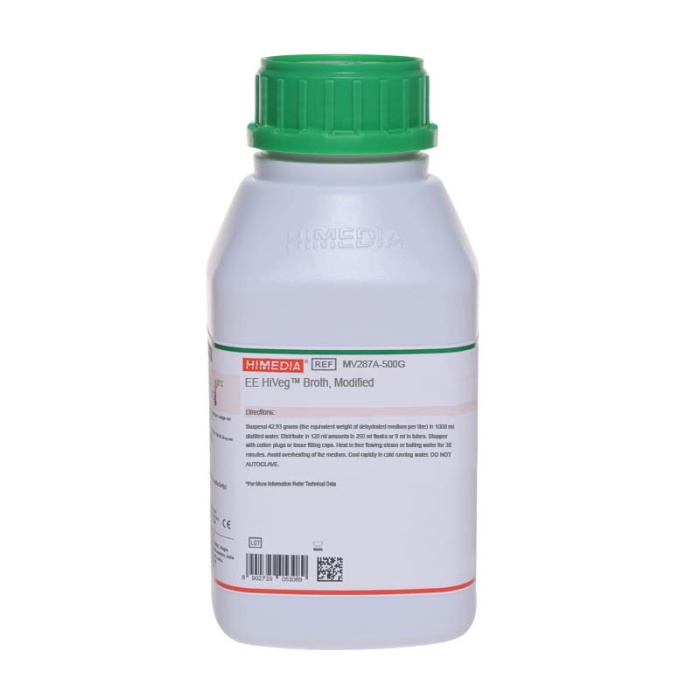
HiMedia Laboratories GmbH, Marie-Curie-Str. 3, 64683, Einhausen, Germany.

 Your enquiry has been submitted
Something problem with the server. Try again.
 Your enquiry has been submitted
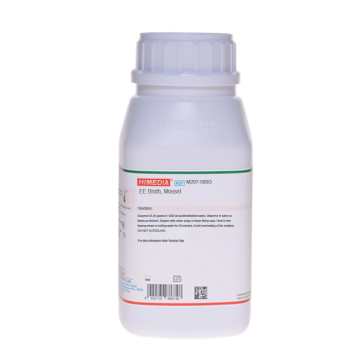
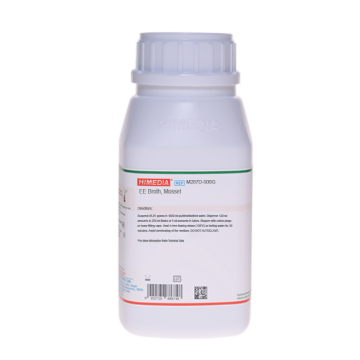
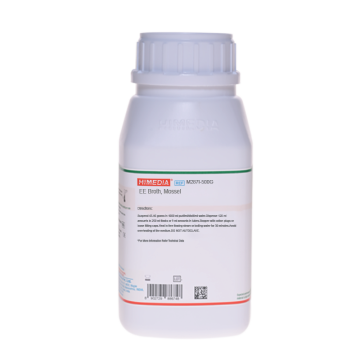
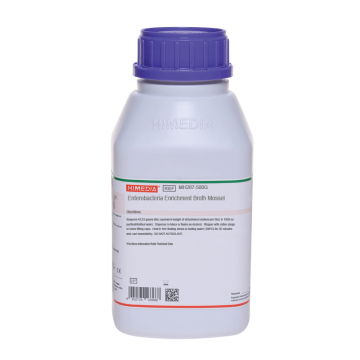
Recommended for selective enrichment of Enterobacteriaceae in the bacteriological examination of food and animal feed stuffs.
| Ingredients | Gms / Litre |
|---|---|
| Gelatin peptone @ | 10.000 |
| Glucose monohydrate | 5.000 |
| Disodium hydrogen phosphate dihydrate | 8.000 |
| Potassium dihydrogen phosphate | 2.000 |
| Bile, dried # | 20.000 |
| Brilliant green | 0.015 |
Final pH (at 25°C): 7.2±0.2
# Equivalent to Ox bile, dried @ Equivalent to Pancreatic digest of gelatin **Formula adjusted, standardized to suit performance parameters
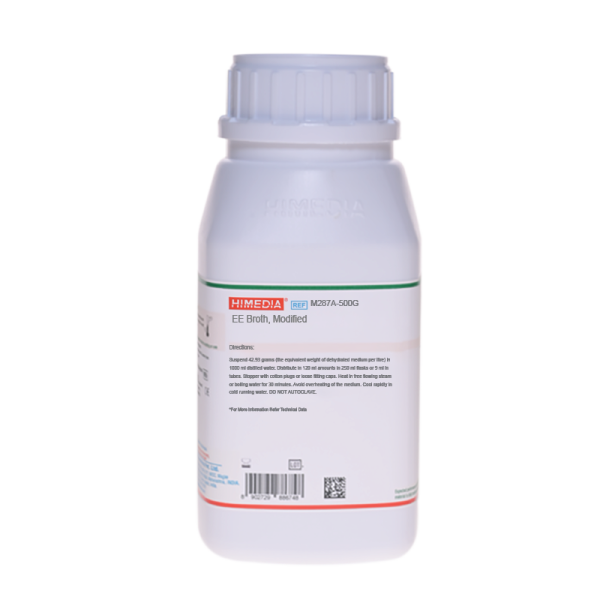
Suspend 42.93 grams (the equivalent weight of dehydrated medium per litre) in 1000 ml purified / distilled water. Distribute in 120 ml amounts in 250 ml flasks or 9 ml in tubes. Stopper with cotton plugs or loose fitting caps. Heat in free flowing steam or boiling water for 30 minutes. Avoid overheating of the medium. Cool to 45-50°C rapidly in cold running water. DO NOT AUTOCLAVE.
EE Broth, Modified is recommended as an enrichment medium for Enterobacteriaceae in bacteriological examination of foods and animal feed stuffs. Gelatin peptone, glucose allow the growth of most of the members of Enterobacteriaceae. Incorporation of brilliant green and Bile, dried makes the medium, inhibitory to non-Enterobacteriaceae. Lactose non fermenters, anaerogenic lactose fermenters or late lactose fermenters may be missed by the standard ‘Coli-aerogenes’ test. To overcome this problem, lactose is replaced by glucose in the media.
The cells damaged due to drying or exposure to low pH are resuscitated in well-aerated Tryptone Soya Broth (M011) for 2 hours at 25°C prior to enrichment. The resuscitation procedure is recommended for dried foods (3), animal feeds (4) and semi-preserved foods (5). This medium should be used in conjunction with Violet Red Bile Glucose Agar without Lactose (M581). Subcultures must be made onto lactose differential media as MacConkey Agar w/ 0.15% Bile salts, CV and NaCl (M081) and Deoxycholate Citrate Agar (M065).
Food samples and animal feed stuff
For food samples, follow appropriate techniques for sample collection and processing as per guidelines (6). After use, contaminated materials must be sterilized by autoclaving before discarding.
Read the label before opening the container. Wear protective gloves/protective clothing/eye protection/face protection. Follow good microbiological lab practices while handling specimens and culture. Standard precautions as per established guidelines should be followed while handling specimens. Safety guidelines may be referred in individual safety data sheets.
Performance of the medium is expected when used as per the direction on the label within the expiry period when stored at recommended temperature.
Appearance: Light yellow to greenish yellow coloured homogeneous free flowing powder
Colour and Clarity of prepared medium: Emerald green coloured clear solution without any precipitate
Reaction: Reaction of 4.3% w/v aqueous solution at 25°C. pH : 7.2±0.2
pH: 7.00-7.40
Cultural Response: Cultural characteristics observed after an incubation at 35-37°C for 18-24 hours.
| Organism | Inoculum (CFU) | Growth | Acid |
|---|---|---|---|
| # Klebsiella aerogenes ATCC 13048 (00175*) | 50-100 | luxuriant | Positive reaction, yellow colour |
| Escherichia coli ATCC 25922 (00013*) | 50-100 | luxuriant | Positive reaction, yellow colour |
| Proteus mirabilis ATCC 25933 | 50-100 | luxuriant | Positive reaction, yellow colour |
| Salmonella Enteritidis ATCC 13076 (00030*) | 50-100 | luxuriant | Variable reaction |
| Shigella boydii ATCC 12030 | 50-100 | luxuriant | Negative reaction, no colour change |
| Staphylococcus aureus subsp. aureus ATCC 25923 (00034*) | ≥104 | inhibited |
Key : (*) Corresponding WDCM numbers. (#) Formerly known as Enterobacter aerogenes
Store between 10-30°C in a tightly closed container and the prepared medium at 15 - 25°C. Use before expiry date on the label. On opening, product should be properly stored dry, after tightly capping the bottle in order to prevent lump formation due to the hygroscopic nature of the product. Improper storage of the product may lead to lump formation. Store in dry ventilated area protected from extremes of temperature and sources of ignition. Seal the container tightly after use. Product performance is best if used within stated expiry period.
User must ensure safe disposal by autoclaving and/or incineration of used or unusable preparations of this product. Follow established laboratory procedures in disposing of infectious materials and material that comes into contact with sample must be decontaminated and disposed of in accordance with current laboratory techniques (1,2).
| Product Name | EE Broth, Modified |
|---|---|
| SKU | M287A |
| Product Type | Regular |
| Physical Form | Powder |
| Origin | Animal |
| Packaging type | HDPE |
| References | 1. Mossel D. A. A., and Harrewijn G. A., 1972, Alimenta II, 29-30 2.Mossel D. A. A., Vissar M. and Cornellisen A. M. R., 1963, J. Appl.Bacteriol., 26(3):444. 3.Van Schothurst M. et al, 1966, Vet Med., 13(3):273. 4.International Organization for Standardization (ISO), 1993, Draft ISO/DIS 7402. 5.Mossel D. A. A. and Ratto M. A., 1970, Appl. Microbiol., 20:273. 6.Mossel D. A. A., Shennan J. L. and Clare V., 1973, J. Sci. Fd. Agric., 24: 499. 7.Mossel D. A. A. and Ratto M. A., 1973, J. Food Technol., 8: 97. |
| Customized Product Available | No |