HiMedia Laboratories GmbH, Marie-Curie-Str. 3, 64683, Einhausen, Germany.

 Your enquiry has been submitted
Something problem with the server. Try again.
 Your enquiry has been submitted
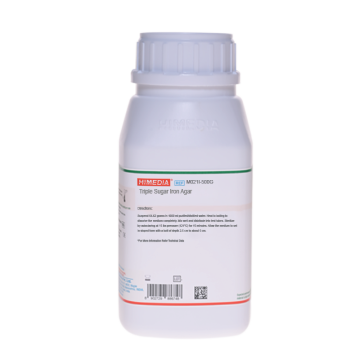
Triple Sugar Iron HiCynth™ Agar is used for the identification of gram-negative enteric bacilli on the basis of dextrose, lactose and sucrose fermentation and hydrogen sulphide production.
| Ingredients | Gms/Litre |
|---|---|
| HiCynth™ Peptone No.1* | 16.000 |
| HiCynth™ Peptone No.6* | 3.000 |
| Lactose | 10.000 |
| Sucrose | 10.000 |
| Dextrose | 1.000 |
| Sodium chloride | 4.000 |
| Sodium thiosulphate | 3.000 |
| Ferric sulphate | 0.200 |
| Ferric ammonium citrate | 0.300 |
| Histidine | 2.000 |
| DL-Methionine | 2.000 |
| Arginine | 1.000 |
| Phenol red | 0.024 |
| Agar | 12.000 |
| Final pH (at 25°C) | 7.4±0.2 |
**Formula adjusted, standardized to suit performance parameters
*Chemically defined peptones
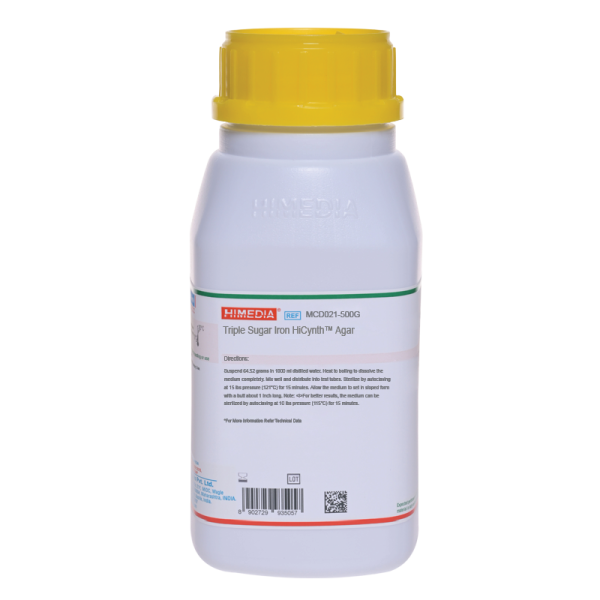
Suspend 64.52 grams in 1000 ml distilled water. Heat to boiling to dissolve the medium completely. Mix well and distribute into test tubes. Sterilize by autoclaving at 15 lbs pressure (121°C) for 15 minutes. Allow the medium to set in sloped form with a butt about 1 inch long.
Note: For better results, the medium can be sterilized by autoclaving at 10 lbs pressure (115°C) for 15 minutes.
Triple Sugar Iron Agar was originally proposed by Sulkin and Willett (1) and modified by Hajna (2) for identifying Enterobacteriaceae. This medium complies with the recommendation of APHA, for the examination of meat and food products (3), for the examination of milk and dairy products (4) and for microbial limit test for confirming the presence of Salmonellae (5, 6) and in the identification of gram-negative bacilli (6,7). Triple Sugar Iron HiCynth™ Agar is the modification using chemically defined peptones free from animal and vegetable peptones to avoid BSE/TSE risks associated with animal peptones.
HiCynth™ Peptone No.1 and HiCynth™ Peptone No.6 provide nitrogenous and carbonaceous compounds, sulphur, trace elements and vitamin B complex etc. Sodium chloride maintains osmotic equilibrium. Lactose, sucrose and dextrose are the fermentable carbohydrates. Sodium thiosulphate and ferrous ions make H2S indicator system. Phenol red is the pH indicator. Organisms that ferment glucose produce a variety of acids, turning the colour of the medium from red to yellow. More amount of acids are liberated in butt (fermentation) than in the slant (respiration). Growing bacteria also form alkaline products from the oxidative decarboxylation of peptone and these alkaline products neutralize the large amounts of acid present in the butt. Thus the appearance of an alkaline (red) slant and an acid (yellow) butt after incubation indicates that the organism is a glucose fermenter but is unable to ferment lactose and/or sucrose. Bacteria that ferment lactose or sucrose (or both), in addition to glucose, produce large amounts of acid enables no reversion of pH in that region and thus bacteria exhibit an acid slant and acid butt. Gas production (CO2) is detected by the presence of cracks or bubbles in the medium, when the accumulated gas escapes. Thiosulphate is reduced to hydrogen sulphide by several species of bacteria and H2S combines with ferric ions of ferric salts to produce the insoluble black precipitate of ferrous sulphide. Reduction of thiosulphate proceeds only in an acid environment and blackening usually occurs in the butt of the tube. Triple Sugar Iron HiCynth™ Agar should be used in environment and blackening usually occurs in the butt of the tube. Triple Sugar Iron HiCynth™ Agar should be used in parallel with Urea Agar / Broth to distinguish between Salmonella and Proteus species. The reactions can be summarized as follows:
Some members of the Enterobacteriaceae and H2S producing Salmonella may not be H2S positive on TSI Hicynth™ Agar. Some bacteria may show H2S production on Kligler Iron HiCynth™ Agar but not on TSI HiCynth™ Agar. This can happen because utilization of sucrose in TSI HiCynth™ Agar suppresses the enzymic pathway that result in H2S production.
Appearance: Light yellow to pink homogeneous free flowing powder
Gelling: Firm, comparable with 1.2% Agar gel.
Colour and Clarity of prepared medium: Pinkish red coloured clear to slightly opalescent gel forms in tubes as slants.
Reaction: Reaction of 6.45% w/v aqueous solution at 25°C. pH: 7.4±0.2
pH: 7.20-7.60
Cultural Response: Cultural characteristics observed after an incubation at 35-37°C for 18-24 hours.
| Organism | Inoculum (CFU) | Growth | Slant | Butt | Gas | H2S |
|---|---|---|---|---|---|---|
| Cultural Response | ||||||
| Citrobacter freundii ATCC 8090 | 50-100 | luxuriant | acidic reaction, yellowing of the medium | acidic reaction, yellowing of the medium | positive reaction | positive, blackening of medium |
| Enterobacter aerogenes ATCC 13048 | 50-100 | luxuriant | acidic reaction, yellowing of the medium | acidic reaction, yellowing of the medium | positive reaction | negative, no blackening of medium |
| Escherichia coli ATCC 25922 | 50-100 | luxuriant | acidic reaction, yellowing of the medium | acidic reaction, yellowing of the medium | positive reaction | negative, no blackening of medium |
| Klebsiella pneumoniae ATCC 13883 | 50-100 | luxuriant | acidic reaction, yellowing of the medium | acidic reaction, yellowing of the medium | positive reaction | negative, no blackening of medium |
| Proteus vulgaris ATCC 13315 | 50-100 | luxuriant | alkaline reaction, red colour of the medium | acidic reaction, yellowing of the medium | negative reaction | positive, blackening of medium |
| Salmonella Paratyphi A ATCC 9150 | 50-100 | luxuriant | alkaline reaction, red colour of the medium | acidic reaction, yellowing of the medium | positive reaction | negative, no blackening of medium |
| Salmonella Typhi ATCC 6539 | 50-100 | luxuriant | alkaline reaction, red colour of the medium | acidic reaction, yellowing of the medium | negative reaction | positive, blackening of medium |
| Salmonella Typhimurium ATCC 14028 | 50-100 | luxuriant | alkaline reaction, red colour of the medium | acidic reaction, yellowing of the medium | positive reaction | positive, blackening of medium |
| Shigella flexneri ATCC 12022 | 50-100 | luxuriant | alkaline reaction, red colour of the medium | acidic reaction, yellowing of the medium | negative reaction | negative, no blackening of medium |
| Escherichia coli ATCC 8739 50-100 | luxuriant | acidic reaction, yellowing of the medium | acidic reaction, yellowing of the medium | positive reaction | negative, no blackening of medium | |
| Escherichia coli NCTC 9002 50-100 | luxuriant | acidic reaction, yellowing of the medium | acidic reaction, yellowing of the medium | positive reaction | negative, no blackening of medium | |
| Klebsiella pneumoniae ATCC 10031 | 50-100 | luxuriant | acidic reaction, yellowing of the medium | acidic reaction, yellowing of the medium | positive reaction | negative, no blackening of medium |
Store below 30°C in a tightly closed container and the prepared medium at 2 - 8°C. Use before expiry date on the label.
| Product Name | Triple Sugar Iron HiCynth™ Agar |
|---|---|
| SKU | MCD021 |
| Product Type | HiCynth™ |
| Physical Form | Powder |
| Origin | Chemically defined (HiCynth™), Lactose |
| Packaging type | HDPE |
| References | 1. Sulkin E.S. and Willett J.C., 1940, J. Lab. Clin. Med., 25:649. 2.Hajna A.A., 1945, J. Bacteriol, 49:516. 3.Salfinger Y., and Tortorello M.L. Fifth (Ed.), 2001, Compendium of Methods for the Microbiological Examination ofFoods, 5th Ed., American Public Health Association, Washington, D.C. 4.Wehr H. M. and Frank J. H., 2004, Standard Methods for the Microbiological Examination of Dairy Products, 17th Ed.,APHA Inc., Washington, D.C. 5.Finegold S. M. and Baron E. J., 1986, Bailey and Scotts Diagnostic Microbiology, 7th Ed., The C.V. Mosby Co., St. Louis. 6.Baird R.B., Eaton A.D., and Rice E.W., (Eds.), 2015, Standard Methods for the Examination of Water and Wastewater,23rd ed., APHA, Washington, D.C. 7.MacFaddin J., 1985, Media for Isolation-Cultivation-Identification-Maintenance of Medical Bacteria, Vol. 1, Williams andWilkins, Baltimore. 8.Isenberg, H.D. Clinical Microbiology Procedures Handb0ook. 2nd Edition. 9.Jorgensen,J.H., Pfaller , M.A., Carroll, K.C., Funke, G., Landry, M.L., Richter, S.S and Warnock., D.W. (2015)Manual of Clinical Microbiology, 11th Edition. Vol. 1. |
| Customized Product Available | No |