HiMedia Laboratories GmbH, Marie-Curie-Str. 3, 64683, Einhausen, Germany.

 Your enquiry has been submitted
Something problem with the server. Try again.
 Your enquiry has been submitted
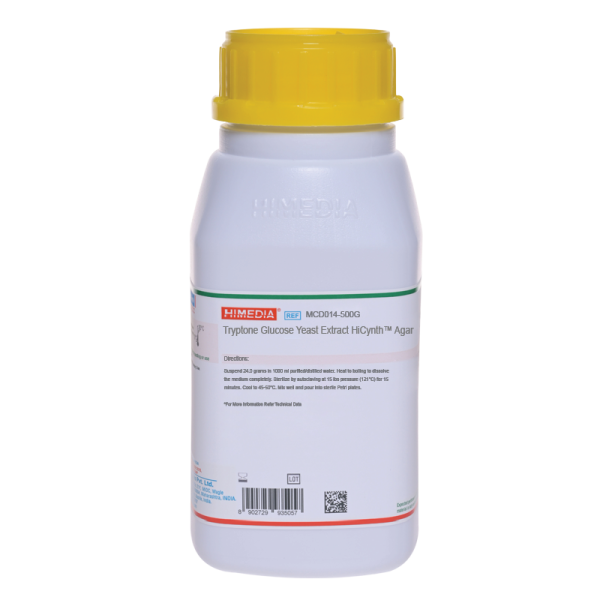
Tryptone Glucose Yeast Extract HiCynth™ Agar is recommended for enumeration of bacteria in water, air, milk and dairy products.
| Ingredients | Gms / Litre |
|---|---|
| HiCynth™ Peptone No.2* | 5.000 |
| HiCynth™ Peptone No.5* | 3.000 |
| Glucose | 1.000 |
| Agar | 15.000 |
| Final pH (at 25°C) | 7.0±0.2 |
**Formula adjusted, standardized to suit performance parameters
*Chemically defined peptones
Suspend 24 grams in 1000 ml distilled water. Heat to boiling to dissolve the medium completely. Sterilize by autoclaving at 15 lbs pressure (121°C) for 15 minutes. Cool to 45-50°C. Mix well and pour into sterile Petri plates.
Tryptone Glucose Yeast Extract Agar was originally developed by Bowers and Hucker (1) which they called as Tryptone Glucose Skim Milk Agar. Tryptone Glucose Yeast Extract HiCynth™ Agar is prepared by completely replacing peptones (animal or vegetable based) with chemically defined peptones to avoid BSE/TSE risks associated with animal peptones. Later on it was modified to the present composition for the cultivation and enumeration of bacteria in air, water (2), milk and dairy products (3). Various authors have studied different aspects of this medium like study of thermophilic bacteria in milk (4), influence of incubation temperature (5) etc. It is used as a standard medium for the bacteriological plate count of milk and dairy products (6). The same is modified using chemically defined peptone free from animal and vegetable peptone.
HiCynth™ Peptone No.2 and HiCynth™ Peptone No.5 provide nitrogenous and carbanaceous compounds, long chain amino acids, vitamin B complex and other essential growth nutrients. HiCynth™ Peptone No.2 and HiCynth™ Peptone No.5 are chemically defined peptones which provides advantage of being consistent and are BSE/TSE and GMO free. Glucose is the energy source. For the enumeration purposes, pour plate method is suggested. Medium must be quickly poured into Petri dishes if milk sample is to be tested, because the milk may get flocculated if the medium remains hot for longer period of time.
Appearance: Cream to yellow homogeneous free flowing powder
Gelling: Firm, comparable with 1.5% Agar gel
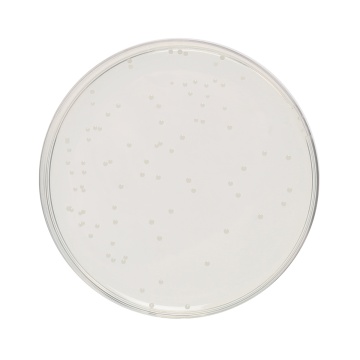
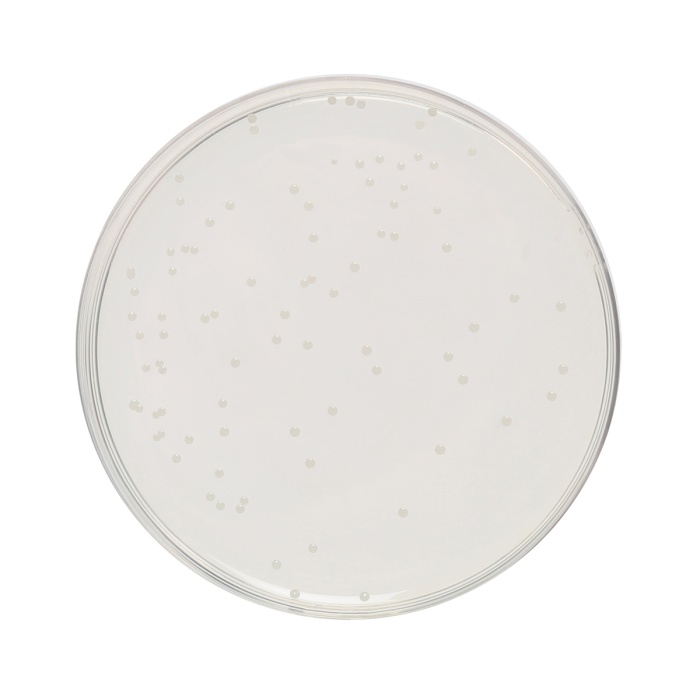
Colour and Clarity of prepared medium: Light yellow coloured clear to slightly opalescent gel forms in Petri plates.
Reaction: Reaction of 2.4% w/v aqueous solution at 25°C. pH: 7.0±0.2
pH: 6.80-7.20
Cultural Response: Cultural characteristics observed after an incubation at 35-37°C for 18-48 hours.
| Organism | Inoculum (CFU) | Growth | Recovery |
|---|---|---|---|
| Bacillus subtilis ATCC 6633 | 50-100 | good-luxuriant | >=70% |
| Enterobacter aerogenes ATCC 13048 | 50-100 | good-luxuriant | >=70% |
| Escherichia coli ATCC 25922 | 50-100 | good-luxuriant | >=70% |
| Enterococcus faecalis ATCC 29212 | 50-100 | good-luxuriant | >=70% |
| Lactobacillus casei ATCC 9595 | 50-100 | good-luxuriant | >=70% |
| Pseudomonas aeruginosa ATCC 27853 | 50-100 | good-luxuriant | >=70% |
| Staphylococcus aureus ATCC 25923 | 50-100 | good-luxuriant | >=70% |
Store below 30°C in a tightly closed container and the prepared medium at 2 - 8°C. Use before expiry date on the label..
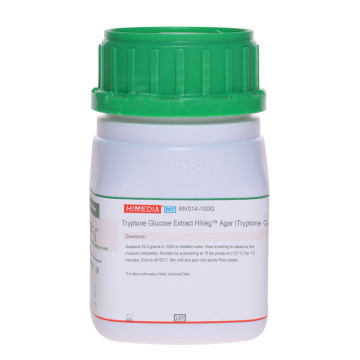
| Product Name | Tryptone Glucose Extract HiCynth™ Agar (Tryptone Glucose Yeast Extract HiCynth™ Agar) |
|---|---|
| SKU | MCD014 |
| Product Type | HiCynth™ |
| Physical Form | Powder |
| Origin | Chemically defined (HiCynth™) |
| Packaging type | HDPE |
| References | 1. Bowers and Hucker, 1935, Tech. Bull., 228, N.Y.State Agr. Expt. Station. 2.Eaton A. D., Clesceri L. S. and Greenberg A. W., (Eds.), 2005, Standard Methods for the Examination of Water andWastewater, 21st Ed., APHA, Washington, D.C. 3.Wehr H. M. and Frank J. H., 2004, Standard Methods for the Microbiological Examination of Dairy Products, 17th Ed.,APHA Inc., Washington, D.C. 4.Pickett, 1928, Tech. Bull. 147, N.Y. State Agr. Expt. Station. 5.Dennis and Weiser, 1937, J.Dairy Science, 20 : 445. 6.Abele C. A., Am. J. Pub. Health, 1939, 29: 821. |
| Customized Product Available | No |