HiMedia Laboratories GmbH, Marie-Curie-Str. 3, 64683, Einhausen, Germany.

 Your enquiry has been submitted
Something problem with the server. Try again.

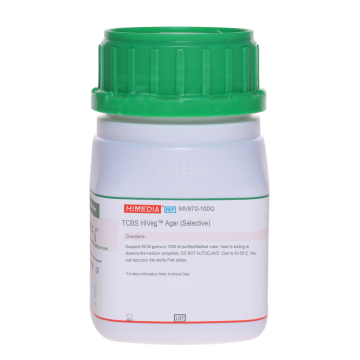
Recommended for selective isolation of Vibrio cholerae and other enteropathogenic Vibrio's from clinical and non-clinical samples.
| Ingredients | Gms / Litre |
|---|---|
| Peptone, special | 10.000 |
| Yeast extract | 5.000 |
| Sodium citrate | 10.000 |
| Sodium thiosulphate | 10.000 |
| Sodium cholate | 3.000 |
| Bile# | 5.000 |
| Sucrose | 20.000 |
| Sodium chloride | 10.000 |
| Ferric citrate | 1.000 |
| Bromo thymol blue | 0.040 |
| Thymol blue | 0.040 |
| Agar | 14.000 |
| Final pH (at 25°C) | 8.6±0.1 |
**Formula adjusted, standardized to suit performance parameters
# Equivalent to Oxgall
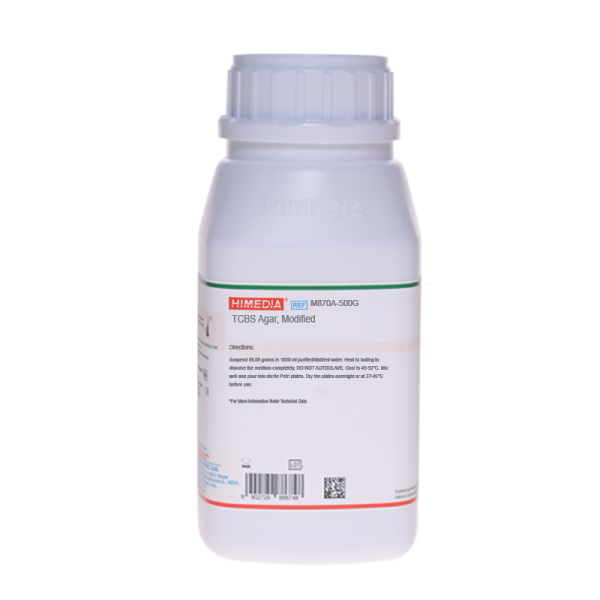
Suspend 88.08 grams in 1000 ml purified/distilled water. Heat to boiling to dissolve the medium completely. DO NOT AUTOCLAVE. Cool to 45-50°C. Mix well and pour into sterile Petri plates. Dry the plates overnight or at 37-45°C before use.
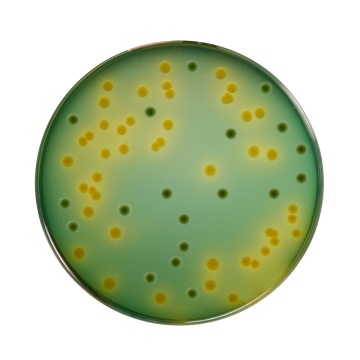
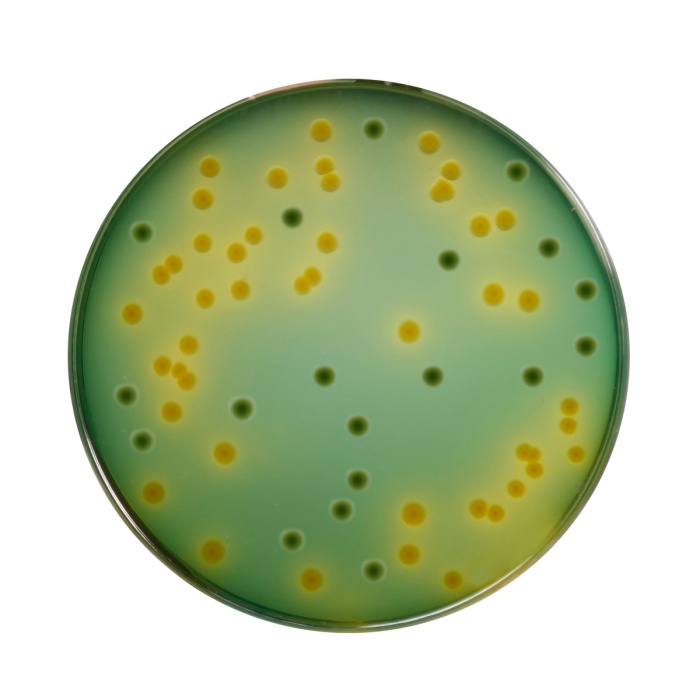
TCBS Agar was first formulated by Nakanishi and further modified by Kobayashi et al. It promotes rapid growth of pathogenic Vibrio's after 24 hours incubation at 37°C. The contaminating non-vibrio' s are suppressed. Peptone special and yeast extract provide nitrogenous and carbonaceous compounds, long chain amino acids, vitamin B complex and other essential growth nutrients. Bile a derivative of bile salts and the sodium citrate inhibit gram-positive bacteria. Sodium thiosulphate serves as a good source of sulphur, which in combination with ferric citrate detects the production of hydrogen sulphide. For the metabolism of Vibrio's, sucrose is added as a fermentable carbohydrate. Bromo thymol blue and thymol blue are the pH indicators. The alkaline pH of the medium improves the recovery of Vibrio cholerae. Strains of Vibrio cholerae produce yellow colonies on TCBS Agar because of fermentation of sucrose. Vibrio alginolyticus also produce yellow colonies. Vibrio parahaemolyticus is a sucrose non-fermenting organism and produces blue-green colonies, as of Vibro vulnificus. As mentioned previously, occasional isolates of Pseudomonas and Aeromonas species also produce blue-green colonies, but overall TCBS Agar is highly selective and any H2S-negative colony is possibly Vibrio species. The medium should be inoculated heavily with faecal specimens because some Vibrio species readily die off on the medium, owing to fermentation of sucrose and accumulation of acids.
Clinical: faeces, etc; Food samples; Water samples
For clinical samples follow appropriate techniques for handling specimens as per established guidelines.
For food samples, follow appropriate techniques for sample collection and processing as per guidelines.
For water samples, follow appropriate techniques for sample collection, processing as per guidelines and local standards.
After use, contaminated materials must be sterilized by autoclaving before discarding.
In Vitro diagnostic use only. For professional use only. Read the label before opening the container. Wear protective gloves/protective clothing/eye protection/face protection. Follow good microbiological lab practices while handling specimens and culture. Standard precautions as per established guidelines should be followed while handling clinical specimens. Safety guidelines may be referred in individual safety data sheets.
Appearance
Light yellow to tan coloured homogeneous free flowing powder
Gelling
Firm, comparable with 1.4% Agar gel.
Colour and Clarity of prepared medium
Bluish green colured clear to slightly opalescent gel forms in petri plates.
Reaction
Reaction of 8.8% w/v aqueous solution at 25°C. pH: 8.6±0.1
pH
8.50-8.70
Cultural characteristics observed after an incubation at 35-37°C for 18-24 hours.
| Organism | Inoculum ((CFU) | Growth | Recovery | Colour of colony |
|---|---|---|---|---|
| Vibrio parahaemolyticus NCTC 10885 (00185*) | 50-100 | good-luxuriant | >=50% | blue |
| Vibrio furnissii NCTC 11218 ((00186*)*) | 50-100 | good-luxuriant | >=50% | greenish yellow |
| Organism | Inoculum ((CFU) | Growth | Recovery |
|---|---|---|---|
| Escherichia coli ATCC 25922 (00013*) | >=104 | inhibited | 0% |
| Escherichia coli ATCC 8739(00012*) | >=104 | inhibited | 0% |
| Escherichia coli ATCC 11775(00090*) | >=104 | inhibited | 0% |
| Organism | Inoculum ((CFU) | Growth | Recovery | Colour of colony |
|---|---|---|---|---|
| Vibrio parahaemolyticus ATCC 17802 (00037*) | 50-100 | good-luxuriant | >=50% | blue |
| Vibrio cholerae ATCC 15748 | 50-100 | good-luxuriant | >=50% | yellow |
| Vibrio fluvialis ATCC 33809 (00137*) | 50-100 | good-luxuriant | >=50% | yellow |
| Vibrio vulnificus ATCC 29306 | 50-100 | fair - good | 20-30% | greenish yellow |
| Proteus vulgaris ATCC 13315 | >=104 | inhibited | 0% | |
| Shigella flexneri ATCC 12022 (00126*) | >=104 | inhibited | 0% | |
| Enterococcus faecalis ATCC 29212 (00087*) | >=104 | inhibited | 0% |
Key: (*) Corresponding WDCM numbers
Store between 10-30°C in a tightly closed container and the prepared medium at 20-30°C. Use before expiry date on the label. On opening, product should be properly stored dry, after tightly capping the bottle inorder to prevent lump formation due to the hygroscopic nature of the product. Improper storage of the product may lead to lump formation. Store in dry ventilated area protected from extremes of temperature and sources of ignition Seal the container tightly after use. Product performance is best if used within stated expiry period.
User must ensure safe disposal by autoclaving and/or incineration of used or unusable preparations of this product. Follow established laboratory procedures in disposing of infectious materials and material that comes into contact with clinical sample must be decontaminated and disposed of in accordance with current laboratory techniques.
| Product Name | TCBS Agar, Modified |
|---|---|
| SKU | M870A |
| Product Type | Regular |
| Physical Form | Powder |
| Origin | Animal |
| Packaging type | HDPE |
| References | 1. Kobayashi T., Enomoto S., Sakazaki R., and Kuwahara S., 1963, Jap. J. Bacteriol., 18: 387. |
| Customized Product Available | No |