Plot No. C40, Road No. 21Y, MIDC, Wagle Industrial Estate, Thane(W)-400604, MH, India


 Your enquiry has been submitted
Something problem with the server. Try again.
 Your enquiry has been submitted
M16 Agar is recommended for cultivation and enumeration of lactic streptococci used in manufacture of cheddar cheese.
| Ingredients | Gms / Litre |
|---|---|
| Papaic digest of soyabean meal | 5.000 |
| Tryptose | 5.000 |
| Beef extract | 5.000 |
| Yeast extract | 2.500 |
| Dextrose | 5.000 |
| Ascorbic acid | 0.500 |
| Sodium acetate | 3.000 |
| Agar | 10.000 |
Final pH (at 25°C): 7.2±0.2
**Formula adjusted, standardized to suit performance parameters
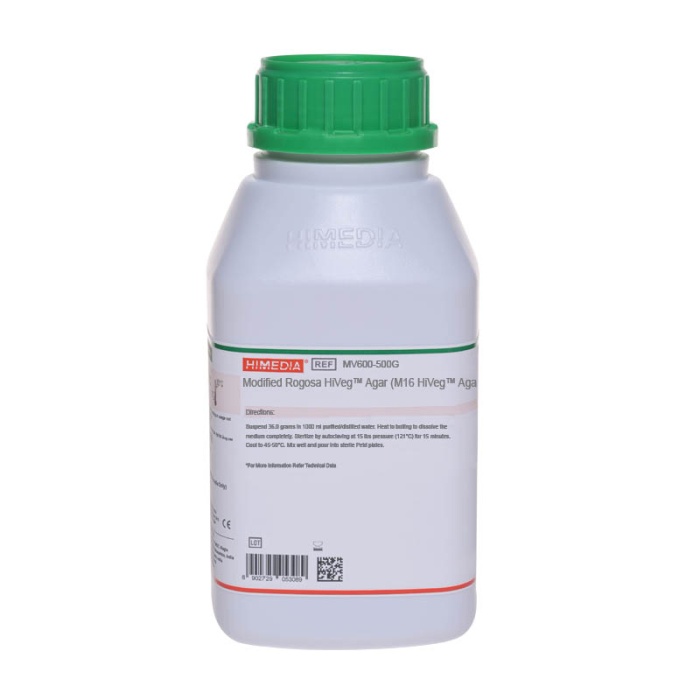
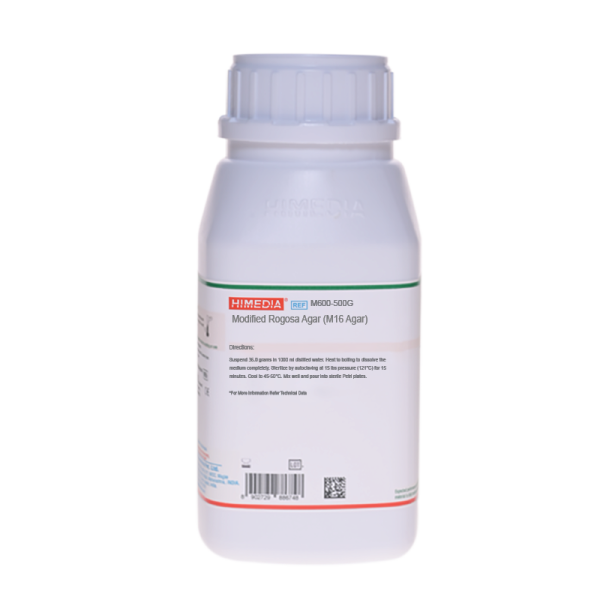
Suspend 36 grams in 1000 ml distilled water. Heat to boiling to dissolve the medium completely. Sterilize by autoclaving at 15 lbs pressure (121°C) for 15 minutes. Mix well and pour into sterile Petri plates.
A variety of acid-producing bacteria are found in nature, in the soil, on raw agricultural products and in certain processed foods. One of the most important groups of acid producing bacteria in food industry is the lactic acid bacteria. Streptococci belong to the lactic acid bacteria group.
Streptococcus is a genus of spherical, gram-positive bacteria, and a member of the phylum Firmicutes (1). M16 Agar is a modification of Rogosa Sodium Lactate Agar recommended by APHA (1, 3). This medium was developed to support growth of lactic streptococci used in cheddar cheese manufacturing in New Zealand (2). This medium can also be used as selective medium for the cultivation of oral and faecal lactobacilli. Since some lactobacilli do not grow on this medium if incubated aerobically, incubation in a CO2-enriched atmosphere is recommended.
The large number of media proposed for lactic acid bacteria, particularly for streptococci and/or lactobacilli, is an indicative of the variability in growth features of different species, thereby the difficulties encountered in growing some strains of this group of organisms. While the lactic acid bacteria in general are tolerant to low pH, they can be very sensitive to other adverse conditions. Freezing and thawing prior to analysis may be detrimental to cell growth. Dilution process may also damage lactic acid bacteria in samples, thus it is best to use sterile 0.1% Peptone Water (M028) as the diluent.
Papaic digest of soyabean meal, tryptose and beef extract provide the essential nutrients like amino acids, minerals etc. Yeast extract supplies vitamin B complex to the lactic streptococci. Dextrose is the fermentable carbohydrate and energy source. Sodium acetate inhibits other contaminating bacteria and suppresses swarming growth. Ascorbic acid provides vitamin C to the organisms.
The samples to be tested are processed to enumerate bacteria by pour plate technique.
Appearance: Cream to yellow homogeneous free flowing powder
Gelling: Firm, comparable with 1.0% Agar gel.
Colour and Clarity of prepared medium: Light amber coloured clear to slightly opalescent gel forms in Petri plates
Reaction of 3.6% w/v aqueous solution at 25°C. pH: 7.2±0.2
7.00-7.40
M600: Cultural characteristics observed after an incubation at 35-37°C for 18-48 hours in CO2 enriched atmosphere.
| Organism | Inoculum (CFU) | Growth | Recovery |
|---|---|---|---|
| Lactobacillus lactis ATCC 8000 | 50-100 | good-luxuriant | >=50% |
| Streptococcus cremoris ATCC 19257 | 50-100 | good-luxuriant | >=50% |
Store below 8°C and the prepared medium at 2 - 8°C. Use before expiry date on the label.
| Product Name | M16 Agar (Modified Rogosa Agar) |
|---|---|
| SKU | M600 |
| Product Type | Regular |
| Physical Form | Powder |
| Origin | Animal |
| Packaging type | HDPE |
| References | 1. Downes F. P. and Ito K., (Eds.), 2001, Compendium of Methods for the Microbiological Examination of Foods, 4th Ed.,APHA, Washington, D.C. 2.Lowrie R. J. and Pearce L. E., 1971, New Zealand, J. Dairy Sci. Technol., 6: 166. 3.Rogosa M., Mitchell J. A. and Wiseman R. F., 1951, J. Bacteriol., 62 : 132-133 |