HiMedia Laboratories GmbH, Marie-Curie-Str. 3, 64683, Einhausen, Germany.

 Your enquiry has been submitted
Something problem with the server. Try again.
 Your enquiry has been submitted
| Ingredients | Gms / Litre |
|---|---|
| Peptic digest of animal tissue | 5.000 |
| Meat extract | 3.000 |
| Potassium nitrate | 1.000 |
| Sodium chloride | 30.000 |
Final pH (at 25°C) 7.0±0.2
**Formula adjusted, standardized to suit performance parameters
Suspend 39 grams in 1000 ml distilled water. Heat if necessary to dissolve the medium completely. Dispense in tubes and sterilize by autoclaving at 15 lbs pressure (121°C) for 15 minutes.
Nitrate Broth is prepared in accordance with the formula published in 'Pure Culture Study of Bacteria' of the Society of American Bacteriologist (1) and present modified formula is recommended by BIS (2). The ability to reduce nitrate is valuable for differentiating and identifying various types of bacteria especially Enterobacteriaceae family (3). Recently ISO committee (4) has recommended Nitrate Broth for the enumeration of Bacillus cereus - colony count technique at 30°C (4).
Non-fermenters and other miscellaneous gram-negative bacilli vary in their ability to reduce nitrates. Some members of this group are capable of denitrification which is a reduction of nitrate to nitrogen gas. For the glucose fermenting gram-negative bacilli, the production of nitrogen gas from nitrate is an important differential test (4). Reduction of nitrate is generally an anaerobic respiration in which an organism derives its oxygen from nitrate. Members of Enterobacteriaceae characteristically reduce nitrate to nitrite which reacts with sulfanilic acid and N,N-dimethyl-1-naphthylamine to produce the red colour. This reaction is known as Griess reaction. If an organism grows rapidly and reduces nitrate actively, the test should be performed after an early incubation period since the nitrite may be further reduced to nitrogen.
Preparation of Nitrate Test Reagents:
For the test: Put few drops of each reagent into the tube containing culture to be tested. A distinct red or pink colour indicates nitrate reduction. The results should be recorded within 5 - 10 seconds as the colour fades on standing. A control (uninoculated) tube should also be tested. If there is no pink colour formation, add pinch of zinc dust to confirm the absence of nitrate in the medium (5). Nitrate reduction is not a confirmatory test. Complete identification should include the morphology, gram reaction, biochemical and serological tests. Addition of excess zinc may result in false-negative reaction.
Appearance Cream to yellow coloured homogeneous free flowing powder
Colour and Clarity of prepared medium Light amber coloured clear to slightly opalescent solution forms in tubes.
Reaction Reaction of 3.9% w/v aqueous solution at 25°C. pH: 7.0±0.2
M439S: Cultural characteristics observed after an incubation at 35-37°C for 18-24 hours.
| Organism | Inoculum (CFU) | Growth | Nitrate Reduction |
|---|---|---|---|
| Bacillus cereus ATCC 10876 | 50-100 | luxuriant | Positive reaction, red colour developed within 1-2 minutes |
| Enterobacter aerogenes ATCC 13048 | 50-100 | luxuriant | Positive reaction, red colour developed within 1-2 minutes |
| Escherichia coli ATCC 25922 | 50-100 | luxuriant | Positive reaction, red colour developed within 1-2 minutes |
| Salmonella Typhimurium ATCC 14028 | 50-100 | luxuriant | Positive reaction, red colour developed within 1-2 minutes |
Store below 30°C in tightly closed container and the prepared medium at 2-8°C. Use before expiry date on the label.
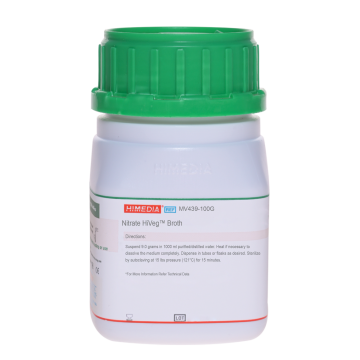
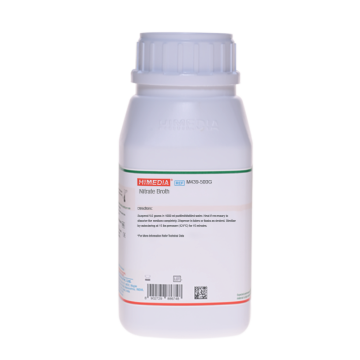
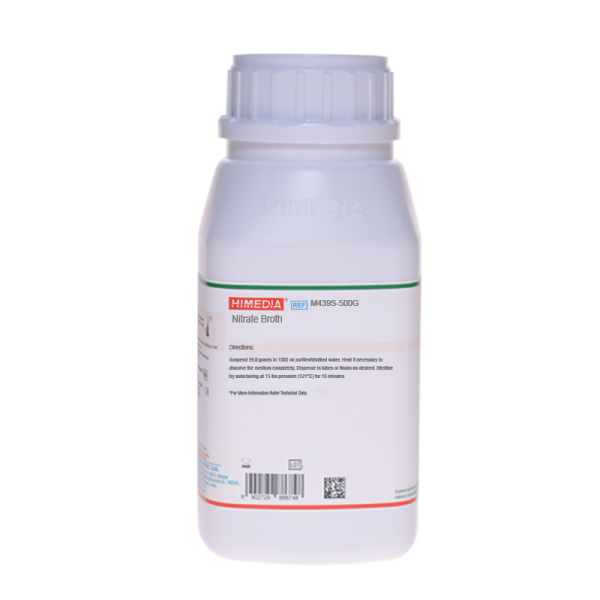
| Product Name | Nitrate Broth |
|---|---|
| SKU | M439S |
| Product Type | Regular |
| Physical Form | Powder |
| Origin | Animal |
| Packaging type | HDPE |
| References | 1.Society of American Bacteriologist, Pure Culture Study of Bacteria, 1944, 12 : Leaflet 11: 8. 2.Ewing, 1986, Edwards and Ewings Identification of Enterobacteriaceae, 4th ed., Elsevier Science Pub. Co., Inc., N.Y. 3.MacFaddin, 2000, Biochemical Tests for the Identification of Medical Bacteria, 3rd ed., Williams and Wilkins, Baltimore. 4.MacFaddin J. F., 1985, Media for Isolation-Cultivation-Identification-Maintenance of Medical Bacteria, Vol. 1, Williams and Wilkins, Baltimore |
| Customized Product Available | No |