HiMedia Laboratories GmbH, Marie-Curie-Str. 3, 64683, Einhausen, Germany.

 Your enquiry has been submitted
Something problem with the server. Try again.
 Your enquiry has been submitted
Recommended for detection of nitrate reduction by bacteria. The composition and performance criteria are in accordance with, ISO 7932:1993.
| Ingredients | g / L |
|---|---|
| Peptone | 5.000 |
| Beef extract | 3.000 |
| Potassium nitrate (KNO,) | 1.000 |
| Final pH (at 25°C) | 7.00 |
**Formula adjusted, standardized to suit performance parameters
# Equivalent to Beef extract
| Ingredients | g / L |
|---|---|
| Peptone | 5.000 |
| HM peptone B # | 3.000 |
| Potassium nitrate | 1.000 |
| Final pH (at 25°C) | 7.0±0.2 |
Suspend 9.00 grams in 1000 ml purified / distilled water. Heat if necessary to dissolve the medium completely. Dispense in tubes, flasks or as desired. Sterilize by autoclaving at 15 lbs pressure (121°C) for 15 minutes.
Nitrate Broth is prepared in accordance with the formula published in Pure Culture Study of Bacteria of the Society of American Bacteriologist (1). The ability to reduce nitrate is valuable for differentiating and identifying various types of bacteria especially Enterobacteriaceae family (2). Nitrate Broth is also recommended by the ISO Committee for detection of nitrate reduction by bacteria(3). Non-fermenters and other miscellaneous gram-negative bacilli vary in their ability to reduce nitrates. Some members of this group are capable of denitrification which is the reduction of nitrate to nitrogen gas. For the glucose fermenting gram-negative bacilli, the production of nitrogen gas from nitrate is an important differential test (4). Potassium nitrate in the medium acts as a substrate for determining nitrate reduction by bacteria. Certain bacteria convert nitrate to nitrite, ammonia or nitrogen gas. The presence of nitrites can be detected by the addition of 0.5 ml each of sulphanilic acid (R015) and a-naphthylamine solution (R009). The development of red violet colour, due to the formation of a red diazonium dye i.e. p-sulfobenzene-azo-a-naphthylamine, indicates nitrate reduction to nitrite. If no colour develops, it means that either nitrate is not reduced or further reduction to ammonia or nitrogen gas has taken place. This can be verified by adding a pinch of zinc dust to the tube. Zinc reduces nitrate to nitrite resulting in a red colour. The red colour indicates that nitrate is still present and was not reduced previously. An absence of red colour after the addition of zinc dust indicates that no nitrate is present and thus the nitrate was reduced further than nitrite. Therefore the nitrate reduction test is evidenced by either the presence of a catabolic end product or the absence of nitrate in the medium. Members of Enterobacteriaceae characteristically reduce nitrate to nitrite which reacts with sulfanilic acid and N, N-dimethyl-1-naphthylamine to produce the red colour. This reaction is known as Griess reaction. If an organism grows rapidly and reduces nitrate actively, the test should be performed after an early incubation period since the nitrite may be further reduced to nitrogen.
Isolated Microorganisms from clinical and non-clinical samples.
For the test: Add few drops of each reagent i.e. sulphanillic acid (R015) and a-naphthylamine solution (R009) into the tube containing culture to be tested. A distinct red or pink colour indicates nitrate reduction. A control (un-inoculated) tube should also be tested. If there is no pink colour formation, add a pinch of zinc dust to confirm the absence of nitrate in the medium (4).
Performance of the medium is expected when used as per the direction on the label within the expiry period when stored at recommended temperature.
Cream to yellow homogeneous free flowing powder
Light amber coloured clear solution in tubes
Reaction of 0.9% w/v aqueous solution at 25°C. pH: 7.0±0.2
6.80-7.20
Cultural characteristics observed after an incubation at 35-37°C for 18-24 hours. Nitrate reduction observed on addition of 0.5ml of sulphanilic acid (R015) and 0.5ml of a-naphthylamine Solution (R009).
| Organism | Growth | Nitrate reduction |
|---|---|---|
| Acinetobacter calcoaceticus ATCC 19606 | luxuriant | Negative reaction |
| Escherichia coli ATCC 25922 (00013*) | luxuriant | Positive reaction, distinct red-pink colour developed within 1-2 minutes |
| # Klebsiella aerogenes ATCC 13048 (00175*) | luxuriant | Positive reaction, distinct red-pink colour developed within 1-2 minutes |
| Salmonella Typhimurium ATCC 14028 (00031*) | luxuriant | Positive reaction, distinct red-pink colour developed within 1-2 minutes |
Key: (*) Corresponding WDCM numbers. (#) Formerly known as Enterobacter aerogenes
Store between 10-30°C in a tightly closed container and the prepared medium at 15-30°C. Use before expiry date on the label. On opening, product should be properly stored dry, after tightly capping the bottle in order to prevent lump formation due to the hygroscopic nature of the product. Improper storage of the product may lead to lump formation. Store in dry ventilated area protected from extremes of temperature and sources of ignition. Seal the container tightly after use. Product performance is best if used within stated expiry period.
User must ensure safe disposal by autoclaving and/or incineration of used or unusable preparations of this product. Follow established laboratory procedures in disposing of infectious materials and material that comes into contact with sample must be decontaminated and disposed of in accordance with current laboratory techniques (6,7).
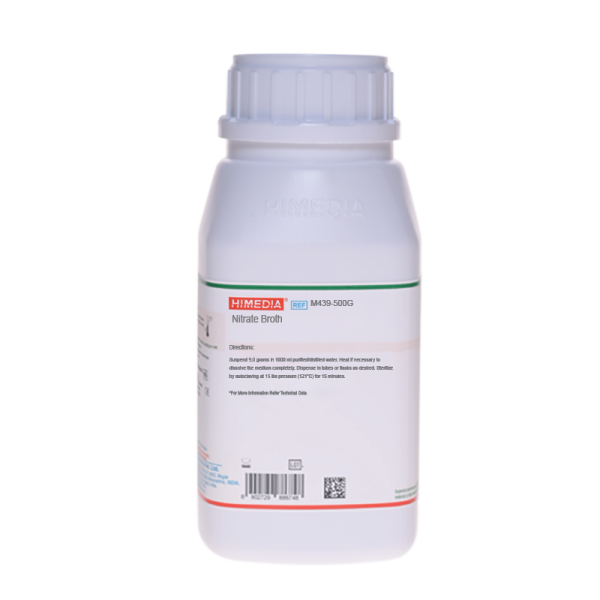
| Product Name | Nitrate Broth |
|---|---|
| SKU | M439 |
| Product Type | Regular |
| Physical Form | Powder |
| Origin | Animal |
| Packaging type | HDPE |
| References | 1.Society of American Bacteriologist, Pure Culture Study of Bacteria, 1944, 12 : Leaflet 11: 8. 2.Ewing, 1986, Edwards and Ewings Identification of Enterobacteriaceae, 4th ed., Elsevier Science Pub. Co., Inc., N.Y. 3.MacFaddin, 2000, Biochemical Tests for the Identification of Medical Bacteria, 3rd ed., Williams and Wilkins, Baltimore. 4.MacFaddin J. F., 1985, Media for Isolation-Cultivation-Identification-Maintenance of Medical Bacteria, Vol. 1, Williams and Wilkins, Baltimore |
| Customized Product Available | No |