HiMedia Laboratories GmbH, Marie-Curie-Str. 3, 64683, Einhausen, Germany.

 Your enquiry has been submitted
Something problem with the server. Try again.

Recommended for cultivation of fungi, particularly for macrospore formation.
| Ingredients | Gms / Litre |
|---|---|
| Oat Meal | 60.000 |
| Agar | 12.500 |
Final pH (at 25°C): 7.2±0.2
**Formula adjusted, standardized to suit performance parameters
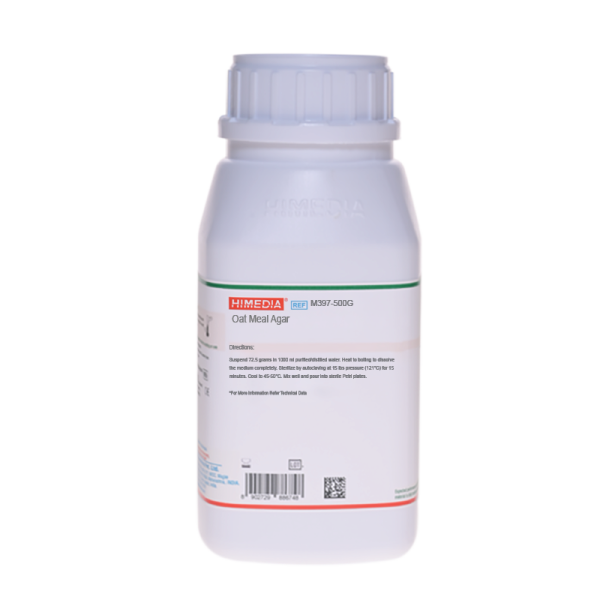
Suspend 72.5 grams in 1000 ml purified / distilled water. Heat to boiling to dissolve the medium completely. Sterilize by autoclaving at 15 lbs pressure (121°C) for 15 min. Cool to 45-50°C. Mix well and pour into sterile Petri plates.
Fungi are multicellular heterotropic members of the plant kingdom that lack roots and stems and are referred to as thallophytes. They are larger than the bacteria and more complex in their morphology. The form of sporulation and the type of spore are important criteria in the identification of various fungi.
Fungi are extremely successful organisms, as evidenced by their ubiquity in nature. Of the estimated 250,000 species, fewer than 150 are known as primary pathogens of humans (4). Identification and classification of fungi is primarily based on the morphologic differences in their reproductive structures. Fungi reproduce sexually or asexually or by both means. Sexual reproduction is associated with the formation of specialized structures that facilitate fertilization and nuclear fission, resulting in the production of specialized spores. Large, multicelled spores are called macroconidia, macroaleuriospores or macrospores and are produced by aerial sporulation (3). Imperfect fungi are those in which no sexual phase has been demonstrated. The spores are produced directly or from the mycelium. Most of the fungi of medical importance belong to the imperfect group. Oat meal is a source of nitrogen, carbon, protein and nutrients necessary for the growth of fungi.
Pharmaceutical sample; Food samples
For food samples, follow appropriate techniques for sample collection and processing as per guidelines (5). For pharmaceutical samples, follow appropriate techniques for sample collection, processing as per guidelines and local standards (1,2). After use, contaminated materials must be sterilized by autoclaving before discarding.
Read the label before opening the container. Wear protective gloves/protective clothing/eye protection/ face protection. Follow good microbiological lab practices while handling specimens and culture. Standard precautions as per established guidelines should be followed while handling specimens. Safety guidelines may be referred in individual safety data sheets.
Performance of the medium is expected when used as per the direction on the label within the expiry period when stored at recommended temperature.
Appearance: Cream to yellow homogeneous powder or soft lumps which can be easily broken down to powder
Gelling: Firm, comparable with 1.25% Agar gel.
Colour and Clarity of prepared medium: Brownish yellow coloured opaque gel with some suspended particles forms in Petri plates
Reaction: Reaction of 7.25% w/v aqueous solution at 25°C. pH : 7.2±0.2
pH: 7.00-7.40
Cultural characteristics observed after an incubation at 25-30°C for 18-48 hours.
| Organism | Inoculum (CFU) | Growth | Recovery |
|---|---|---|---|
| Aspergillus brasiliensis ATCC 16404 (00053*) | 50-100 | luxuriant | - |
| Candida albicans ATCC 10231 (00054*) | 50-100 | luxuriant | >=50% |
| Saccharomyces cerevisiae ATCC 9763 (00058*) | 50-100 | luxuriant | >=50% |
Key : *Corresponding WDCM numbers.
Store between 10-30°C in a tightly closed container and the prepared medium at 20-30°C. Use before expiry date on the label. On opening, product should be properly stored dry, after tightly capping the bottle in order to prevent lump formation due to the hygroscopic nature of the product. Improper storage of the product may lead to lump formation. Store in dry ventilated area protected from extremes of temperature and sources of ignition. Seal the container tightly after use. Product performance is best if used within stated expiry period.
User must ensure safe disposal by autoclaving and/or incineration of used or unusable preparations of this product. Follow established laboratory procedures in disposing of infectious materials and material that comes into contact with sample must be decontaminated and disposed of in accordance with current laboratory techniques (1,2).
| Product Name | Oat Meal Agar |
|---|---|
| SKU | M397 |
| Product Type | Regular |
| Physical Form | Powder |
| Origin | Animal |
| Packaging type | HDPE |
| References | 1. Hugh R. and Leifson E., 1953, J. Bacteriol. 66:24. 2.MacFaddin J. F., 2000, Biochemical Tests for Identification of Medical Bacteria, 3rd Ed., Lippincott , Williams & Wilkins, Baltimore, Md . 3.MacFaddin J. F., 1985, Media for the Isolation-Cultivation-Identification-Maintenance of Medical Bacteria, Vol. I, Williams and Wilkins, Baltimore 4.Cowan, 1974, Cowans and Steeles Manual for the Identification of Medical Bacteria, 2nd Ed., Cambridge University Press, Cambridge, Mass. |
| Customized Product Available | No |